Comparing YASHICA GT and GTN 35mm Rangefinder Cameras

April 11, 2018
#248

Gentle reader,

By now you know about many of the collections that have been acquired by Nancy and I. You also may have detected a "slight" tendency of mine towards OCD. As some wise person once said, "Admitting you have a problem is the first step towards healing." In my case, maintaining neatness and doing things to the best of my abilities is an asset, not a liability.
YASHICA was one of the more prolific makers of rangefinder (and later SLR) cameras. In fact, a YASHICA J was the very camera I found at a church bazaar that started me collecting cameras more than twenty years ago. YASHICA formed a partnership with Germany's CONTAX camera company helping them to produce SLR cameras under both names. They both used the same mount so lenses from either would work on both. I have not had any of those cameras.

YASHICA came out with the Electro series starting in 1966. The name referring to their being electrically metered and having electrical shutters, rather than mechanical ones. They made them in various sizes with both chromed metal and all-black finishes. Their "G" series are large bodied with big and fast f1.7 lenses. The last of the line are GSN in chrome and GTN in all-black which appeared around 1974.
The previous models labeled GS and GT came out fifty years ago in 1968.
There is an excellent website that I read prior to initiating this article. I quickly saw that he has an excellent grasp on all things YASHICA. So I will limit this article to the visible differences and improvements from GS/GT to GSN/GTN. Since the all-black models are better looking to me, I have chosen these to show you.

The GT, I bought via eBay, it is in excellent condition. It was the second one that I have had. I sold off the vast majority of my camera collection a few years ago after my camera mentor, retired US Army Colonel Bill Arps passed. That is not why, one factor was that eBay was killing off camera shows which are great fun for one used to seeing only photos of desired cameras on line. The other was I realized this, "OK, you have shown you can amass and display a large camera collection. Now what?" 
Below are photos of the collection at it's peak. Not shown are the large format cameras.
This is the first reduced state. I built this cabinet originally to house Nancy's Beanie Babies collection. My first GT can be seen third row down on the right.
The final size, actually, there are several additions since my joining three camera collector/user groups on FaceBook has reignited my interest in shooting film. Thus, this small area is more crowded than I like.
Back to the subject at hand. These Yashica cameras are robust and well made. They were unique in using a large (for a camera) 5.6 volt Mercury battery. Here is a photo of the GT with the aforementioned battery as I showed it on eBay. (It sold within hours!)
The battery is about the same height as a AA but thicker. What looks like the positive terminal (and is on most dry cell batteries, center post on top) is in fact negative on these with positive being flat and slightly indented. 
I focused on the lenses for these shots. So, starting with the lenses, see any difference? Yes, COLOR was added to the front ring on the GTN. Actually, YASHICA did that many years earlier to assure buyers that their lenses were "color corrected". Why they did so for these final models, I do not know. Also, 45mm is actually closer to what our eyes see as far as width of what we see. Yet 50mm was universally used for "normal" lenses by most makers.
Those leather loops were designed to keep the strap's metal bits from rubbing on the body and fouling the finish. They came with the GTN which I found last Saturday at a thrift store for $14.99. Best camera find for me in years! It was in the case with the strap attached (incorrectly) and that Mercury battery inside the camera.
GT above, GTN below. Obvious difference is the LED is no longer there on the GTN. There is a light in a window to the right of the winding lever on the top. I'm not sure what it's for, but both have it. In the case of the GTN, it doubles as the battery check light.
Next, lets look at the bottom plates.      
Three things stand out. Battery cover is chrome on the GT and black on the GTN. Second is the baseplate on the GT (left) has a cutout where the film loads. Also, note the little silver piece on the very right side of the GT? That is pulled down to release the back cover to access the film chamber. BONUS: GT has "COPAL ELECTRIC" on the lens and GTN only has "COPAL" in a different place. Both have the same shutter to my knowledge.
The top plates have several differences: The font is different on the GTN. Next, the rewind knob has a silver handle as does the edges of the now-HOT shoe and the shutter button is also chrome on the GTN. Lastly, the meter can now handle up to ASA 1000 speed film while the GT only can handle up to ASA 500.
Finally is the left side of the camera. Despite the GTN now having a hot shoe, they retained the PC connection on the side. The little chrome lever is seen (above) on the GT. One hooks a fingernail on that and pulls down to release the back cover. On the GTN, one pulls the rewind knob upward to release the back. The other difference is the shape of the piece of metal that comprises the left edge of the camera. The GTN (below) us much plainer.
Here is the link that I mentioned at the top of the article in case you wish to learn more about YASHICA Electro 35 G series cameras:  

Thanks once again for taking the time to read my humble blog.

Scott

April 11, 2018 


How does one determine if their stereo sounds good? Test Records!

April 10, 2018
#247
Gentle reader,


Way back in June of 2010, I wrote about downloading the test CDs created by the French speaker manufacturer, FOCAL. That was the ONLY time I ever downloaded music. No MP3s for this guy. Here is the link to that article:
Long before there was digital anything, yes, there were computers, but they were huge things that took up whole rooms and used vacuum tubes. And I'm not even sure IF they were digital. Anyway, before CDs, there were of course, records. 

If one wanted to dazzle their buddies when they came over to hear tunes, one put on a test record, one created by someone who gathered the best sounding music and put them all on one LP and sold them as such. Later on, manufacturers, most often speaker makers, got into the act by putting out LPs for salesmen to play to best demonstrate how wonderful THEIR speakers sounded compared to all the rest, less superior, speakers. Over the years, I have come across several and collected them.

Another type of test record is for properly setting up one's turntable cartridge and making sure it works properly. Several of the LPs you will see below are for that purpose.

ALTEC-LANSING is a company known worldwide and is famous for it’s professional loudspeakers that are to this day, used in sports arenas and theaters around the globe. They branched into home speakers as well, many years ago. The smallest of their commercial speakers were named “Voice-of-the-Theater” and they are shown in the colorful drawing on the back cover. I helped my buddy build a pair of them. The woofer is in a large horn-loaded enclosure and the rear bass waves come out of the port at the bottom-front of the speaker box. Mounted on top is their famous horn-loaded tweeter.


ALTEC speakers, like Klipsch and other brands that came out in the 1950's and early 1960's were extremely efficient. Just a few watts could drive them very loudly with little distortion. There are several models shown inside the gatefold cover. The back cover shows the LP covers and information for each artist’s music that comprises the record’s music.

AUDIOTEX Audiotester LP is next. I believe this is my oldest one. It has monophonic on one side and stereophonic on the other. No date is found, but it must be late 1950's. The various tests on each side are listed on the back and what they test for.

That $4.98 cost for this tester would run you around $43.98 today. So, one would have to commit a big amount of money to buy this one.
 "NOT FOR SALE" (above)
BOSE, a speaker company famous for their home and auto speakers, (my 2002 Subaru WRX had BOSE speakers in it) is best known for their unconventional 901 model speakers as shown on the front cover of the LP above. They invented “Direct-Reflected” sound which premiered in their model 901s. As you can see, they have a small grille on the front and the backs are angled. There are nine 4" full-range drivers (speakers) in each cabinet. One on the front (behind that grille) and four in a square pattern on each rear panel. To achieve the best sound, one needs their equalizer which boosts the treble and bass to compensate for the small (for bass) and large (for treble) speakers. Properly set-up, though, they produce an amazing sound. They made many iterations of the 901s over several decades. Out of production for some years now, they are sought after by music lovers and have been "dream" speakers for many. The model 301, of which my wife bought me a pair, replaced the 901 as their top-of-the-line. The same method is achieved with a front-facing 8" woofer, and a tweeter that is angled towards the center of the room. On the back at the opposite corner is a second tweeter and the bass ports for the woofer. These point to the corners of the room. “Direct-Reflected” music is achieved as a result, since the rear firing tweeter and bass port's sound bounces off the wall behind and to the sides of each speaker. I set mine up as instructed and they sound AMAZING! Some poo-poo BOSE speakers as cheap or gimmicky, but they have probably never heard them set-up properly.

MERCURY RECORDS produced this test LP and dealers used it to demonstrate the 901 speakers. Like Promotional records and CDs that are not supposed to be sold, this was also not to have been sold. Apparently there was also a popular music one too. There is a long article on the back cover explaining the virtues of BOSE 901speakers.

DECCA RECORDS is a British record label. They are sold in the USA with either LONDON RECORDS or RICHMOND RECORDS as their label. The latter selling for less money than the former. This one is from 1967. Many different test grooves on each side with only one piece of music at the end of side two.

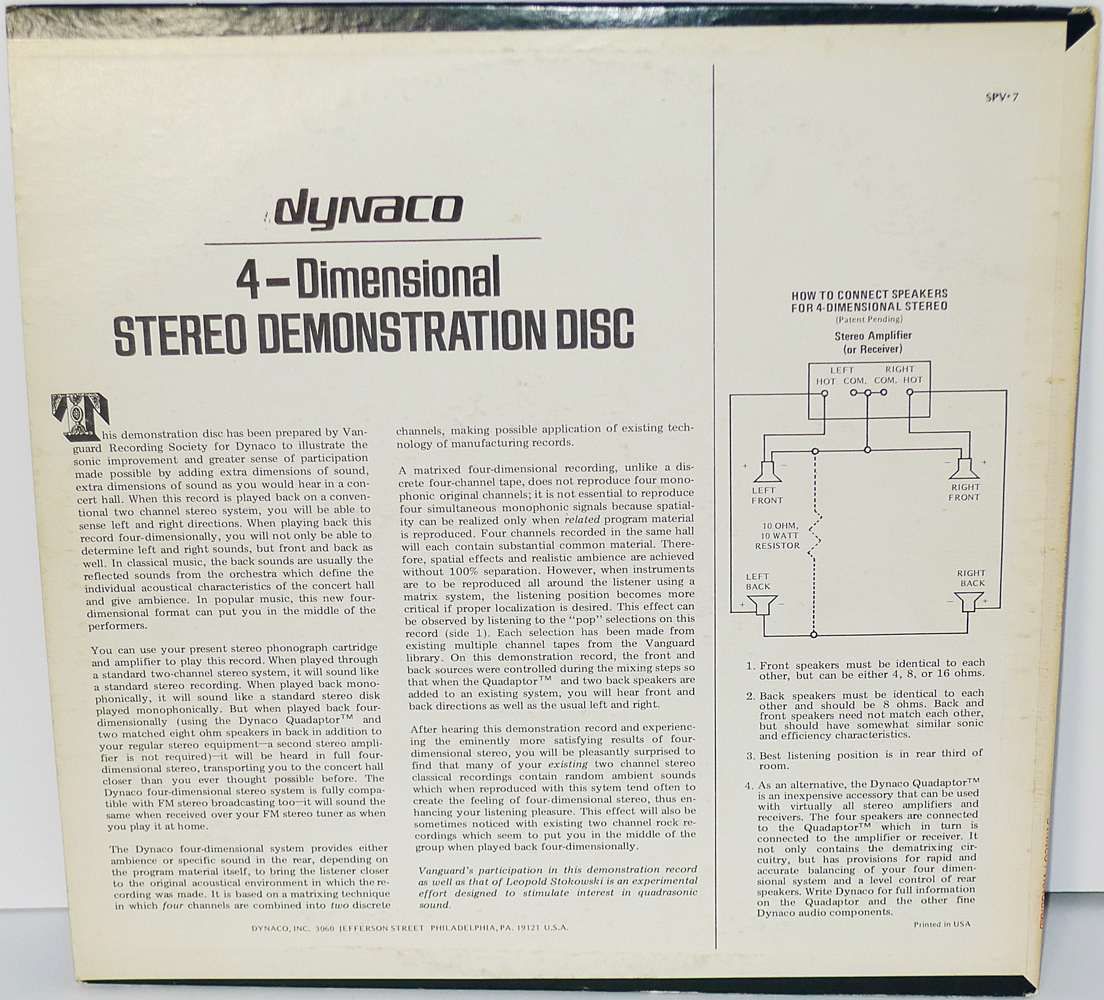
The record below is what started all this business with test records. I'd seen other Dynaco lovers proudly showing off this or another earlier Dynaco test record.

My impressions of this LP listened to with the QD-2 and my Dynaco A25XLs speakers now providing for the rear channels can be read in the previous article:


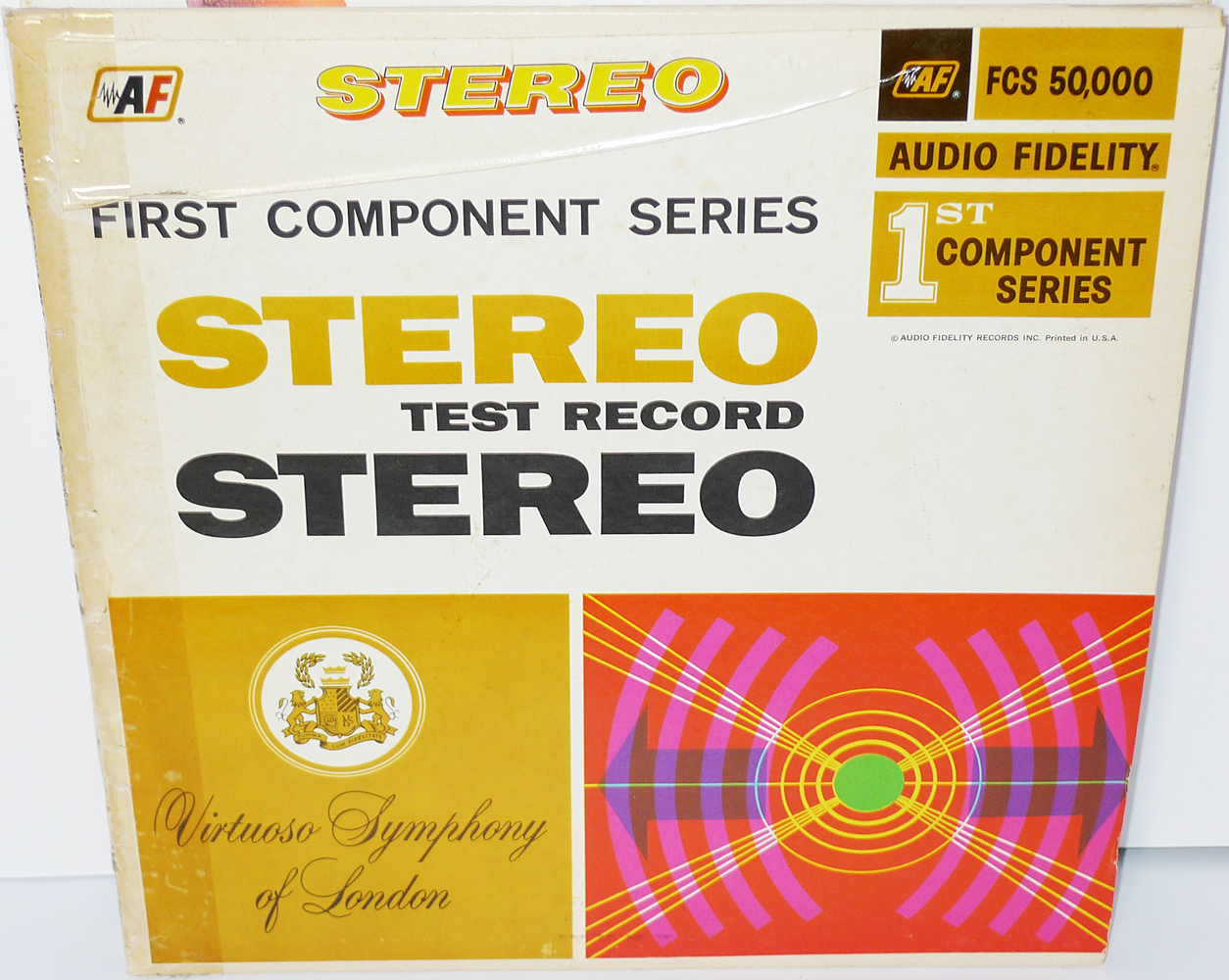
AUDIO FIDELITY RECORDS put out this FIRST COMPONENT SERIES STEREO TEST RECORD in 1959. They claim to have created the first stereo test record ever made in 1957. They claim frequencies from 16 Hertz (sub-sonic) to 25,000 Hertz (ultra-sonic) are recorded on this LP. The cover explains what can be found in each test. Without an oscilloscope to see the waves, one must take their word for it.
 Dig that crazy 'cat' on the cover?

The FISHER RADIO COMPANY was once known for high quality electronics. “FISHER STUDIO STANDARD” could be found on the front of many of their components. Avery Fisher was the founder of the company and he produced this record in 1972. Popular music is on side one and classical on side two. It really does sound wonderful. Both sides are also encoded with the SQ matrix, so I will be trying this one to see how the Panor-era Dynaco QD-2 sounds with it. 
JBL stands for the name of the inventor of their loudspeakers: James B. Lansing. This 1973 demonstration LP was produced by his company in 1973 to showcase the sounds of their speakers to potential buyers. The music on the two LP records was written, played and recorded specifically for this double LP set. There are eight pages of liner notes that show the musicians, instruments, studio equipment, cutting lathe and other things associated with making the records. SESSIONS is the title of the album.
KLH, a vaunted name in loudspeakers back in the last Century. My dad had KLH model 17s. To me speakers had to be that size and have off-white grille cloth. This record produced by KLH, but mastered by Everest Records is my most recent find (July, 2018). Cover, sleeve and LP are in amazing shape. No date that I could find, but I suspect 1960's.

RADIO SHACK, a name and a company that stood for more than half a century in the US, sadly is now no more. In it’s heyday, there was one or more in most towns and cities of America. This STEREO TEST RECORD is actually the one STEREO REVIEW magazine created and produced. The back cover shows what the various passages do to test your equipment. It is from 1963. 

SHURE, is a name made famous by their microphones and record cartridges. I’ve had some of each over the years. AN AUDIO OBSTACLE COURSE is a  "trackability" test record came out in 1967. The liner notes are featured in the second and third photos after the cover photo.  I have used this LP repeatedly setting up new cartridges over many years.


Lastly, (above) in a “FOR PROMOTION ONLY” cover is THE record put out by STEREO REVIEW magazine. I do not recall what happened to it’s original cover. Copyright 1973 Ziff-Davis Publishing Company, which makes it ten years later than the Radio Shack version. It IS the same LP, however. I compared them.

I admit I have not listened to all of these. But perhaps will in the future. 

Thanks for looking!

Scott

April 10, 2018

Quadraphonic Adventures: 1990's Dynaco QD-2 Passive Surround Sound Device Tested.

April 2, 2018
#246

Gentle reader,

Firstly, thank you for taking the time to read my humble blog. It truly warms my heart that you do and thanks SO much for your comments and positive feedback. I had no inkling than anyone would read it, let alone that so MANY do! Thanks again.
My new-to-me QD-2. Could not remove the stains from the faceplate, despite trying numerous products. Not obvious when in place in the system.

 Proper and good quality banana plug terminals.
As you may know, I started getting into good stereo (and quadraphonic) equipment back around 1975-76. A friend had an amazing Pioneer 60 watts-per-channel stereo and I loved how it sounded so I wanted big clean sound too.

At first, I began reading Stereo Review, High Fidelity and Audio magazines. The reviews while well written, seemed to be all glowing endorsements. Then I saw an ad for a book by Mark Tobak titled: THE AUDIO ALTERNATIVE. I ordered it and once it arrived, dived in, reading about the various pieces of equipment he had tested and reviewed. Based upon his recommendations, I chose for my first system: Dynaco PAT-5 preamplifier kit, 2: SWTPC (SouthWest Technical Products Company) Tiger .01 60 watt mono power amplifiers, a pair of (floor model) Dynaco A-25 speakers and a B.I.C. 940 turntable with the optional walnut base and smoked dust cover. I do not recall what cartridge it came with. I bought each piece as I could afford it, starting with the PAT-5 kit. I’d never soldered before, but Dynaco’s instructions were excellent. Good thing I had that experience since the SWTPC kits were harder to do.
Above is a recent PAT-5 that had I bought and a stereo (lower powered) version of the Tiger mono amps. I wrote about these in an earlier article.
 
First, a little history on quadraphonic surround sound so that you will better understand what I’m talking about:

Quadraphonic music reproduction was introduced around 1968, or so. It was a new idea to increase the realism of home music listening by adding a pair of speakers behind the listeners. Many methods were developed, but there was only one DISCRETE form or quad music which most people could afford, and that was 8-track tape cartridges. 8-track tapes had four stereo tracks of music on a 1/4" wide tape that ran at 3 3/4 inches-per-second on a continuous loop of tape. Think of a super-highway eight lanes wide. The tape player’s head (which the tape moved across while playing) moved up or down every time a piece of silver tape (that joined the two ends) passed by the head. So, the tape head’s movement switched to the songs on the next two tracks. After all four “sides” had been played, it started at the first song again. With quadraphonic tapes there were TWO four-channel tracks side-by-side on the tape and the head played all four continuously, first side one, then the head moved up or down to the four channel tracks that comprised the second side of the music recorded on it. The tape itself had to be twice as long with a quad version of the same recording than the stereo version used. Thus, true and unique music could be placed on each of the four tracks to make up the “surround” music. Before I began building my first stereo, I bought a cheap quad system made by Electrophonic. It was an AM/FM Stereo receiver with built-in quadraphonic 8-track player and inputs for a turntable. It came with four cheap speakers. I bought only one quad tape: Blood, Sweat & Tears was the band, I don’t remember which record it was. It was a neat effect, one did seem to be right on stage with the band. If the unit had any quad decoding circuits, I do not recall.

Now, LP records, have a “V” shaped groove, each side of the groove holds one channel of music, which produces stereo sound. Electronics companies and record labels collaborated  on coming up with a way to get four channels of music from only two sides of the groove in the records. What systems they created were encoded systems. Each worked differently. They were called: QS, SQ and CD-4. QS was developed by Sansui and it was later the basis for Dolby Labs creation of Surround Sound for home theater movie systems, which at that time was either VHS video tape or Sony’s Betamax tape. Years later I found a huge and heavy Sansui quad receiver at a thrift store and it decoded VHS surround sound tapes perfectly. If you wish to learn more about quadraphonic sound, here is a link: 
Quadraphonic sound - Wikipedia
Dynaco's founder, David Hafler, figured out a way to extract “ambient” music and some of the sound of the space where the music was recorded with a passive-matrix circuit. In other words, no electricity was needed for their device to work. They called their creation that did this magic: Quadapter. That device’s model number was: QD-1. It matched the faces of their preamplifiers and integrated amplifiers they were producing, such as the PAT-5 above.

Sadly, the original Dynaco company went out of business. Another company based in Taiwan, the Pan-Orient Company, Panor for short, bought the rights in the late 1980's to the Dynaco name and set out to update some classic Dynaco tube products and create new, audiophile quality tube and solid state equipment as well. Since quadraphonic had faded away and analog and digital systems were in wide use by consumers with “home theaters” they decided to update the QD-1 of yore with a new look so that consumers could enjoy surround sound in home theaters without the expensive receivers and all the associated algorithm circuits and complications normally needed. All at a bargain price. They named it: QD-1 Series II.
I had enlarged the terminal holes to accept banana plugs.
I have owned a couple of the Panor-era Dynaco QD-1 Series II passive surround sound units over the years and they worked well. They had successfully added a center channel to them. My only complaint was they came with cheap plastic spring-terminals for the many speaker cables. They provide very little surface area contact for the sound signal. The first one I had, (above) I drilled the terminals to accept banana plugs. I passed it on to a new owner. A couple of years later, I bought another one. It was Series IIL. That one I replaced all the cheap connectors with double banana plug terminals. It was ugly, but it worked. Then I sold that one on as well.

NOW, THE DYNACO QD-2 FIVE CHANNEL SURROUND SOUND SYSTEM.
There have been many test records put out by various concerns over the decades. I have collected a number of them. Last weekend we visited a thrift store and they had a copy from the 1970's of Dynaco “4-Dimensional STEREO DEMONSTRATION DISC”. It was in great shape, too. So I bought it.

Looking at it later, I realized that I once again needed a Dynaco QD device to fully appreciate what the record was designed to showcase. A look on eBay, and to my surprise, there was a QD-2 available! The QD-2 has what the QD-1 models lacked: Proper 3/4" spaced 3-way banana/binding posts. 14 of them. The price was reasonable and it arrived yesterday.

Unlike the QD-1 Series II models, the QD-2 sported a mirror-finish faceplate verses the plain black painted metal of it's predecessors. However, no matter what I used to clean it, I could not get it spotless.
 
There are three control knobs which mimic the earlier models. I believe the internal circuits and controls are unchanged, but do not know for sure.
Dynaco QD1 review
I heard a rattle when I picked up the QD-2 and since I always open new electronics to see what’s inside, I did this time as well. I found the two screws that hold the circuit board down were missing. A search of my metric fasteners drawer yielded two screws perfect for the task. I used DeToxit spray on the two controls on each side, but the huge gain control which is three attenuation controls stacked, one for the center and two for the rear/surround speakers will not allow internal cleaning.
The minor resistance seen (on my digital multimeter) prior to cleaning the controls was gone. It was essentially, the proverbial: Strait wire, with gain. Except it doesn’t actually gain. Despite what the knob states. Oh, it get's louder, but that device merely attenuates the music coming from the center and surround speakers.

I have owned a number of different types and brands of speaker cables all of which I have reviewed in these articles. One kind that I bought a 100 foot roll of is ten gauge, twisted pair. One conductor seems to be silver and the other copper. The latter wears translucent blue insulation, the former, clear. Both are enclosed in thick-clear plastic tubing. I like the way it sounds and still use it in many projects. Since I had so much, I chose it for the rear speakers and the Dynaco A25XL units as the speakers. The cabling can be seen in photos further below in the article.
  The QD-2 "in situ", terminals plugged and ready for business.
 Klipsch KD-2 right front above, left front below.

 A25XL right surround above, left surround below.

Since I was moving the speakers, I took the time to carefully sand the walnut veneer and apply boiled linseed oil to all the surfaces. They turned out very well. I also applied the oil to my Klipsch KG-4 speakers which would now be the main/front speakers. What a difference in the looks. Since my youngest grandson started pushing on the woofer of one of my speakers, I have put all the grilles back on. No difference in sound and they do look better. As far as I can tell, the black cloth is from the Danish company that built them oh so long ago.
At first, I angled the A25XLs a bit towards my listening chair, which is a very old wingback chair that also reclines. I love that chair, but it is looking threadbare in places.  
Then, I decided to place them facing the chair. The wings do get in the way in this situation, but by switching to just the surrounds, music is clearly heard. I tried the Dynaco LP first and was not disappointed! I have one from Fisher that is quad encoded and also have a lot of quad LPs of various genres. 
Above and below shows the system with the QD-2 in place between my Dynaco ST-200 power amp and PROTON 1100 preamp.

Overall, I really like the experience. The soundstage seems to have opened up and I do feel that I am sitting near-field because the music truly is surrounding me. I am excited to try many different recordings (I have over 3000!) to see how they sound, especially the quad LPs. 
 The flash really lightens the poor-old-chair's coloring.
    The front of the room with bonsai and dragons rearranged.
Online reviews of these Panor-era Dynaco QD-1 Series II and QD-2s are all very positive with some stating they will "never go back to plain stereo". That is quite a convincing statement! These units are often available on eBay, although the QD-2s are quite rare. Pure happenstance it was there when I needed one.
Thanks for taking the time to read this long tome! Next chapter will be about all the test records and CDs that I have in my collection.

Scott

April 2, 2018

Earbuds In-Ear Verses Over-Ear Headphones Which Ones Sound Better?

 October 8, 2026 #553 Gentle reader, I have been in the best-sounding-enjoyment-of-recorded-music-I-can-afford, hobby for fifty years. I do ...