Creating a searchable database of all my thousands of LP recordings.

Gentle reader,

Since I've retired, I've been doing a lot of cleaning, organizing and fixing things in and around the house. Outside, my wife and I created a dry creek bed to control rain runoff. We've been getting an unprecedented amount of rain and unusually cool weather for the month of May in Virginia, U.S.A., 2017. I wrote about that project here:
It is working very well and being tested daily. Believe me, I am enjoying this mild weather for the end of May in the South!
 
In the past, I have shown the various new shelves and racks I have found to house the (then) ever growing music collection. The very first one, shown below, I made back when I was nineteen in 1975. My then-girlfriend's dad was a very skilled woodworker and he taught me much. I bought white walnut* boards from him and with his training and assistance I built it:
Back then, it was all glued and clamped. But after many decades of moving it, always painstakingly emptying it first, the top began to loosen. I tried to stabilize it with the metal brackets you see above. Then I finally added screws from the top into the walls.

*White Walnut comes from the kind of trees that grow walnuts that we eat. Black walnut is what often people think of as "Walnut" in furniture. Black walnut are inside a very hard husk and inside that are traditional shells. Inside the shells are the "meat". I don't know if black walnuts are edible. Back to the shelf, I finished it with Tung oil and boy was I thirsty when I got done! That's a little joke.

The shelf, which sits to my left as I type this, is 60 inches long, 36 inches tall and 20 inches deep. I chose those measurements to fit the widest (19 inch rack-mount) audio equipment I might buy someday. Plus the bottom shelves would hold ALL my LP records. Obviously as a teen I did not have a lot of money to buy music. But I knew as time went by the collection would grow. I never dreamed to this extent! Vast majority are from thrift stores. Most cost less than one dollar. As far as the Classical, 95% are in excellent to mint condition.

A couple lucky or perhaps, destined thrift store finds over the years netted me the two tall shelves shown below:
The first find was this unfinished (no stain or oil/varnish applied to it) shelf that was obviously hand made by someone to hold LP records. It now sits in the closet of the Listening Room. It is 35 inches wide (wider at the top trim), 72 inches tall and 13 inches deep.

The next one, factory made, was also obviously made to hold a record collection. It is actually two shelves made to be joined to look like one massive shelf. 
It is beautifully finished and from the sides due to clever construction, looks far deeper than it actually is. Measures 45 inches wide (trim at the top is wider) 19 inches deep (actually 15 inches) and 76 inches high. Each of the ten shelves are 21 inches wide. They can hold a large number of LPs.

So, the original wide shelf that I built holds Classic Rock and other Popular music records on the top three shelves. The bottom shelves contain TV and Film music scores. A few are "Music from the Film..." which is often popular or jazz music and not the usually orchestral music that adds to the story of the films or TV episodes. As an example, the Films Forrest Gump and M.I.B. offered TWO different CDs with music from each film. One labeled: SCORE, the other MUSIC FROM. Get it?

The unfinished shelf in the closet holds: Jazz, Big Band music, international music, some Pop artists like Herb Alpert and comedy records. That and some miscellaneous records.

The largest and best finished shelf hold only Classical music. The term "Classical" is a generic term for Western music (NOT Country and Western) written often long ago and performed by solo artist, small groups (chamber music) and medium and large orchestras. It dates back to the Renaissance and "Classical" is still being written today. There is an era called Classical, just as there is one called Romantic. But to most Classical covers the many hundreds of years that this type of music was and is written.

Some time ago, it came to me to list every LP record that I owned. It was a precursor to doing the project in the computer. I hand wrote 88 pages for JUST the LPs! After finishing the list, I decided that I have ENOUGH RECORDS! And have only bought ONE since.
When was the last time you did any actual writing with a pen and real paper? With so much done via computers and "devices" hand writing is a dying art.

So, as I said, I'm starting with the Classical LPs as they are the biggest collection. I am using Word Perfect's program Quattro Pro. Microsoft has Excel as their spreadsheet program.

I've created eleven columns. Left to right they are: RECORD LABEL, COMPOSER, TITLE OF ALBUM OR MUSIC ON IT, ORCHESTRA, CONDUCTOR; PLUS SOLOIST IF THERE WAS ONE, RECORD CONDITION (MINT EXCELLENT, GOOD, FAIR), PRESSING #) YEAR MADE, COUNTRY MADE IN, FORMAT (STEREO, MONO QUADRAPHONIC) and lastly, NOTES. The last one is for things like Promotional, Audiophile pressing, etc.

Short of taking a photograph of my screen with a digital camera, I don't know how to visually show you the program and process.

One of the cool and time saving things about this program is it remembers not only things you typed before, but which conductors worked with certain orchestras and other time savers.

At the time this photo was made, I'd just pulled the first of the "D" albums. At first, I was carrying an many as I could from the listening room to this room. Then I realized for health sake, it made more sense to only bring TEN at a time. That way I was getting up and down and moving much more often. IT is a medical fact that sitting for a long period of time is bad for us. Suggested is for every 20 minutes of sitting 2 minutes of getting up and moving is the best way to go.

I am now up to Mahler which is on the forth shelf. You can see the letter dividers if your screen is big enough. That's 333 rows completed. Now it's time to get up and move, so I'm going to post this.

Thanks for looking! Page views are approaching 98,000 since I began! The most popular post is this one: A "Modern" Dynaco Amp, Onkyo cassette and Amplifiers I have known at 4,233 page views! It truly humbles me! 

Scott

SLEEPER Volvo V50 T5 meets C30 T5, Little Brother

Gentle reader,

This will be brief. In July, 2014, I bought my first Volvo, a 2005 V50 T5 with a Six-Speed manual transmission. I wrote about it here:

While I would not choose grey (or is it gray, I never can remember) as a car color finding any Volvo wagon with a manual transmission is hard enough, let alone the V50 model that I sought. Yet the color which I dubbed: Anonymous Grey works to further the sleeper-ness of this car.
 
But, the reason I write is that I finally came across a parked Volvo C30 T5, my car's little brother. This one may be newer, but they didn't change them much. It too has the Six-Speed.

So, I took the opportunity to photograph them side-by-side for comparison. They are indistinguishable from the front, so I did not shoot the front view.

NOTE: If you click on any picture, an overlapping window will open showing the photos in a much larger size.
Above, the rear view is the most different. The C30 was the spiritual successor to what many consider Volvo's most beautiful car, the 1800 ES of the early 1970's. Note the body on both gets narrower towards the rear, but the C30 more so. The back window is also narrower, and echoes the 1800 ES' large glass hatch. Thus the taillight assemblies are quite different. 
While both have the same engine: 2.5 liter turbocharged five-cylinder, the exhaust tips of the C30 are more prevalent. The V50's more subtly aimed somewhat downward below the bumper. 
C30 features a small spoiler above the back glass (called "back light" in the car business). The V50 offered an optional spoiler that mimicked the larger 300 horsepower V70R T5 model's rear spoiler, but mine lacks it. Someday I may buy one for it.
I aimed to park mine exactly lined up with the C30. By the looks of this one's front end it is one of the later models which gained a more unique front end look.
To my surprise, they are virtually the same length. Yet due to the extreme slope of the C30's roof, back seat headroom and shoulder room suffers. Both cars have defroster elements on the rear side windows. I assume coming from Sweden, they have a need for that.
I have a 1/24th scale diecast of a C30 and it seemed too large to me. But I now see the major extremities are about the same. 

I also wrote about my 1/43rd scale diecast Volvo collection which can be seen here:

That's it for today, just thought you might be interested. Thanks for looking,

Scott 

Blast from the past: ZLR film cameras; Olympus IS Series PLUS tests on Digital cameras!

Gentle reader,

It has been a while since I wrote about cameras. Like almost every other photographer around the world, I have embraced digital cameras. My awesome wife got me started by buying me a Fujifilm Finepix camera with 2X zoom and 1.3megapixels. Sound's like nothing now, but Windows 98 was the current OS at the time so it was just fine. 

I joined eBay in 1998 and prior to that camera, I had to use film, get it developed put on CD-ROM and then use those for eBay auctions. Archaic, slow and expensive.

I bought my first "real" camera, (35mm SLR) in April, 1995. It was a used Olympus OM-10 with 50mm lens and a generic flash. My first visit to a pawn shop netted me the set for $100. Prior to that, all I'd had was a J.C.Penney 110 film camera. As a child, I had a green plastic camera that used 620 roll film. It was a Sears or Savoy model. That was in the 1960's. Yep, I'm ancient.

What got me started on camera collecting was finding a Yashica 35mm rangefinder camera at a church bazaar and buying it. My father-in-law showed me how rangefinder cameras worked and how one focused it. As I learned more about cameras, I decided that I wanted to someday own a Leica rangefinder camera. As time went by, finally I did. Still have it, a 1946 IIIC with 50mm f1.5 lens. And have many other lenses for it. My fantastic wife later bought me the modern equivalent of Leica screw-mount RF cameras, a Voigtlander Bessa R. Completely modern and yet able to use the readily available LTM M39 lenses (Leica Thread Mount 39mm wide threads).

OK, back story out of the way, on to the subject of "ZLR" cameras we go. Olympus coined (and probably registered) that acronym which they stated stood for: "Zoom-Lens-Reflex camera". First time I saw one, I knew I had to have one. Here is a photo of one I did buy used:
 
Is that not a sleek design? Yes it is, and it fits very comfortably in the hands and the built-in zoom lens covered 35mm wide angle to 135mm telephoto. But the one I really coveted was their top-of-the-line IS-3DLX model. WAY outside my price range back when film was all there was. Oh, I have one now, sure, like most film cameras they are now cheap. In fact, I just bought the last accessory to complete the kit: Front mount teleconverter that stretches the tele-end to a whopping 300mm! I already have the wide angle lens that widens it to 28mm as you will see below.

Here are many photos I had made of ZLR cameras from many manufacturers that I used to have in my collection, years ago:


Black's was a camera store chain with enough money to convince a camera company to re-brand one of their ZLRs with the store's name. If memory serves, this was a Ricoh model.


Above are the rest of the views of the Olympus IS-1 camera. The rear screen showed various camera functions and setting's menus.

Above and below shows the built-in two headed flash. The top one was for long shots, the bottom one for wide angle and closer shots.


Above is the next in the Olympus line, the IS-2. I never saw much difference between the 1 and 2. But bought it anyway.


Above shows an IS-1 and IS-3DLX side-by-side. As you can see, the latter is larger in every way. This particular IS-3DLX was not working, but added to my collection to complete the set. Olympus expanded upon the IS line with many smaller cameras. Most of whom had two-digit number and even higher count names. They were all smaller than these and less capable.


SIDE BAR: In the automotive world, there is a process called "Badge Engineering". What they did, not so much anymore, was simply change the badges on a car, maybe the grille and taillights and viola! A whole new model! The closest I can think of right now is Toyota/Lexus. The Lexus' lowest price sedan is a badge-engineered Toyota Camry with a nicer interior for which buyers pay much more money. If someone pointed that out to them, do you think most of them would pony up the extra cash for the Lexus? Another example is the Chevy Suburban/Cadillac Escalade/Hummer H2. ALL THE SAME TRUCK! Just different looks outside and in. The original Escalade was clearly a Suburban with plastic pieces added to the body, a different grille and taillights. Badge Engineering.
BACK ON TASK: Clearly above you can see the Olympus AZ-4 ZOOM is a Ricoh Mirai with a different name and painted body. Yes, there are other subtle differences, BUT: Same camera.


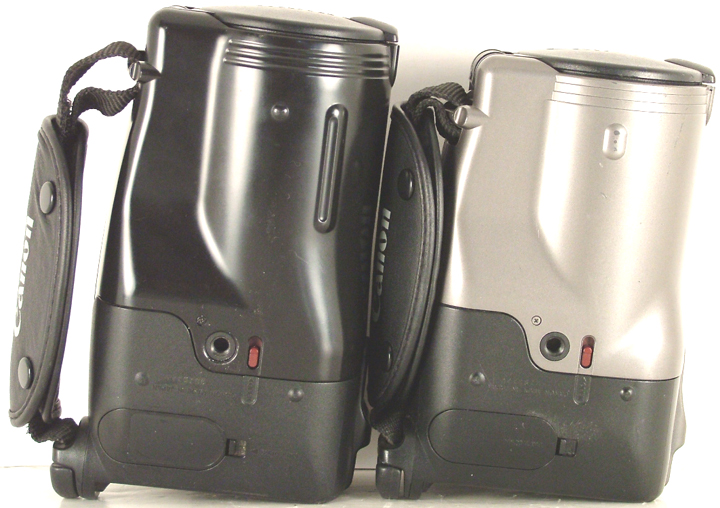
Above are technically NOT ZLR cameras. One could be led to believe they are by their design. And woe be the camera salesman to dissuade you from thinking that. In the bottom photo directly above, see the lens at the 2 O-clock position? That in fact connects directly and in a straight line to the viewfinder (where you look into the camera on the back). SLR cameras and real ZLR cameras, you are looking THROUGH THE LENS. The "L" and "R" refer to Lens and Reflex. The "S" refers to Single lens, verses TLR which means TWIN lens reflex camera where you are looking through one lens at the top of the camera while shooting through the second lens at the bottom. So, I guess these Canon Photura cameras were an update on the ancient TLR cameras. The image in the viewing lens zoomed right along with the taking (big) lens, but you were not looking through that big lens. The lens cover opened above cleverly held the flash, thus the Fresnel looking flash cover. These Photura cameras look in fact like video cameras looked like in later years.

Below, at last is my only remaining ZLR. It is a fully functioning IS-3DLX camera with the (when-new) very expensive accessory G-40 flash. They would ONLY fit certain IS series cameras and have a completely different foot and shoe than traditional cameras and add-on flashes do. Also shown is the accessory wide angle lens which increased the short end of the lens: 35mm down to 28mm. The other lens extends the 180mm stock lens to 300mm. IF it is truly 180mm and the lens is truly 1.7X, then it is actually 306mm. 


The G-40 flash is loaded with functions and as you can see in the photos below is capable of pointing the light in numerous directions. The flash built-in to the camera (not shown open) has two heads. One for close up wider angle photos and one for longer shots. The G-40, once the switch is moved to the right, also adapts to the extra wideness or length of the lens with the appropriate attached lens. Clever.

The head not only tilts it also swivels 350 degrees.
Cool fact, these Olympus IS/L and IS/W auxiliary lenses are of such high quality, that one can screw them to the front of their DSLR camera lenses to either widen (makes an 18mm on an APS-C sensor DSLR) camera equal to 14.4mm. 18mm is equivalent to a full-frame or 35mm camera's 28mm lens. Thus it makes that equal to a 22.4mm lens. The telephoto lens on a 200mm DSLR lens would increase it's reach equal to a 340mm telephoto. On a 300mm lens it reaches the equivalent of 510mm! 
The IS/L 300 lens arrived yesterday in it's factory leather bag equipped with the front lens cap. Also in the bag was the rubber device above. It is a clever cover for the viewfinder. When taking long exposure photos, light can seep in from the viewfinder and ruin the shot. So they included this device. Cheap and effective. My Nikon N90S has a little lever that when flipped closes a little cover inside the viewfinder.

This and the photos below show the camera on and fully extended to 180mm.


As you can see on the scale, it will make Macro shots to about 135mm as close to the subject as 6/10th of a meter. Olympus also made another accessory lens called IS/L B-Macro. It is about 1/2" thick and screws on the same. It also includes a large defusing filter for the flash either G-40 or on-camera. Haven't got one of those. What it did was decrease the distance one had to stand from the close-up subject and created an image 1/2 the size of the object on film at 40cm distance. Actual Macro creates a life-size image on the film or sensor.
Now a series of shots showing the wide and telephoto accessory lenses mounted on the camera with it on and at the correct zoom positions for the lenses to provide maximum width or reach.


NOW a word on how the camera industry chose to continue this type of camera design in the digital world. My Fujifilm Finepix S7000 which made all these images AND my much newer Panasonic Lumix DMC-FZ40 camera seen below with my other two Lumix models are called "BRIDGE CAMERAS". 

Bridge cameras are for the digital photographer that wants more than a pocket-able point-and-shoot camera but isn't ready for or not wanting to invest in a DSLR and many lenses. Because their sensors are smaller than DSLRs they can have much more complex lenses with incredible capabilities. The longest bridge camera zoom that I know of is Nikon's Coolpix P900 which has an incredible 83X optical zoom. Equivalent in 35mm to: 24-2000mm. That's TWO METERS! A DSLR lens like that would be so huge, heavy and expensive that even IF one could afford it, they wouldn't be able to use it.
Below all three camera's lenses are fully extended.
 Above you can see the shape is similar to the ZLR film cameras.

Originally when I wrote this blog I wasn't paying attention. I'd erroneously loaded photos of my former Panasonic Lumix FZ8 rather than my current FZ40 which is newer, larger and has more Megapixels and a longer Leica lens. The FZ40 is 14 Megapixels and has a 24X optical zoom that starts at (35mm equivalent) 24mm wide angle and the long end is (35mm equivalent) a whopping 576mm!

It just occurred to me (then) that I could use both of the Olympus accessory lenses on this camera. That would increase it's range from 19 to 979mm! That's making it's effective optical zoom to 51X! Awesome, indeed. 

Below is photos of the FZ40 with and without the Olympus lenses and images MADE with and without the Olympus lenses:
Above, 576mm, below with lens: 979mm.

The above and below photos were shot handheld (no tripod) through a window to the subject. Photographers know that to get clear, crisp telephoto shots, a tripod is essential. Above equal to 576mm, below equal to 979mm. Not bad.

 Above 24mm, below with lens 19mm.

Above with built-in flash, handheld, the 24mm equivalent photo. Yes, those ARE all three original STAR WARS movies on Laserdisc! Three photos are of my gorgeous wife, the other is my eldest daughter around 13. Yes, I a man, DO own a Ken and Barbie. No ordinary ones either X-Files Mulder and Scully. The stuff lined up below the pictures are things I have on eBay. Except the fan, it cools me when I'm "racing" on the XBox 360.
Aside from the expected extra width and height, notice the things at the bottom in shadow? That's due to the large diameter of the Olympus wide angle lens which blocks the flash. Plus, since the flash was designed to cover a little wider than 24mm equivalent, the edges are darker than the normal wide angle photo. 

So, do these lenses work well with the FZ40? Yes, however, they are heavy and could damage the lenses' tubular construction. So, I support the front of the lens. Since the camera already covers wide angle to extreme telephoto, they are only a novelty. But a useful one. 

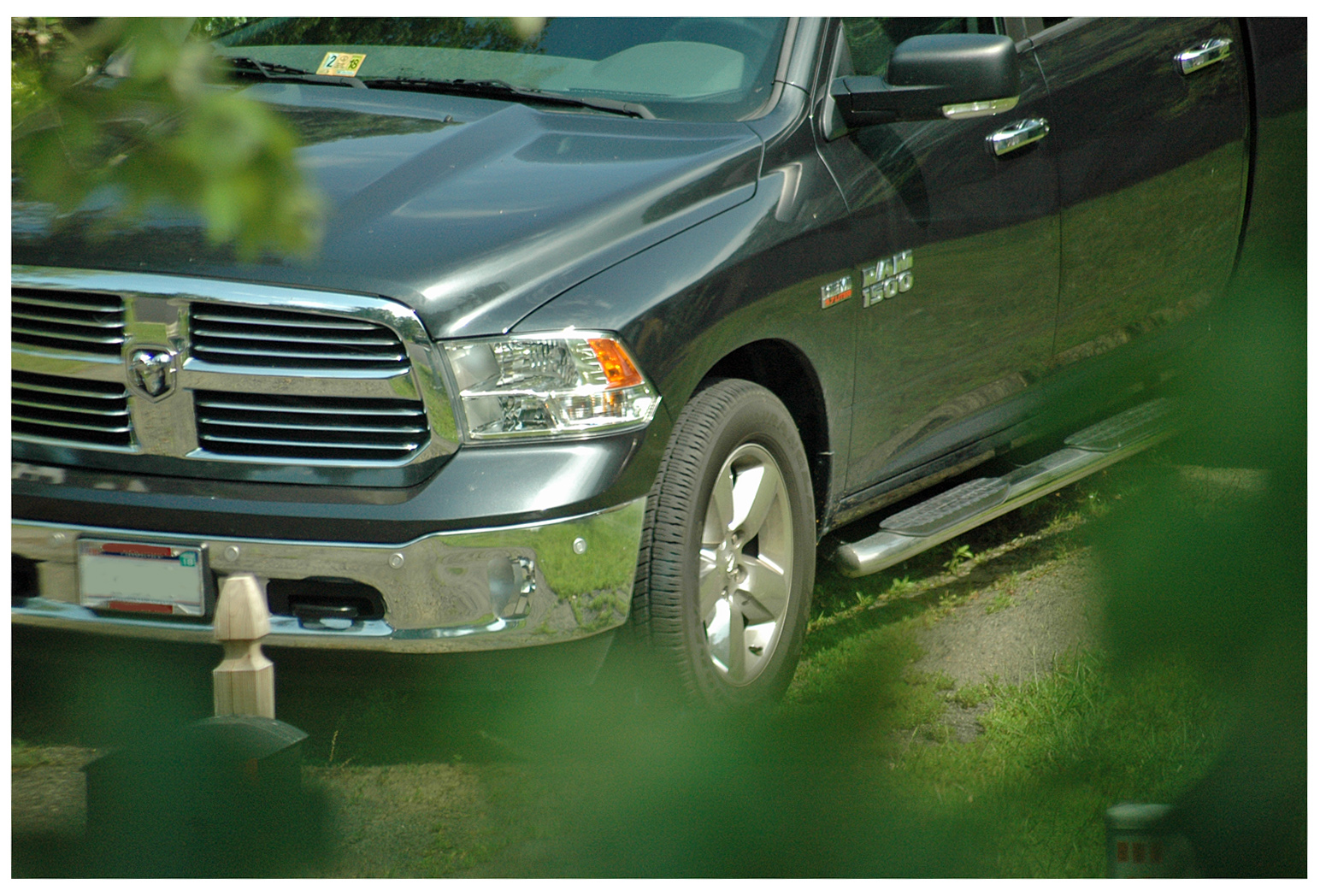
Today, May 19, 2017, I received the Step-Down rings I'd bought via eBay. I needed a 58mm to 55mm step-down ring to attach the Olympus 1.7X lens to my Sigma 70-300mm digital lens for my Nikon D70S DSLR camera. I once again shot the pickup truck across the street HANDHELD with the following results:


The Olympus IS/L 300 1.7X front-mount conversion lens change the optical length of the 300mm end of the Sigma to the equivalent to 510mm which with the 1.5X crop factor of an APS-C sized sensor equals a whopping 765mm! 
 
Hand-holding a camera with a long lens (or mirror lens of the same optical length) is extremely difficult to shoot any speed slower than the length of the lens. In this case 1/750th of a second. I guarantee you with today being cloudy, the shutter speed was much slower than that.

Some final thoughts and facts on digital camera, specifically sensors verses film. Due to the nature of digital camera sensors, they have to have the light pointing as STRAIGHT as possible at the pixels. Thus "Kit" (APS-C DSLR) lenses usually are 18mm which is equal to 27mm in 35mm. True wide angle lenses for DSLR cameras (focal lengths LESS than 18mm) are very expensive. BTW, the LOWER the "mm" number, the wider the view it captures. SO, using an Olympus IS/W lens attached to an 18mm "Kit" lens brings it down to 21.6mm in 35mm equivalent. Using this Olympus lens added on is a huge bargain by comparison. I've used it on my Nikon DSLR's kit 18-55mm lens and it widens the image WITH NO LIGHT LOSS. Using the 300 lens as I wrote about way above would greatly increase telephoto's reach also with no light loss. Awesome indeed.

LAST THING, there are tons of Auxiliary lenses available on eBay and the Internet marketed usually as "Fisheye Macro" auxiliary lenses. The difference between those inexpensive lenses and these Olympus IS/L lenses is quality. These Olympus lenses cost multiple hundreds of dollars new. They are extremely well engineered to give excellent resolution with the Olympus IS-3DLX camera. They do work well in my testing and I will be doing more testing with my Nikon DSLR on a tripod. So I may be blogging about those results in the future.

Thanks for taking the (very long) time looking at my humble blog,

Scott 

Updated: May 13, 2017.

I bought a NEW Yamaha CD Player! Build Date of April, 2026. Check it Out!

  August 19, 2026 #551 Gentle reader, Most of you are aware that I have been in the home audio hobby for fifty years now. Thanks to the thri...