September 15, 2022
#452
Gentle reader,
I am a Volvo enthusiast, nay, a Volvo LOVER! I have always liked them, having started driving my own car in September, 1973. My senior year in high school.
My career began as I planned it, as a novice, but trained, auto mechanic. I began at 16 at a Mobil gas station, just before the Arab Oil Embargo hit. The owner specialized in European cars, specifically Rovers and Land Rovers.
We moved East in 1974 after I graduated. I met some local boys who were into foreign cars: Jaguars, Mercedes Benzes, and Volvo. One of them drove an Amazon sedan.
But, I was a Chevy guy. My first four cars being made by Chevrolet. I soon joined them with a Triumph Spitfire and Audi 100LS. DECADES later, I drive a 2005 Volvo V50 T5 turbo wagon equipped with the M66 manual transmission. So, those are my credentials.
That's it, on the left. My buddies XC70 is on the right. V50s and their sedan brothers, S40s are compact cars. They were not that popular in the US. FAR more people bought S60s, V70s and XC70s than the compact cars.
A word on how Volvo USED to name their cars. C, as in C30 and C70 stood for Coupes and Convertibles. Both having only two doors. S stands for Sedan, cars with four doors. V stands for Versatile and all are wagons. XC stands for Cross Country. X stands for cross. All XCs are wagons or SUVs with all-wheel-drive and sit higher than their wagon siblings and usually have plastic cladding around the wheel openings and elsewhere on the body. See above.
I won't get into what Volvo now calls their vehicles. But to say they broke from tradition, would be true.
As far as engines, ALL current Volvo cars and SUVs ONLY come with two-liter four cylinder turbocharged (and in some case also supercharged and/or electric motor or all electric motors.
A note on the photographs of the virtual Volvos and their specifications: IF there is a secret to make photographs of 1080p HD TV images look good, I do not know what it is. Therefore, they don't look that good. I sought to get all five cars in the same poses.
The VIRTUAL Volvos I have in my virtual garage all came from the factory with turbocharged inline engines. The oldest has a four cylinder and the newest a SIX cylinder turbocharged engine. Two, the latest, are all-wheel-drive. Two are front-wheel-drive and the oldest is rear-wheel-drive.
For the sake of parity (making them as equal, class-wise, as I could) all now have all-wheel-drive. I did the EXACT same modifications to each car: Same wheels and tires (except the 850, I chose wheels which best matched what the actual race cars wear), same modifications to the driveline, stance, suspension, brakes, engine components, (I replaced all transmissions with a six-speed sequential type) and modifications to their drivetrain to make them all A Class.
All five wear authentic "livery" race car speak for paint scheme(s), based upon real Volvo race cars from the past.
Are you ready to meet them? Oldest first.
This is one of the rarest of Volvos in real life. A 1983 242 Turbo Intercooler Evolution. It has a 2.1 liter four cylinder engine, the legendary "red block". Stock it put out: 225 horsepower and 250 pound-feet of torque. It is a "body on frame" design and is the only Volvo offered in Forza 4 which is rear-wheel-drive. It wears one of the most famous BTCC* race winning liveries. In testing it, I found that the power overwhelmed the rear tires, as a result, I converted it to all-wheel-drive. It would be quite the trick to do that to a real 240 series Volvo. *British Touring Car Championship. To learn more about the real cars: Volvo 242 Turbo Evolution | Forza Wiki | Fandom Here is the real car.
This is a 1997 Volvo 850 T5-R, one of the most iconic of vintage Volvos along with it's S60 T5-R sedan brother. It sports authentic BTCC livery of the two-car team. TWR read the rules very carefully and found that Estate (wagons) cars were not forbidden from racing. TWR stands for Tom Walkinshaw Racing. So, they built two cars for the series much to the fans delight. They did quite well. Both were raced with front-wheel-drive. This one is all-wheel-drive. Stock, it put out: 237 horsepower and 221 pound-feet of torque. To learn more about the real cars: Volvo 850 T-5 R Technical Specs, Dimensions Here is the sister car. Although the virtual one has driver RYDELL on it.
Hmm, no spoilers on the real cars.


This is a 2004 S60R, which, like it's much cooler wagon brother, the V70R, came from the factory with all-wheel-drive. UN-like the 850 T5-R, one could order either with a six-speed manual transmission. STOCK, it's engine puts our 300 horsepower and 295 pound-feet of torque. To learn more about them:
While not the same livery, this is American driver Randy Pobst's S60.
Again, not the same livery, but a real C30 race car.
The virtual car is a 2009 Volvo C30. It and the C70, which is was a coupe also, but later was only a convertible with either a soft top, on the older ones, or folding hardtop on the newer ones. The C30 and later C70s, along with the S40 and V50 are "P1" Volvos. All share the same chassis, drivetrain, etc.* All came with inline FIVE cylinder engines, either "N/A" naturally asperated, or T5, turbocharged engines. All C30s could be ordered with the M66 manual transmission, but most have automatics. I have seen ONE C70 with the M66, but it is a Unicorn. STOCK, the engine put out 218 to 227 horsepower and 236 pound-feet of torque. *The P1 Volvos shared chassis with (then) Mazda 3s and European Ford Focus (Foci?). The previous generation Focus RS was basically a C30 with a Focus body. It used Volvo T5 engines and M66 transmission. Here is a photo of the engine bay of one:

Basically, identical to P1 Volvo engine bays.
This is the engine bay of my V50. The main difference is the routing of the Turbo-to-Intercooler pipe.
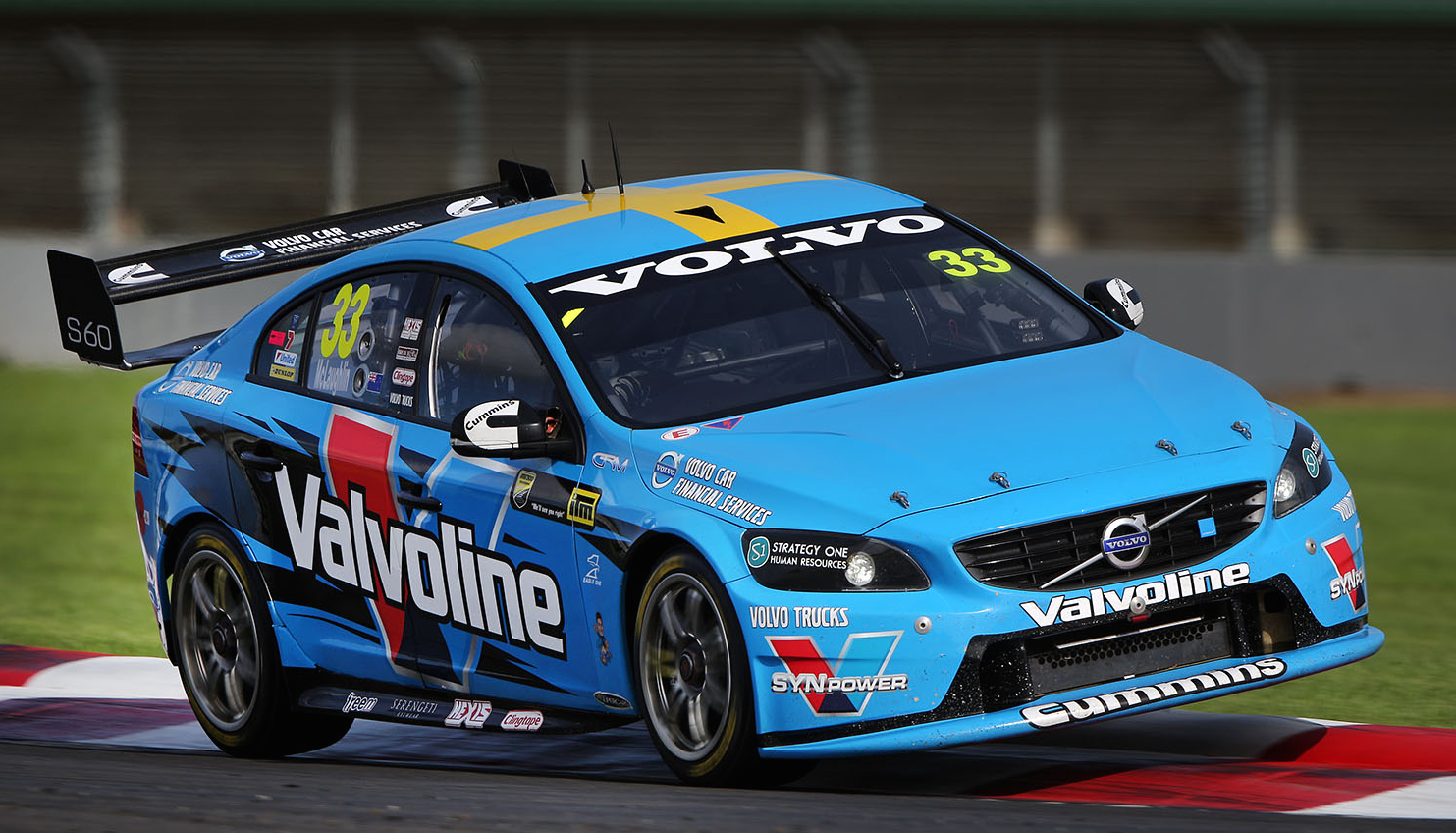
Last and latest, this is a 2011 S60 R-Design. It runs an inline SIX cylinder turbocharged engine. Here is a photograph of a real T6 engine bay:The livery is based upon one of two Volvo S60 race cars as raced in Australia and New Zealand as part of the V8 Supercars series. UN-like Touring car racing, they are all rear-wheel-drive with V8 engines from the various makers (then: Ford, Holden (GM), Mercedes Benz, Nissan, and Volvo. UN-like the Fords, Holdens and Mercedes which came from the factory as rear-wheel-drive with optional V8 engines. Nissan and Volvo cars were all front-wheel-drive. Both made V8 engines, however. Nissan used a pickup truck engine and Volvo the Yamaha-designed V8 engine from the S80 sedan and XC90 SUV. Here is said engine in a XC90:
 |
Note that it is SIDEWAYS.
This is a photo of one of the actual V8 Volvo engines, race prepared and ready for installation in the cars. The V8 engines are mounted longitudinally, as God intended.
Below is Scott McLaughlin "jumping the kerbs" in 2014. The S60 R-Design T6 engine is quite powerful, highest, STOCK of all of these cars. It puts out: 325 horsepower and 354 pound-feet of torque.
So, now that I have shown you all five Volvo race cars. Let's look at their specifications after being virtually run on a Dynamometer.
Each of these charts show the individual cars virtual performance. Algorithms and physics are put to use by the game designers to mimic each real cars performance based upon extensive testing of real examples of all the cars available to buy and race. This is the fourth and by many racer's opinions, the BEST version of Forza. 242 Zero-60: 3.190 seconds. Zero-100: 8.736 seconds. Top Speed: 163.1 MPH. 60-0: 108.8 feet 100-0: 282.2 feet Lateral G Forces @ 60 MPH: 1.05 @ 120 MPH: 1.03 G. 850 Zero-60: 3.741 seconds. Zero-100: 9.344 seconds. Top Speed: 177.5 MPH. 60-0: 111.3 feet 100-0: 288.9 feet Lateral G Forces @ 60 MPH: 1.05 @ 120 MPH: 0.99 G.
2004 S60R Zero-60: 4.112 seconds. Zero-100: 9.428 seconds. Top Speed: 177.6 MPH. 60-0: 112.0 feet 100-0: 302.8 feet Lateral G Forces @ 60 MPH: 1.00 @ 120 MPH: 0.99 G.
C30 R-Design Zero-60: 3.719 seconds. Zero-100: 9.660 seconds. Top Speed: 168.3 MPH. 60-0: 105.0 feet 100-0: 278.5 feet Lateral G Forces @ 60 MPH: 1.06 @ 120 MPH: 1.00 G.
2011 S60 Zero-60: 3.978 seconds. Zero-100: 9.863 seconds. Top Speed: 176.7 MPH. 60-0: 118.7 feet 100-0: 301.3 feet Lateral G Forces @ 60 MPH: 1.00 @ 120 MPH: 1.02 G.
And now, Performance Specifications:
1983 242: Engine output: 329 Horsepower, 342 Pound-feet of torque. Empty weight: 2,952 pounds. Front to Rear Weight Balance: 51/49.
1997 850: Engine output: 400 Horsepower, 343 Pound-feet of torque. Empty weight: 3,082 pounds. Front to Rear Weight Balance: 50/50.
2004 S60: Engine output: 329 Horsepower, 342 Pound-feet of torque. Empty weight: 2,964 pounds. Front to Rear Weight Balance: 51/49. |
2009 C30: Engine output: 361 Horsepower, 401 Pound-feet of torque. Empty weight: 2,968 pounds. Front to Rear Weight Balance: 54/46.
2011 S60: Engine output: 401 Horsepower, 433 Pound-feet of torque. Empty weight: 3517 pounds. Front to Rear Weight Balance: 59/41.
And now, calculated performance: Top Speed, Handling, Acceleration, Launch and Braking:
These bar graphs show each cars abilities based upon their torque (acceleration/launch) and horsepower (top speed) and braking. ALL have theoretically, identical brakes, wheels and tires. But, each car has different weight:
242: 2,952#, 850: 3,082# S60: 2,964# C30: 2,968# S60: 3,517#
The first four cars all weigh within a few pounds of each other. But, the newest car, a 2011, has far more weight due to: Extra airbags and stronger structural materials. Plus, it's engine is by far the heaviest.
ALL five cars lapped Infineon's NASCAR circuit almost the exact same time despite the differences in their specifications. This shows how accurate the game designers are at recreating reality.
A word on ground effects: AKA, spoilers, splitters, wings, side skirts, etcetera. They do two things, reduce the amount of air going under the cars and provide downforce which makes for quicker cornering. However, they also create some drag at top speeds. Depending upon the car, each loses six to ten miles per hour top speed. Only on courses with lots of long straight sections: Le Mans for example or oval tracks and ones that add road courses to their ovals does this matter. For most racing, the increased traction makes the spoilers worth it.
LONG gone are the arcade versions of racing. Proper simulations have you sitting in the driver's seat, looking out the windshield (although other views are available) steering with a wheel, shifting the car's gears manually. Again, as God intended. And using pedals to stop and go.
Here are links to previous articles about Volvos and simulation racing. So that you can see my racing setup.
The Robb Collections: My Hand Fabricated Simulation Racing Rig. "Vintage" Forza Motorsports 4 Racing.
The Robb Collections: Racing Volvos. Yes They Do Race Them. In Many Guises and Types of Racing. PART ONE.
The Robb Collections: Racing Volvos. Yes They Do Race Them. In Many Guises and Types of Racing. PART TWO
Thank you SO much for taking the time to read this extensive article. This blog is all about things and hobbies that Nancy and I passionate about. I also write a couple other blogs, which are quite different.
Pictures of Nancy. The Love of My Life.
People Say I'm Special. But I Don't Know Why
Scott
September 15, 2022
#452