January 22, 2018
#299
Gentle reader,
This is the first time I've written in almost a month. Mostly due to the holidays and all that entails.
Plus, I've not been buying any new equipment.I am perfectly happy with the listening room system and this one too.
I sold the vintage Fisher receiver and Advent speakers, both of which I fixed up and wrote about here. Plus the Legend LE414 speaker switch that I also modified and featured in this space. More on that further on down below.
I sold the vintage Fisher receiver and Advent speakers, both of which I fixed up and wrote about here. Plus the Legend LE414 speaker switch that I also modified and featured in this space. More on that further on down below.


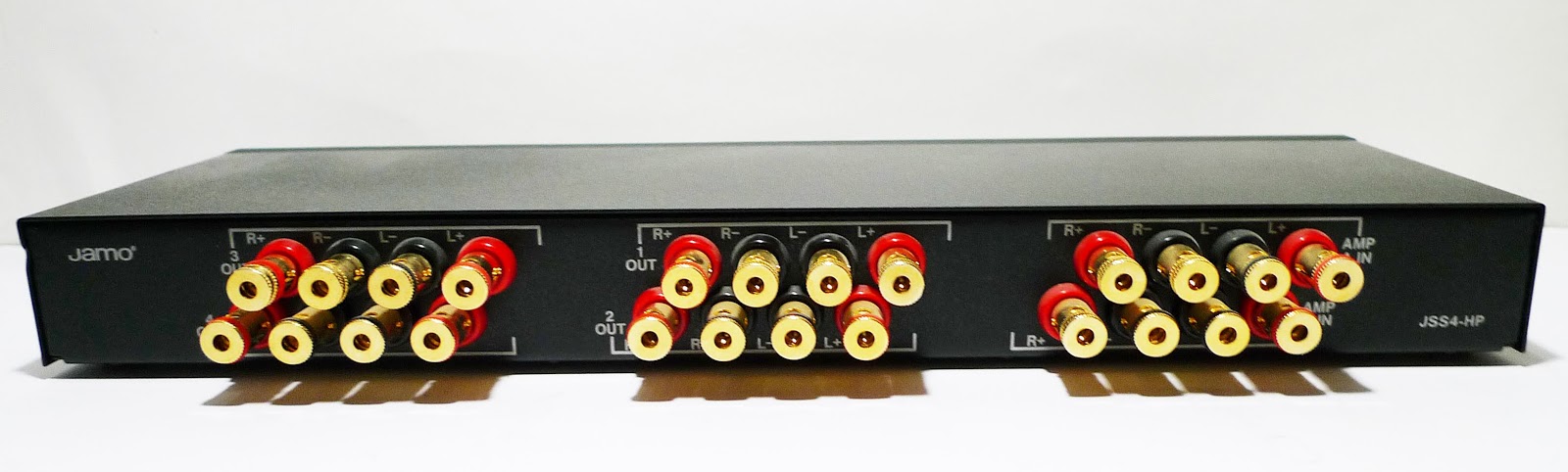

See (below) how they staggered the terminals? These are not traditional three-way binding/banana terminals. They accept banana plugs in the end holes or bare wires. If using bare wire, one presses on the spring loaded, (they have enough physical resistance to assure you they will hold tight to the wires) and inserts the bare wire ends. By staggering the terminals, there is room to pass wires between the upper terminals to the lower ones. See? Pretty cool. The drawback is that one cannot use forked spade lugs. Why are they called spades when they should be called forks? I know what a spade terminal looks like. A spade. No forks in sight.


Speaker outputs #1 and #2 are here.

And speaker outputs #3 and #4.


Model number and description shown here.

Completely passive, as you can see. I downloaded the PDF file of the owner's manual. It explains how resistors are built in to maintain at least a four Ohm load at all times if two or more pairs of speakers are engaged.
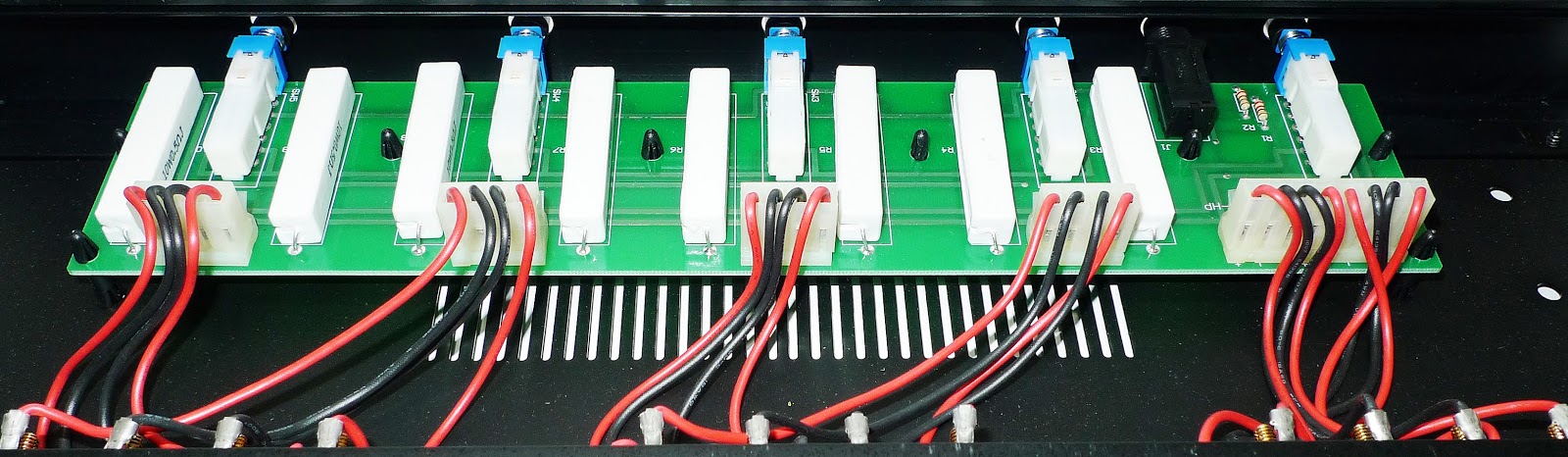
A better look at the board that holds the switches and resistors.


As are speakers #3 and #4 plugs shown here. All very neatly done. At first, I thought, "Hmm, they could have used larger gauge wires." Then I realized the circuit board uses relatively small traces, so larger wires would not make sense.
I wrote about the modifications I did to the Legend LE-414 speaker switch seen below here:
Improving Ultra-Rare Legend LE414 Speaker Control Selector Switch Assembly
 Here it sits atop the JAMO for comparison. HUGE difference in size.
 The one advantage the Legend has is three-way binding/banana terminals.
 Next, I will show you how I mounted the JAMO and keep it from possibly tipping backwards from the weight of the speaker cables I use.
 I first read about Blu-Tak reusable adhesive some years ago in Stereophile or The Absolute Sound.
Other companies jumped on that bandwagon by making their own versions in various colors. But Quake Hold, which makes ALL kinds of things to secure your stuff from earthquakes, makes the most secure of these adhesives.
I have picked up speakers on stands held by Museum Putty and the stands which weigh more than the speakers do not fall off.
To remove speakers, I have had to seriously pry them. Great stuff. And it leaves no residue!
 Using my handy Craftsman folding utility knife, I cut four small squares as such:
 I then bent them in two so that they are thicker than the feet of the switch and applied them, as seen below.
 Since the switch is not as deep as my OPPO universal player, it was fastened to the disc player's top, centered front to rear.
 Since I no longer have "surround sound" in the listening room, (oh, by the way, this is the stereo that sits next to my computer in the home "office") I am no longer using the extremely rare 1990's Dynaco QD-2.
So, I had the Monster Cable Z-Series speaker cables that I shortened to make jumpers to hook up the QD-2 available.
 These are all of the Monster Cable Z-Series speaker cables that I have on hand for future use. The ones with green banana plugs came with the 15 foot pair I needed for the listening system. I believe it is for center channel speakers. The other two are about 8 feet long and were once 10 footers.
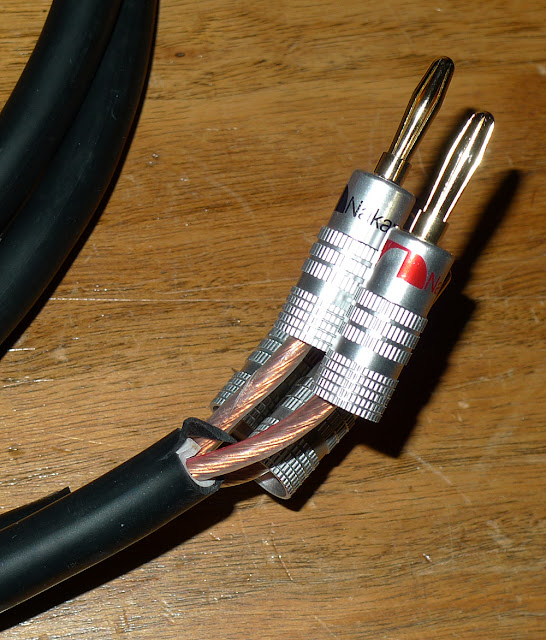
 Here are said jumpers. I always replace speaker cable's factory terminals with Nakamichi ones. They are the best.
 Because the ones above hold SO tight, I decided to try their traditionally shaped bananas seen below.

Until recently, said vintage Fisher receiver that I mentioned at the top of the article, was at the bottom of this stack. It drove the more efficient speakers and the Yamaha the less efficient ones. The cassette deck was connected to it and the OPPO to the Yamaha. CDs were still an expensive novelty when the Fisher receiver was made.
My decision to pass it on, (along with other things I have on eBay) left me with four speakers in here and only two pairs of terminals on the Yamaha.
JAMO to the rescue! I now have a superb speaker selector switch that matches the black-stack. And even though it looks narrower than the rest, that is an optical delusion. It is 17 inches wide.
 History has shown me that masking tape adhesive eventually softens, makes the tape translucent and leaves a residue that is hard to get off.
So, I began using fiberglass high-heat electrical tape for marking cables. I use a RED marker for the Right channel and BLACK for the left. I also colored the smooth portion of the Nakamichi plug's "insulators" (which by the way ARE conductive!) so that it is easier for me to tell positive from negative at a glance.
 As you can see, they are clearly legible and the tape is designed to be permanent. I used a lot of it working on 700 volt DC floor heaters in many a subway car over the decades.
 The photo above justifies my use of Sharpies on the plugs. For some reason, I put shrink tubing on one end of these jumper cables, but not the other. The positive wire does have a red stripe on it but it is hidden in this photo, even so, I always verify by performing a continuity test with a Volt-Ohm-Meter.

 These photos give a better view of the holes that accept bare wires on the JAMO should one choose that route.
 One last thought on speaker cables: All I use are twisted pair speaker cables. Even though they are resistant to 60 Hertz interference, standard speaker wires might have RFI issues. The twists resists.
You may have seen the little yellow Post-It note I stuck to the speaker switch. That is temporary. My wife has a nice label maker and will be happy to make some proper labels for me. (Which she has done, see near the bottom of the article.)
OK, you may be wondering what the markings are, right? Go ahead and admit it. OK, I'll tell you:
C-V Cerwin-Vega LS-12
301 BOSE 301 Series V
LX4 Optimus Pro LX4
M7W Modified Minimus 7W
Now that you have gotten a good laugh out of the way, each pair of speakers have meanings to me.
I'd never seen nor heard any Cerwin-Vega! speakers prior to finding the LS-12s at Salvation Army. I know they have a reputation as "dorm room speakers" these sound excellent and are slightly more efficient than my Klipsch KG4s. Plus, how many other speaker makers use diecast aluminum woofer frames and make very efficient speakers? Hmm?
My wife bought the BOSE 301 Series V speakers for me years ago hoping I would stop using the large speakers in the living room. I did not. But once I set them us similar to the way 901s are supposed to be and critically listened to them, they aren't bad sounding. Not audiophile quality, but very good. And they are efficient. I mounted them near the ceiling on adjustable flat-screen TV brackets as can be seen below:
 The C-V LS-12s sit directly beneath them and the LX4s and M7Ws are atop them as seen below:

 The stormtrooper and TIE fighter pilot are now consigned to the box of donations waiting to return to the same thrift store I found them in.
 Both of the small speakers are secured with Museum Putty. The mess of cables above is now neatly tucked away. OCD has it's uses.
I wrote a series of articles on modifications I made to the Minimus 7W speakers. And since the woven Kevlar woofers I used are from the cult-following LX4 speakers, I watched for and was able to secure a pair via eBay.
By the way, the articles about the M7W speakers and mounting of the BOSE 301s are some of my most popular. So others have chosen those speakers.
 The photo above shows the labels that my wife made for me. Much better than the post-it-note.
I also bought a NOS AUVIO 3.5mm-to-stereo-RCA cable via eBay to replace the cheap one I had been using. That's the white one plugged into the HD radio atop the switch.
 As I wrote above, I used Quake-Hold reusable adhesive to secure the switch to the top of my OPPO universal player.
Not one to totally trust the weight of the two units, I decided to suspend the eight heavy speaker cables, above and below.
 "No wire hangers!" A line from a book and movie about Joan Crawford, I believe. Anyway, wire hangers can and have been used many ways by many people. This use is ideal, unlike say using it to hold up car exhaust.
 I slid the other end through an unused hole in the bracket that secures the right BOSE 301 to the HDTV bracket. This also takes the strain off of that speaker's banana plug terminals I installed some years ago. I have spring terminals!
That's it for today's story. I hope you enjoyed it. I do not know when I may write again. As I stated, I am not buying equipment anymore.
I'm completely pleased with the listening room system (after 44 years!) and really enjoy this kit too. Plus, having four pairs of speakers to choose from and all of the components right next to me is handy and enjoyable.
Thank you once again for taking the time to read my words and view my photos.
Scott
January 22, 2019
Updated February 6, 2019
I wrote about the modifications I did to the Legend LE-414 speaker switch seen below here:
Improving Ultra-Rare Legend LE414 Speaker Control Selector Switch Assembly


Other companies jumped on that bandwagon by making their own versions in various colors. But Quake Hold, which makes ALL kinds of things to secure your stuff from earthquakes, makes the most secure of these adhesives.
I have picked up speakers on stands held by Museum Putty and the stands which weigh more than the speakers do not fall off.
To remove speakers, I have had to seriously pry them. Great stuff. And it leaves no residue!


So, I had the Monster Cable Z-Series speaker cables that I shortened to make jumpers to hook up the QD-2 available.


They are a little easier to insert and remove.

Until recently, said vintage Fisher receiver that I mentioned at the top of the article, was at the bottom of this stack. It drove the more efficient speakers and the Yamaha the less efficient ones. The cassette deck was connected to it and the OPPO to the Yamaha. CDs were still an expensive novelty when the Fisher receiver was made.
My decision to pass it on, (along with other things I have on eBay) left me with four speakers in here and only two pairs of terminals on the Yamaha.
JAMO to the rescue! I now have a superb speaker selector switch that matches the black-stack. And even though it looks narrower than the rest, that is an optical delusion. It is 17 inches wide.

So, I began using fiberglass high-heat electrical tape for marking cables. I use a RED marker for the Right channel and BLACK for the left. I also colored the smooth portion of the Nakamichi plug's "insulators" (which by the way ARE conductive!) so that it is easier for me to tell positive from negative at a glance.


Aforementioned shrink tubing seen above.


You may have seen the little yellow Post-It note I stuck to the speaker switch. That is temporary. My wife has a nice label maker and will be happy to make some proper labels for me. (Which she has done, see near the bottom of the article.)
OK, you may be wondering what the markings are, right? Go ahead and admit it. OK, I'll tell you:
C-V Cerwin-Vega LS-12
301 BOSE 301 Series V
LX4 Optimus Pro LX4
M7W Modified Minimus 7W
Now that you have gotten a good laugh out of the way, each pair of speakers have meanings to me.
I'd never seen nor heard any Cerwin-Vega! speakers prior to finding the LS-12s at Salvation Army. I know they have a reputation as "dorm room speakers" these sound excellent and are slightly more efficient than my Klipsch KG4s. Plus, how many other speaker makers use diecast aluminum woofer frames and make very efficient speakers? Hmm?
My wife bought the BOSE 301 Series V speakers for me years ago hoping I would stop using the large speakers in the living room. I did not. But once I set them us similar to the way 901s are supposed to be and critically listened to them, they aren't bad sounding. Not audiophile quality, but very good. And they are efficient. I mounted them near the ceiling on adjustable flat-screen TV brackets as can be seen below:


Heidi and Gretchen stand guard as usual.


I wrote a series of articles on modifications I made to the Minimus 7W speakers. And since the woven Kevlar woofers I used are from the cult-following LX4 speakers, I watched for and was able to secure a pair via eBay.
By the way, the articles about the M7W speakers and mounting of the BOSE 301s are some of my most popular. So others have chosen those speakers.

I also bought a NOS AUVIO 3.5mm-to-stereo-RCA cable via eBay to replace the cheap one I had been using. That's the white one plugged into the HD radio atop the switch.

Not one to totally trust the weight of the two units, I decided to suspend the eight heavy speaker cables, above and below.


That's it for today's story. I hope you enjoyed it. I do not know when I may write again. As I stated, I am not buying equipment anymore.
I'm completely pleased with the listening room system (after 44 years!) and really enjoy this kit too. Plus, having four pairs of speakers to choose from and all of the components right next to me is handy and enjoyable.
Thank you once again for taking the time to read my words and view my photos.
Scott
January 22, 2019
Updated February 6, 2019