December 23, 2020
#410
Gentle reader,
For those who follow my blog, Thank you! For those who are new to it, Welcome!
When I started this twelve years and fifteen days ago, it was just something to do. I never thought anyone would even read it.
And boy was I was wrong. So, again, dear reader, THANK YOU!
When we moved into what will probably be our final home in 2001, we designated the front left bedroom to be our home office.
We had planned to set it up with two desks facing each other, like on the (ancient) radio and television series starring Jack Webb, called DRAGNET. That's him on the left, below.
But that never happened. The room has gone through many changes and been quite cluttered over the years.
With my buying and selling on eBay (since 1998) collecting film cameras, and many other things, then later selling the massive (4000+) camera collection compiled over DECADES by my late-friend and mentor, Colonel Bill Arps, it got quite crowded.
At the time of this film photo being made, the desk, a cheap multi-level wood-products one was on the wall opposite the wall shown here. That wall is now behind me and the room works much better. Plus, now it is a sleek, multi-level steel and glass desk. And I have a nice view out the window.
See what I mean? What a crowded mess! The window is just out of frame on the right.
To get you caught up on what came before what I am about to show you, please read this article:
The Robb Collections: Moving My Large Scale Diecast Car Collections And Rethinking The Room
OK, caught up now? Good, because once the walls were laid bare and the MANY nail, screw and tack holes were filled and the walls cleaned. It was time to figure out what to put up where.
This is what the wall behind my desk chair looked like before I stripped everything off. It is very difficult to photograph something behind glass or clear plastic, as you can see, due to lights and other reflections.
Another little back story. I was practically born with a toy car in my hand. I was always a car guy and planned from an early age to be a professional auto mechanic. Which I did, among other things, for forty-four years before retiring.
We were a library visiting family and I was always checking out books about cars and car racing. Studying the World Book of Cars or something like that, I in 1966 at ten years old, decided that the four cylinder Porsche 912 would be the better choice than the more expensive and untried six cylinder 911. They looked the same, but the 912 used the proven 356 engine and cost way less.
Our parents encouraged our interests to a point. A preacher does not make a lot of money and with five kids, it has to go far. So eating at a fast food place was a real treat which did not happen often.
That being said, when I found out in 1971 that Steve McQueen's movie about my favorite race, the 24 Hours of Le Mans, was coming out, but only showing in the next town, I asked Mom if my brother and I could go see it. "Sure, honey, if you can figure out a way to get there and back." Challenge accepted. She did not understand the importance of this film to me.
Being in a small town, and somewhat resourceful, I obtained the local bus schedules, figured out what bus would get Jim and I there and when, then presented it to Mom, she was quite taken aback. Being true to her word, she gave me the money for the bus tickets and movie fare for both of us.
Steve McQueen was MR. HOLLYWOOD in the 1960's and 1970's. He had enough street cred to pick and choose his film roles. He was also a badass who loved to drive fast sports cars and race motorcycles. He also wanted to race sports cars.
That's him in a Porsche 908 at the 12 Hours of Sebring, in Florida in 1970. He and Revlon heir Peter Revson nearly won OUTRIGHT that race against the Porsche 917s and Ferrari 512S prototype cars. AND, he drove with his left foot in a CAST. He'd broken it the previous weekend in a motorcycle race.
Le Mans is where he wanted to race. He'd attended the 1969 24 hour race in France, searching for sites to place cameras and much more. He'd missed out at the chance to do the film which eventually called GRAND PRIX which starred James Garner. So he was itching to do the most realistic racing movie ever.
The blue car in front is the same Porsche 908 he and Peter Revson won their class and came is second overall at Sebring in March, 1970. Here it is in June racing in AND filming the ENTIRE race and much of the practice sessions too. It had a 35mm movie camera under the protrusion on the hood and two poking out the back of the car. The car not only finished the race, but did quite well despite cameras being swapped out far more frequently that normal pit stop schedules.
OK, the stage is set. You've seen a small example above of the chaos the walls were in before this.
THIS is what the wall opposite me looks like now. I used an 18mm wide angle lens to get the shot and had to reposition myself to minimize the two ceiling lights reflections in the glass and plastic.
The wall behind me has just a few paintings and other non car related things on it now.
Now, I state in the title that there are original photos here, and there are. Starting with the oldest.
Those who have seen last years film, FORD v FERRARI may think they know the whole story. They probably do not.
Above is a photo I found online, one of many, which shows a blue Ferrari 250 GTO parked beside one of the SIX Cobra Daytona coupes it raced in 1964 and 1965. A shame they couldn't get a red car.
Quickly, Carrol Shelby's 427 Cobra race cars, even with an aerodynamic fastback hardtop were not as fast as the Ferrari GTOs. Peter Brock, an employee at Shelby designed what would be called the Daytona Coupe. It's seen in the film. Anyway, in the 1964 season, the Shelby coupes were winning most of the races, with only the Monza, Italy race left. Enzo Ferrari allegedly put pressure on the FIA to cancel that race! In 1965, the Shelby Daytona team won almost every race, including Le Mans (the GT40's did not finish a single race!) beating Ferrari and winning the international sports car racing championship for America!
This photo above is a cropping of a photo from 1964 or 1965 at Le Mans. Here is the uncropped photo:
It was made with what is called a "Twin-Lens-Reflex" camera, or TLR for short. Probably one like this Rolex I had in my collection:
I made the camera's image full sized, it was too small at "Extra Large" since it is a vertical photo.
The top is open, the person holding the camera looks down into the top, through an angled mirror and through the top lens. One composes and focuses with that lens and shoots through the bottom lens. It makes square photos on 120 or 70mm film.

I bought this and several other photos you are about to see from Road and Track magazine a few years ago. As you can see by the number above, I was the first person to buy this photo.
This one was an official Ford Motor Company shot used under license by Road and Track magazine from the 1967 24 Hours of Le Mans. I don't recall what print number it is, it is taped to the mat, and I did not want to disturb it.
I just found this color image in my files of Le Mans period photos. While looking identical, if you look at the man above the BP sign in both photos, he is facing a slightly different angle. Also, the woman in the red dress standing beneath the FORD (4) sign is also different. She is looking towards the camera in the color shot. My guess is the photographer had two cameras, one with black & white print film and one with color slide film.
I have a 1:18th scale diecast model of number 4, (above).
Numbers one through five are Ford GT Mark IV racers which are sometimes mistakenly referred to as "GT40", they are not. They, unlike the Mark I, II, and III Ford GT40 cars, were 100 per cent designed and built in the United States. The earlier cars were all made in England.
This is a Mark I Ford GT40 in 1969. They had changed considerably from the 1964/65 cars. This photo is from that Sebring 12 Hours race. That car, which by then was "just" a sports car, no longer a prototype because so many had been made. It won a LOT of races along with it's teammates in 1968 and 1969, including Le Mans. Twice. No OTHER single car won the race twice before or since.
My aged Epson photo scanner was acting up today and froze while scanning this photo. It is a Mirage. Not a Ford GT40. It started out as one and was converted back to one, but in this form, it was a Mirage.
This is a print from the original negative, #59 of 100, of THE Porsche 917 which won the Daytona 24 Hours race, also in Florida, but in January, to Sebring's March event. It was made before the race, but after practice. Note the sand blasted front end.
This is a still from the film Le Mans, autographed by Vic Elford who drove the #25 917LH (Lang Heck, German for Long Tail) in the 1970 race and also in the film. Our movie hero Steve McQueen is in #20 917K (Kurtz, German for Short).
This is a very famous shot from the beginning of the 1970 race at Le Mans. It is autographed by Vic Elford AND Brian Redman.
The photographer was using what is called a "Press Camera" which shoots sheet film (rather than a roll) which measures four by five inches. Below is mine. The large flash was removed for this photo.
He had prefocused the camera halfway between where he was standing with the camera on a tripod and where the line of cars were waiting. IF you have seen the film, it was the first (and last) year where the drivers were strapped in ready to race with their engines OFF, rather the having run across the track from the other side, the famous "Le Mans start". Anyway, when fifty-five race engines all roared to life at once, it startled him and he clicked the shutter early. Which is why it is out of focus. Below is a link to that scene. It's not very good video quality, but was the shortest one I found.
Le Mans- Steve McQueen - YouTube
In the race, and the previous two years, Brian Redman, an Englishman, was part of the three car team formed by JW Engineering, utilizing many of the same drivers as they had in 1968 and 1969. The same man, John Wyer, was behind Carroll Shelby's Aston Martin team in which he and Roy Salvatori won Le Mans many years earlier. It was Shelby's last race as a driver.
This is not my image. I found in on the Internet.
The one below, is a pencil drawing of him and the Porsche 917K he drove in the race and which Steve McQueen drives in the film.
This is all that would fit on my 9" by 14" scanner. Below is the whole image.
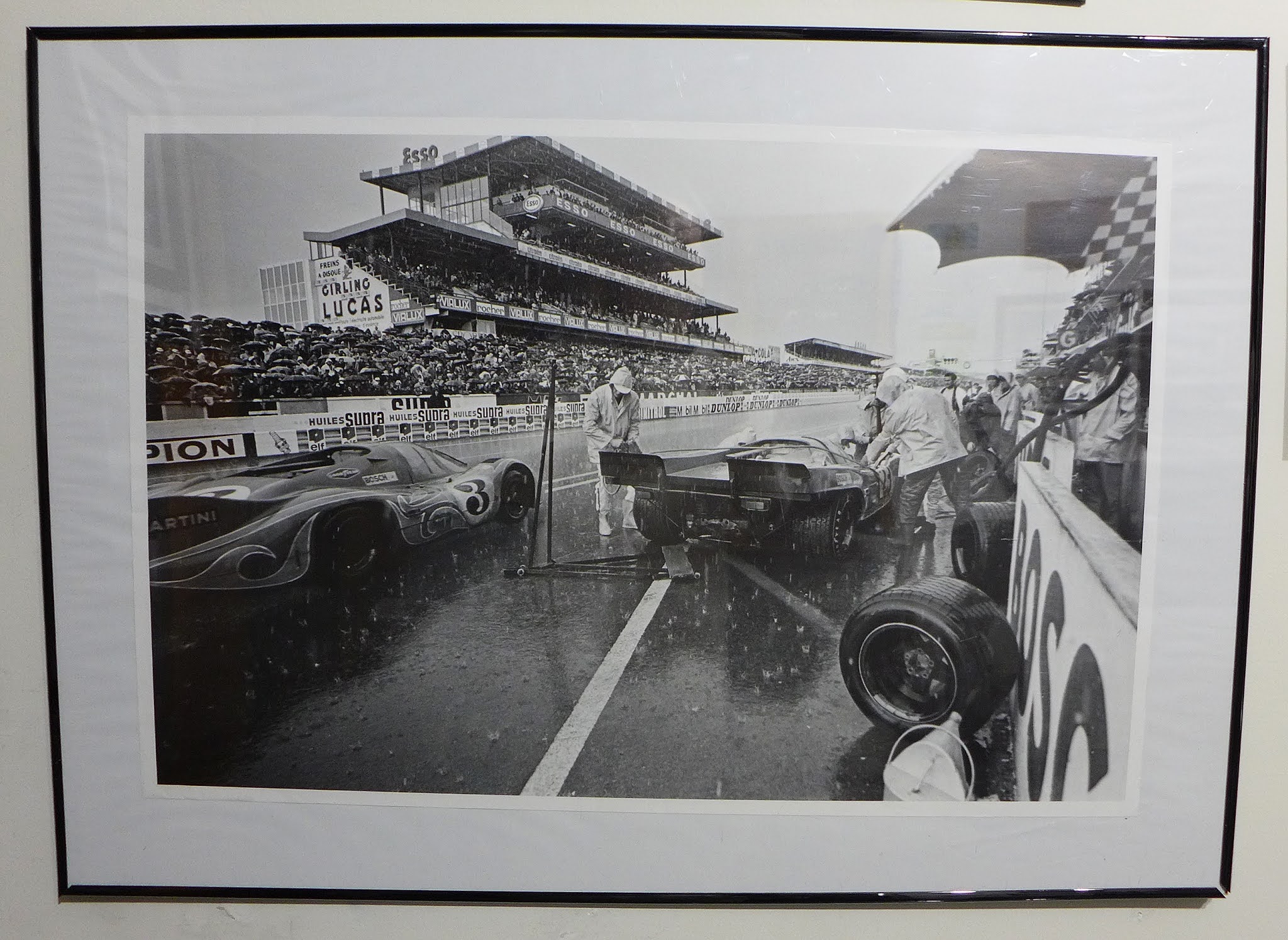
Here it is in the frame on the wall. I was still using the 18mm lens, which is why the edges of the frame appear curved.
This photo was taken in the pits during the 1970 race. It shows the eventual winning Porsche 917K being serviced and the Martini 917LH "Hippie Car" just leaving the pits.
In the actual 1970 race at Le Mans, the number 20 Gulf Racing 917K, did not finish. Redman's co-driver, racing past the pits, missed an upshift and blew the engine up! It happens.
I have THE book on the making of the film as well as the documentary film about it. This is the three cars, identical to the ones raced, in the building they were serviced in during the many months of filming.
The different arrangements of the orange paint was so that from the pits, each car could be instantly recognized.
A highly desirable trio of Porsche 917K diecast car models from the race.
The two photos above and six other filming shots below were all found on the Internet.
Yes, they cut the roof off of one of JW Engineering Ford GT40s to use as a camera car! By then, it was just an old race car.
One of the many revolutionary camera mounts created for the making of the film. If you haven't seen it, get the Blu-ray!
The many professional racers, Derek Bell and Jackie Oliver, shown here, knew of McQueen's racing ability and treated him like an equal.
Steve, looking introspective here and below in another image I bought which the artist only made fifteen of. Too large to scan.
Alain Lemire created the image from two scenes in the film. Our hero at the beginning of the film stops at a place along the course in which he and a Ferrari driver crashed the year before during the race at night. The other driver did not survive. Plus, the epic scene from Lap One as the cars storm down the hill under heavy braking for the light Mulsaine corner.
For more on this subject, here are links to a couple other articles I wrote on the subject:
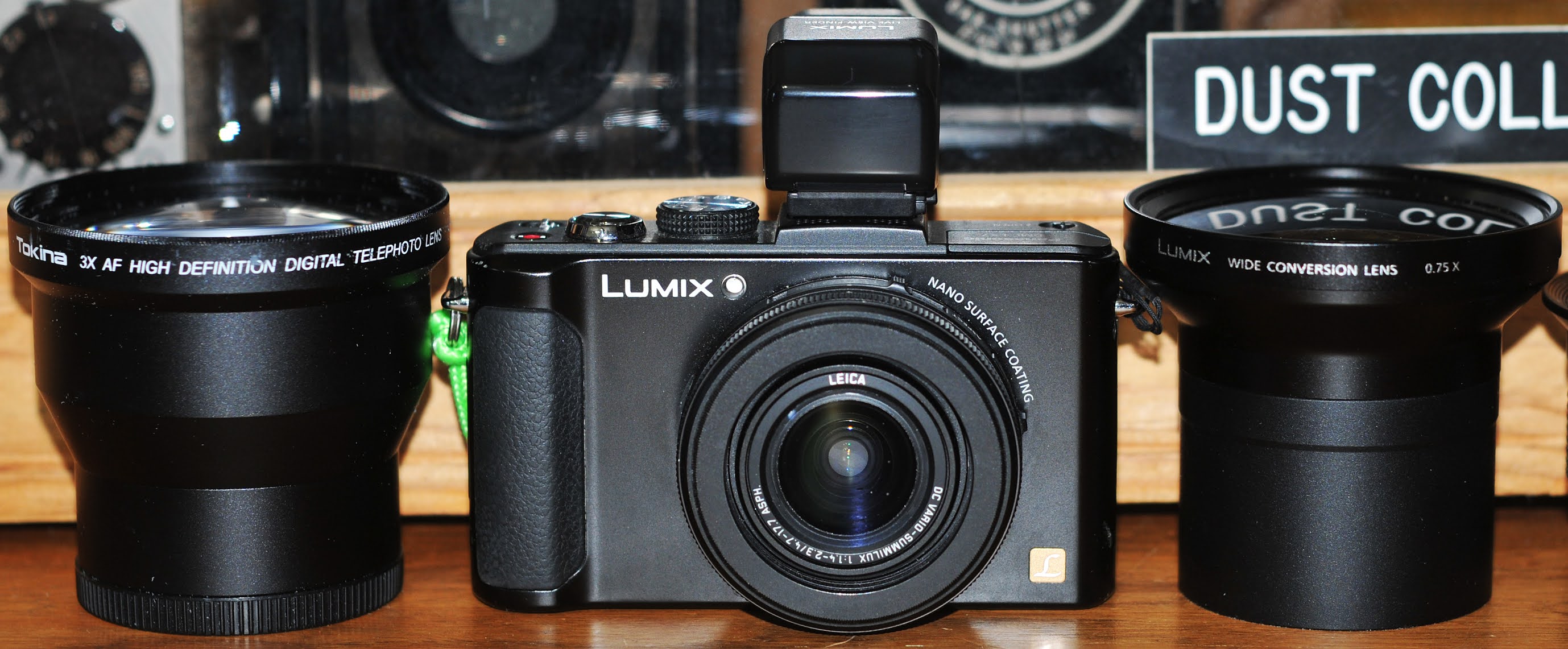
Thank you SO much for taking the time to read my humble blog. Please take a moment to click or tap FOLLOW, located within the large image of the TLR camera, above.
Also, feel free to comment below or on Facebook.
Scott
December 23, 2020
#410
Have a Merry Christmas, if you can and hopefully we will ALL have a better 2021.