Why "Normal" Should Never Return. Rethinking Priorities After The Pandemic.

April 19, 2020
#379

Gentle reader,


Four generations touching.

The peoples of this earth have gotten through worse plagues than we are experiencing right now with Covid-19.

A hundred years ago, after the end of the extremely deadly first World War, "The war to end all wars" what came to be called the Spanish Flu occurred, which according to Wikipedia:

 "Lasting from January 1918 to December 1920, it infected 500 million people – about a third of the world's population at the time. The death toll is estimated to have been anywhere from 17 million to 50 million, and possibly as high as 100 million, making it one of the deadliest pandemics in human history." Emphasis added.

It spread without the aid of Air travel. Imagine how much worse it would be today. How are MILLIONS of bodies dealt with? Yet, the world recovered. Then the Great Depression happened.

The world one hundred years ago was vastly different than now. No telephones, a large percentage of the world still had no electricity, indoor plumbing (or toilet paper) and other things we cannot imagine living without today. 

It is my considered opinion that we cannot and should not seek to return to "normal".

Thanks to mass access to the Internet and proliferation of "devices" much of humanity has lost touch with reality.

Think back to before this happened. If you paused to look around you, what did you see, everywhere? People looking down at their phones.  No matter the venue, people were engrossed with their phones.

Music performances for which people pay dearly to see, countless audience members are recording it with their phones. Much to the dismay of the performers. And the enjoyment of those who want to SEE as well as hear. But they cannot for the hundreds of phones and tablets selfish people are holding up.

How many have been hurt or killed because drivers were using their phone in someway rather than paying attention to driving. 
 
Many of you will argue that smart phones are tools and they are needed in their lives. I can see that, they are marvelous inventions. 
 
I have many tools. They are all in tool boxes, on shelves or arranged on pegboard. When I am not using them, I know where they are. But the only tool I carry around is a Swiss Army knife.

Let me ask you this, how did you get along before cell phones were invented? We got on just fine. As did everyone else. 
 
We used maps we kept in the car to find our way. We opened the phone book to find someplace to eat, shop or make an appointment. We went to the library (when is the last time you even thought of the library?) to look something up. Computers were something scientists and the government used. If someone had said, "Have you been on the Internet?" to us we would have asked them what that was.

During dinner we all talked about our day. We played board games together. On the weekend we worked or played in the yard. We took walks, rode out bikes, played ball, catch or tag. Not one of those activities involved a "screen". 

I was born in the 1950's, my wife in the 1960's we married in the 1990's. It was many years before I suggested she get a (flip) cellphone in case her car broke down. When she upgraded to a better (flip) phone a couple years later, she got me one too.
This is the type of phone I use now. It goes on the Internet, but I never use it for that. It has many apps, which I never use. I make and receive calls and texts with it. It doesn't even have a camera. Which is fine by me. But that's me. 
 
I am NOT saying we should get rid of our phones. That will never happen. Please keep reading.

Of your many Facebook friends, how many do you actually know? My wife and I joined when the kids did because we wanted to see what they were up to. They posted EVERY activity back then.

I just looked, I have 69 friends on Facebook, 48 of them are people I have actually met and AM really friends with. That is a very high percentage. What is yours?

I am retired, so this forced (and necessary) isolation has not affected me very much, I was home anyway. I do crave going out with my wife, but we do so only to grocery shop. She is (as I was) and "essential" worker so we are not suffering financially like so many millions of Americans who have lost their jobs due to stay-at-home orders. 
 
For many years, one of our favorite things to do was go thrift shopping, either at stores or yard sales or flea markets and antique stores. We were literally filling our house with other peoples junk. The vast majority of things we have sitting on shelves and other places, we will never use, or even think about.
 
My family was poor when we were young. Five kids, and working mothers were mostly unheard of. Dad was a preacher so money did not go far. We had one car. One black and white TV. The telephone company owned the phones, so we had one if we had any at all. I already mentioned things we did. All of us wore hand-me-down clothes. Poor yes, sad? Not at all. We knew no differently. We had toys and friends and we loved playing together. Our parents still managed to make Christmas day wonderful.
 
We, and hopefully you too, have been using this time to reexamine out lives. So MUCH of what we have is pure excess and not NEEDED.  

With the convenience of Amazon and all the other websites it is too easy to buy things. A question we ALL should ask before buying something is this: DO I NEED THIS?

Since I am in my sixties, and all the kids are in their thirties, eventually, someone is going to have to deal with all of our STUFF.
 
Since this column has always been about our collections, I will tell you changes I began long before this happened. 
I used to collect film cameras of all sizes and types. Above only shows a (large) fraction of the 504 total that I had bought over many years.

One day, it occurred to me, "OK, you have proven that you can create a nice camera collection. Now what?" I had no one to share it with, nor anyone in the family who would want them. So, I decided to sell them off. 
The collection was down to these, plus some large ones not seen.
Then it was down to this.
This is the present collection. Every camera, except the one on the upper shelf, second from the left, was GIVEN to me by friends or family members. There are two large ones which were also gifts. I will never sell anything that was a gift.

I have always loved books, right now, just in this room there are two large shelves with hundreds of books. And many more on shelves around the house. The number is way down from the thousands we once had. Many were donated, some were sold. More will go. If I have read them once, why read them again with so many waiting for me to read them?
I have collected over 2,000 LP records. Music, unlike books, is something that one wants to listen to again from time to time. Above is a photo of the Classical records. I have multiple different performances of favorites. One could argue, "Just pick the best and get rid of the rest." I'm thinking about it. Sigh.
These are the Jazz and Big Band records.
Housed in this cabinet I made in my teens from white walnut wood is the classic Rock and Pop on the top shelves and movie/TV scores/soundtracks on the bottom.

We also have more than 1000 CDs and even 100 cassette tapes. in our music collection. 

Yes, one could download most onto a hard drive and listen to them with their phone. Not this guy. So, kids, you may have to deal with all these records.

Collections we have had and gotten rid of: Glass paperweights, Beanie Babies, countless (hundreds) stereo components and speakers, GI Joe type military figures, old glass bottles, old toys, wristwatches, and much more I can't remember.

But there is still so much more that can go. The hundreds of diecast cars, for instance. Am I recommending turning our home into a monk's cell? No. But our home and no doubt yours is filled with stuff.

Fortunately, we do not have a garage, I would love to have one, but SO many people have filled theirs with things they have no room for elsewhere. We have never had to rent a storage space either. 

My POINT is this: Use this time to REALLY think about what your life has become. LOOK, really look, around your home, make lists of things that are really important to you. Tag things that you forgot you even had, things your kids might like and things that you will never use again. Look in every closet, under beds, on shelves, the garage, your storage space, everywhere. Especially your CLOTHES. Think of all the homeless out there who could gratefully wear so much of what may not even fit anymore! What of ALL that STUFF do you really need? And what is just taking up space? Do you really NEED a TV in every room? Come on?

Then begin boxing things up. Put on a mask and visit places that sell boxes (Lowes, Home Depot, truck rental places) and get lots of them. Fill them up. Set the boxes, furniture and thins in one location and then look around with newly opened eyes at how much more ROOM you now have.

Also think about just how many HOURS a day you spend online. I am just as guilty of that as you may be. But I use my PC. Which means when I'm not on it, I am doing lots of other things. Plus, a lot of time I am writing. I admit that I too spend too much time on Facebook. 

If you really think about what you see on your Facebook page, how little are personal things someone you know put there? Or how much are silly or political or posts others insist or dare you to share? Is most of what you see ENRICHING your life? Or simply entertainment quickly forgotten? 
 
Seriously, this time we are forced to be home can be put to better use. Are you up to the challenge?

Now that I have put my thoughts and concerns to you, I am going outside, for once it's not raining, and do something about the yard. I'm taking the dogs out too. They need some fresh air and exercise. What are you going to do?

Scott
April 19, 2020
#379

Comparing Nikon D200 to D300 DSLR Cameras

April 10, 2020
#378

Gentle reader,


I have been into photography since I was a kid in the 1960's when my parents gave me a green plastic Sears roll film camera.
Economics prevented me from having another camera until my first child was born, all we could swing was a JCPenney 110 camera. 
And no, I did not use the green one in the interim. I could not afford a "real" i.e., 35mm SLR, camera until April, 1995. Which was an Olympus OM10 I found at my first trip into a pawn shop. Camera, lens and flash was $100.
I used to collect film cameras, eventually having over 500, but not all at once. I never came across a JCPenney 110 in all those years, but this Minolta gives you an idea what it looked like.
My film camera collection some years ago, mounted on my invention I named: CameraLock.

Previously, in 2017, I wrote about upgrading from my first Nikon DSLR, a D70S to the D200:


I am not going to go into the specifics of the D200 verses D300, I will put links to two professional articles written when the D300 came out at the end of 2008 at the end of the article.
Both cameras have the optional battery pack that doubles batteries and adds controls so that when the camera is flipped vertically, one still has the same controls under your fingers.
The only sign of wear the D300 shows is the "300" has been worn off. 
The left side door is now one piece on the D300. The battery pack on the D300 has a drawer that slides out.
The viewing screen is much larger on the D300, I have ordered the genuine Nikon screen protector for it. 
Rear controls are almost identical, with the wider screen, the grip on the right of the D300 is a little narrower, but still effective. 
Right sides are nearly identical. The battery pack's shutter button and on/off switch is seen here.
Aside from the stylized shape of the flip-up flash and round verses not-round buttons behind the shutter/on-off switch on the D300 (right) and different uses for the rotating switch on the left, they function and look almost the same.
The battery packs are shaped differently, and the D200 one has a stuck on label while the D300's is molded in.

The D200 specs from one of the articles:
  • Announcement Date: 2006-02-23
  • 10MP - APS-C CCD Sensor
  • ISO 100 - 1600 ( expands to 3200)
  • Nikon F Mount
  • 2.5" Fixed Type Screen
  • Optical (pentaprism) viewfinder
  • 5 fps continuous shooting
  • No Video Mode
  • 920g. 147 x 113 x 74 mm
  • Weather Sealed Body
  • Replaced Nikon D100
The D300 specs from the same article:
  • Announcement Date: 2008-03-12
  • 12MP - APS-C CMOS Sensor
  • ISO 200 - 3200 ( expands to 100-6400)
  • Nikon F Mount
  • 3" Fixed Type Screen
  • Optical (pentaprism) viewfinder
  • 6 fps continuous shooting
  • No Video Mode
  • 925g. 147 x 114 x 74 mm
  • Weather Sealed Body
  • Replaced Nikon D200
Note that the lowest ISO for the D300 is 200 verses 100 in the D200. This speaks to the fact that most consumer lenses are zoom models which do not have fast (low number) apertures. Thus, will need a higher ISO in order the capture images. 

Also note the D300's higher pixel count and CMOS verses CCD sensor.

The best part to me about this particular D300 is that I got it for $87.50 WITH the battery pack and two Nikon batteries, which is MUCH cheaper than most D300s on eBay.

I had sold my beloved Panasonic Lumix DMC-LX5 camera with the intent of upgrading to the LX7 which has a faster Leica lens. But others are willing to pay more than I am.
I realized that my FZ200 camera (below) has SO many more features than the LX5 and I have not even made 1000 photos with it yet, so decided it made more sense to invest in a better Nikon.
Why am I upgrading and why an eleven year old camera? The D200 has problems focusing. It works fine otherwise. So far, every shot I have made with the D300 has been tack sharp. And, being retired and on a fixed income (and my Scottish ancestor's genes) force me to live and spend economically.

Oddly, since neither Nikon can record video, the D300 has live view on the screen. One cannot shoot that way, so I am not sure why they offer that. 

The manual is 452 pages long! Granted, they are small pages, but still. My cameras have way more features than I will ever use.

Now, since the main differences I have encountered and that I have not already related is with their battery packs.
On the D200, one removes the battery door, it comes off easily, and the pack's shaft slides into the battery compartment. Well, what would you call it?
Spring loaded pins on the shaft press against terminals inside the body of the camera. These link all the controls on the battery pack to the camera.

Nikon uses a PAC-Man icon to indicate opening doors. Odd that there is a symbol for a multi-function switch, but no switch or control.
Open the door and there are the batteries. Both cameras use the same type.

Genuine Nikon batteries, like all of their items are more expensive, so I bought a generic second one.
And there "are the quirks and features" of the Nikon D200 battery pack. Doug DeMuro fans will get that quote.

And now, for the very different D300 battery pack.
To start off, it has no massive shaft nor the need to removed the battery door. The battery stays in place, the pack adds a second battery.
See the "L" shaped rubber piece on the pack (left)? That is storage for the seal over the camera's terminals. Clever.
Since cameras and so many more products are sold in countless countries, symbols play an important role. PAC-Man, arrow and battery symbols explain on the left end of the pack.
Drawer disengaged and partly slid out. The stuck-on label and serial number are on top of the battery pack.

Remember that I pointed out the multi-function label on the D200 battery pack? 
Well, below, you can see that the D300 pack does have the control so that one can go through the menus with the camera vertically. Clever. 
 
Again, a symbol shows which way to slide the battery in. The PUSH is on the lever that locks the battery in place.
Both bodies with all of the lenses I have. Only one is digital-specific: a Sigma 18-125mm zoom on the left. Nikon 50mm f1.8 "normal" lens in the center, and a Sigma-made, Quantaray branded, (once a Ritz Camera store brand) 28-300mm zoom on the right and the beast in back is a Tamron 200-400mm zoom.

 Impressive zooms.
The two Sigma lenses fully engorged, I mean zoomed out.
And at their widest ends. The 28-300 on the left, 18-125mm on the right.
The new face of Nikon for me. One cool factor about Nikon and Pentax SLR film and digital cameras, is that in both cases and ONLY in their cases, film lenses from the 1950's onward can mount on digital bodies and be used, albeit without automatic factors beyond aperture closing and opening.

Thus, any Nikon (and Pentax) autofocus lens can be mounted and used on (their respective) digital bodies and be completely compatible and usable. 

I understand some of the less expensive late model Nikon DSLR cameras require lenses which have a focus motor built-into the lens. These two cameras have focus motors in the camera that mechanically couple to the lens's focus equipment.

As I stated, only one of my lenses is digital-only. Due to the digital "crop-factor" 35mm or full-frame lenses are cropped by the APS-C (film) sized sensor. 

Thus, this 50mm lens has a focal length of 75mm. Which is why wide angle lenses for digital bodies are so expensive, being that sensors require the light to hit them straight on, unlike film which doesn't care what direction the light hits it.
As a result with the lenses I have, their cropped focal lengths are: (18-125mm): 37-187.5mm, (28-300mm): 42-450mm and (200-400mm): 300-600mm in 35mm or full frame digital sensor. 
A selection of some of the Nikon mount lenses I have owned in the past.
I am showing that every single one of these lenses would mount on and be usable on my D300. 

And now the links to those two articles I told you about. Interesting to me is that both bodies retailed for over $1,000 in their day.


Thank you for taking the time to read my humble blog, your kind words and comments, here or on Facebook are what keep me writing and shooting.

Scott
April 10, 2020
#378

Building Classic Trans Am Simulation Racers in Forza 4 Javelin, Firebird, Camaro, Challenger, Barracuda, Mustang

April 9, 2020
#377

Gentle reader,
After spending many days compiling my 370+ articles into a series of Indexes, I am now ready to write again. Below is a link to all articles in this subject:

 
Below is a link to the Index "to rule them all", a little LOTR humor.


Trans Am racing was formed by the SCCA in 1966 with the first race at Sebring in March of that year. There were two classes that raced together: Under five liters and Five liters (305 cubic inches) engine capacity. The former largely Porsches and Alfa Romeos. The latter American "Pony" cars.

The term "Pony Cars" was coined on the mistaken belief that the Ford Mustang was the first sports coupe made. Actually the Plymouth Barracuda came out first. As the Mustang was based upon the humble Falcon, the Barracuda was based upon the Valiant. 

As we all know, the Mustang set the car world on fire when it was debuted at the 1964 World's Fair and the other car makers scrambled to catch up. 

I would preferred a BOSS 302 (five liter) engine rather than the BOSS 429. The 429 engine had hemispherical combustion changers in answer to Chrysler's NASCAR dominating 426 Hemi engine. Rather than put one in their Galaxie models, they shoehorned them into a Mustang body. The engine was considerably larger and heavier than the Mustang was made to house.

NOTE: During my first job as a young Chevy car dealer mechanic, a young woman who worked there (mid-late 1970's) had a BOSS 429 and she let me drive it. WOW! What a powerful car!
Ford came out with the luxury Mustang called a Mercury Cougar in 1967. Livery above, is based upon Bud Moore's two-car team.
Livery above is based upon Dan Gurney's Cougar race car, I believe. At any rate it is accurate as most shown are.

General Motors came out with the Chevrolet Camaro and Pontiac Firebird in 1966 for the 1967 model year. 

Livery on the 1969 Camaro below is based upon Roger Penske's incredible series of Camaros driven by the legendary Mark Donohue.
Dodge followed in 1969 with the Challenger which was as close to the Plymouth Barracuda as the Firebird was to the Camaro in construction and style.
American Motors Corporation came out with the Javelin in 1968 and their shortened two-seater AMX later. 

Livery on the 1971 AMX below is based upon Roger Penske's incredible series of Javelins driven by the legendary Mark Donohue.
All of the photos above are from a series of articles I wrote in 2015 when I completed every race in Microsoft's XBox 360 racing simulation called Forza 4.
At the time, I was using what was our very first HDTV, a 32 inch Samsung model which is also a monitor suitable for PC use (above). 
As a result, it can be viewed much closer than most HDTVs, having much smaller pixels. The photos made of it's screen images are fairly sharp compared to the ones below.
My son-in-law gave me this plasma 42 inch HDTV, which being so much larger, the in-cockpit view closely matches what I see while actually driving a real car than the smaller 32 inch TV did. 

For a quick history of the Trans Am series, watch this video from Trans Am:
I had seen a couple vintage Trans Am races recently on YouTube, the best here:

I set out to recreate as many of the early cars as I could. I no longer belong to XBox Gold so I can not access the multitude of paint schemes, called "livery" in the racing world that I used to buy. If I did not already have a paint scheme stored, I could not decorate my new Trans Am racers.

While Shelby American did field three 1966 Mustang GT-350 cars initially, I did not include either of the later Shelby cars in Forza since they had too large of engine capacity and were not raced in Trans Am series in real life.

I used the exact same wheels, tires, brakes, spoilers (front and rear), and suspension mods, plus, I lowered them from one to one and one half inches and replaced stock air intake and exhaust with racing intake and exhaust mods on all cars. I did not modify the engines. I did remove all excess weight and equipped the cars with full roll cages and chassis stiffeners.

Since many of the cars have larger than 305 cubic inch engine capacity limit, I needed to equalize the playing field somehow. 

So, once I completed their individual modifications I used the "quick upgrade" and chose A600. This equalized their performance. Making many a little more powerful than the real cars. Zero-to-60mph times and top speeds vary greatly due to engine capacity. 

You will see, that since Forza is principally made for circuit racing, that the equalization process worked to provide parity,

I then raced each car around the circuit in California called Infineon, in their day it was called Sears Point. It is the circuit featured in the 2019 race video on YouTube linked above.

Individual specs will follow with photos of my newly created racers.
The oldest pony car I have in Forza 4 (1966 or later) is this 1968 Barracuda Formula-S. The Formula-S was a sportier Barracuda made to handle better. Forza rates this as an A592.

Fully modified specifications: Horsepower: 500, Torque: 487 pound-feet, 0-60mph: 4.0 seconds, top speed: 166 mph. Lap time: 1:49
While the car qualified body wise, it has a 383 cubic big-block engine, it would not have been able to race.
In Forza 4, only the 1969 Camaro Z28 model qualifies with a five liter engine. Forza rates this as an A598.

Fully modified specifications: Horsepower: 419, Torque: 419 pound-feet, 0-60mph: 4.0 seconds, top speed: 145 mph. Lap time: 1:49

Forza does not give engine sizes, so I am assumed it was only five liters. Based upon the engine specs, I suspect it is much larger, such as their 400 cubic inch engine. Forza rates this as an A600.

Fully modified specifications: Horsepower: 493, Torque: 528 pound-feet, 0-60mph: 3.0 seconds, top speed: 183 mph. Lap time: 1:51 Yeah, not a 305!
Due to a strike in the GM plants, the 1970 Camaro and Firebird models did not come out until 1970 (instead of September, 1969) and were called 1970 1/2. Their body styles were completely different than the original 1967-1969 bodies.
When I originally bought this pain scheme, it was for a bumper-less body. I suspect that this model has the 350 cubic inch engine. Forza rates this as an A599.

Fully modified specifications: Horsepower: 475, Torque: 468 pound-feet, 0-60mph: 3.4 seconds, top speed: 175 mph. Lap time: 1:52 Much more likely that it is a 350.
If you look closely, you can see a black tip on the factory rear spoiler. Forza's idea of "adjustable".
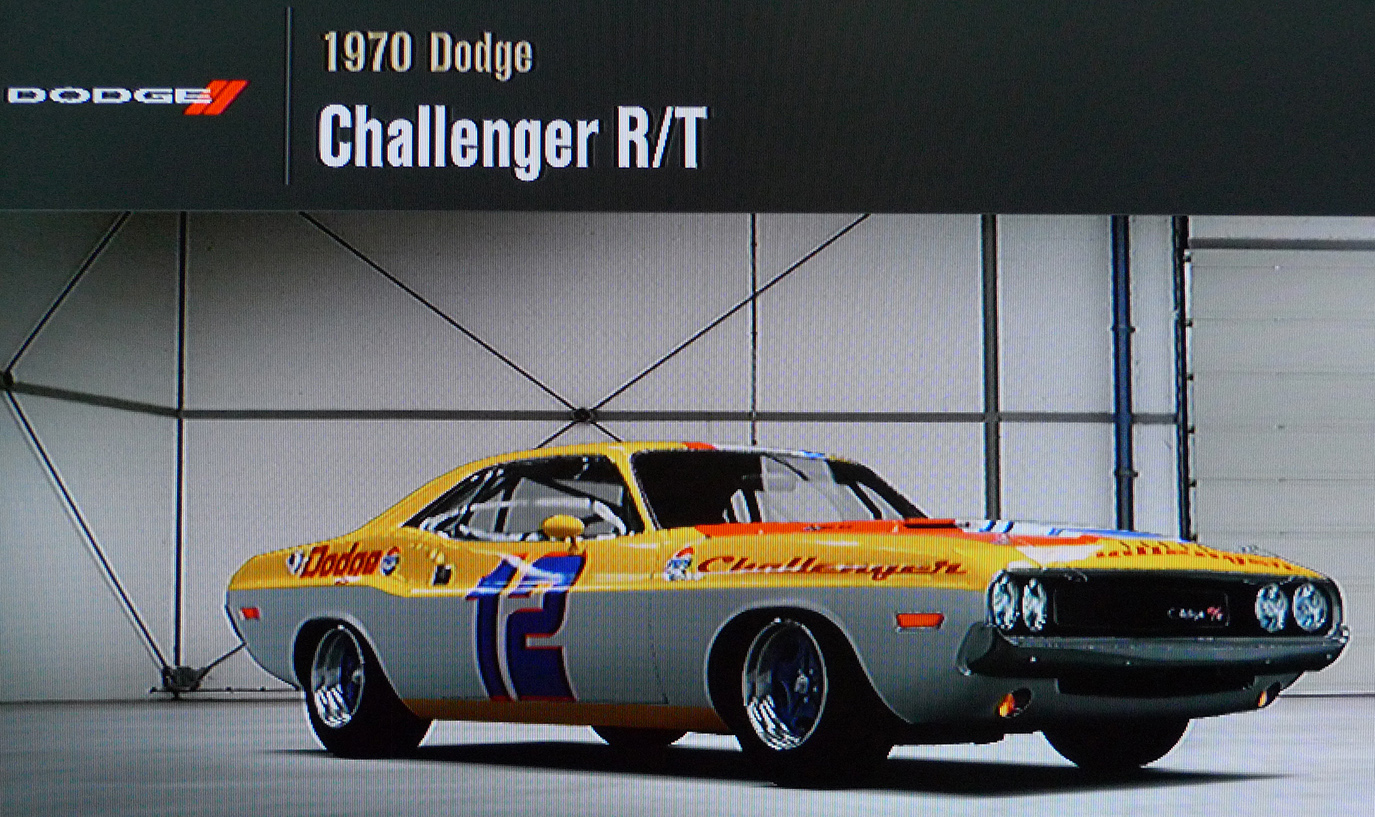
This livery is based upon Sam Posey's 1970 Dodge Challenger.
This image clearly shows Forza's adjustable rear spoiler. This car has the big block 440 6-Pack engine. Forza rates this as an A598.

Fully modified specifications: Horsepower: 513, Torque: 552  pound-feet, 0-60mph: 3.7 seconds, top speed: 171 mph. Lap time: 1:52.  
As I stated above, I would prefer the Boss 302 which is closely matched to the Camaro Z28. Both engines were made for Trans Am racing and thus were slower off the line with all of their power and torque available much higher in the RPM band. Forza rates this as an A591.

Fully modified specifications: Horsepower: 496, Torque: 552 pound-feet, 0-60mph: 4.3 seconds, top speed: 170 mph. Lap time: 1:49
The Forza adjustable rear spoiler replaces the stock Mustang BOSS spoiler seen in my 2015 racer.
The Mercury Cougar cars are longer and heavier than their Mustang siblings. More luxurious as well as Mercury cars always were compared to Ford versions (Crown Victoria verses Grand Marquis, for example). Forza rates this as an A600.

Fully modified specifications: Horsepower: 411, Torque: 518 pound-feet, 0-60mph: 3.5 seconds, top speed: 127 mph. Lap time: 1:51

American Motors Corporation never had the sales and thus the money as "the big three" car makers. But they made some competitive muscle and performance cars which were more unique than the competition. This car has their 401 cubic inch big block engine. Forza rates this as an A600.

Fully modified specifications: Horsepower: 437, Torque: 524 pound-feet, 0-60mph: 4.1 seconds, top speed: 135 mph. Lap time: 1:50.

The 426 Hemi Chrysler engine was the ultimate iteration of their top engine they created in the 1950's. This car was clearly made to dominate in 1/4 mile (and stoplight) drag racing rather than circuit racing. Forza rates this as an A600.

Fully modified specifications: Horsepower: 495, Torque: 671(!) pound-feet, 0-60mph: 3.7 seconds, top speed: 164 mph. Lap time: 1:53.

Lastly and most recently made, is this 1973 Firebird Trans Am in American racing colors of white and blue.

1973 was the swan song year for muscle cars with the new emission rules strangling engine performance. This car has the Super Duty 455 cubic inch big block engine. Forza rates this as an A592.

Fully modified specifications: Horsepower: 541, Torque: 648 pound-feet, 0-60mph: 3.5 seconds, top speed: 162 mph. Lap time: 1:49.
So, despite all of the engine sizes ranging from 302 to 455 cubic inches with widely varying power output, they are all within 3 seconds per lap. 

I tend to corner easier when not in an actual race, especially in this case. So in competition, each might be closer in lap times and a second or two quicker as well.

I want to thank you for taking the time to read my humble blog, the research took much more effort that usual but I enjoyed it. Now, time to go racing!

Scott
April 9, 2020
#377
 

White Van Speakers. Who Fell Victim to those Sneaky "Salesmen" Back in The Day?

  July 10, 2026 #459 Gentle reader, There is an interesting Audio-Equipment-History YouTube channel called "Multimedium". They mak...