Surround Sound Dynaco QD-2 is Back in The Listening Room System!

August 25, 2019
#323

Dear reader,

I began my forty-plus year journey seeking excellent sound reproduction around 1975 after seeing/hearing my new friend's kick ass stereo. I began by researching. Back then, there were libraries, no Internet and I started reading Stereo Review magazine. 
In the back was an ad for a book called The Audio Alternative by Mark Tobak. Audio Alternative | marktobakmd
He wrote an unbiased study of stereo and quad equipment. No ads, no input from makers. He tested many components from the day and prior and gave opinions as to sound, build quality and value. 
As a result of reading it, I built a Dynaco PAT-5 preamp kit and a pair of SWTPC Tiger 01 60 watt mono power amp kits. I bought a pair of demo Dynaco A25 speakers and a B.I.C 940 turntable.
NOTE: If you are viewing this on a computer, clicking on any picture will open a second window over this one. You click through or use your right and left arrow keys to look at the photos. They will be larger than seen here. If you are viewing it on a device such as a phone or tablet, I do not know if that works the same way.
Back then, Quadraphonic sound was the new thing and Dynaco built a device called a Dynaquad. Image below is from the Internet.
There were at least three competing Quad systems that decoded the rear channel's sounds from record grooves.  
Dynaco's idea was simpler and passive. It did a pretty good job of simulating quad.
In the 1990's, Panor Corporation bought the rights to the Dynaco name and began building high end audio equipment. They also updated the 1970's circuitry and added a center channel. The QD-1 Series II was their least expensive item. I bought it directly from Panor.
They updated it a couple times and the QD-2 (rear seen below) was the final iteration and it, at last, included three-way binding/banana post terminals.
They also added a shiny black chrome faceplate that sadly shows every fingerprint. "In situ" below.
When I first got the one above, I wrote about it here:
As you can see above, I have two other Panor-era Dynaco components, their PAT-6 Preamp/Tuner and ST-200 power amp. Both purchased used. I considered the twice as powerful ST-400 Series II power amp, but while playing 3 dB louder, it only has one set of speaker terminals and no controls.
The first time around, I used my Dynaco A25XL speakers as surrounds. The room was quite crowded. I soon had them on stands shown below.
You have no doubt realized that the room has changed. The huge record shelves now sit where the stereo rack/shelf sat.
Because of the Tannoy C-88 speakers I found and upgraded:  Tannoy C-88 Twin Tweeter Transplant Step By Step the Dynaco speakers were just sitting in the back of the room. 
Since I do not collect equipment and thus is not being used, I decided to move the A25XL speakers to the living room. "Better to ask forgiveness...", (she said no when I proposed the move), I waited a week or so and moved them anyway. She accepted that they looked okay there, what with all the wooden things we have in that end of the house.
But now, I had the Cambridge Soundworks speakers on stands from the living room just sitting where the A25XLs had been. That would not do.
Since the room was airier now, I decided to hook them up via the QD-2 (thus also having IT also out of the closet and working) and placed them as seen flanking my much loved and threadbare old reclining wingback chair.
Yes, you keen eyes have detected that the Klipsch KG4 speakers are no longer in the listening room. The Tannoy C-88s flank the shelf and Cerwin-Vega! LS-12s are on the outside. 
Explained: Klipsch KG4 OR Cerwin-Vega! LS-12 Speakers?
The Tannoy had become my favorite speakers since I upgraded them and I rarely used the Klipsch. And I found that I was using my Cerwin-Vega! LS-12 speakers way more than the other pairs of speakers in THIS room. 
Plus everything else in the listening room is black, so I did the swap. And boy are those C-V's heavy!
Many poo-poo Cerwin-Vega speakers, these are the only ones I have ever found in the wild, but I think they sound great. Having the largest woofers and highest efficiency of any of my speakers, they are great for when I play Tchaikovsky's 1812 Overture, especially the Telarc SACD or the Mercury Records version. Both of which have the best cannon shots.

I toyed with the idea of having the small speakers turned to face me/the chair. But as they have a good dispersion and in this case are meant to augment the stereo sound from the front speakers. 
I found that they are just audible enough to really expand the sound into the room. 
Have you ever stood between your speakers when the music is playing, in my case in front of the record shelf?
If not, try it. You will immediately feel like you are standing on stage. The dispersed sound is a wall all around you. 
With the rear speakers, the high frequencies (being directional and thus less obvious so close to the shelf) are still heard since they are pointed to the front of the room.

I recommend looking for one of the Dynaco QD components, either one of the 1970's originals or a QD-1 Series II or IIL or if you can find one a QD-2. Give it a try. No power needed. Just a couple or speakers for the rear and wires for them.

I really appreciate your taking the time to read my humble words and view my images. It is your kind words and comments that keep me writing and shooting.

Scott
August 25, 2019
#323

DBX Encoded LP Records. Are They As Amazing Sounding As Some Say?

August 17, 2019
#322

Gentle reader,

There were two main "Noise Reduction" systems developed to reduce tape hiss in conventional analog music sources. 
Dolby developed theirs exclusively for tape recordings. I don't know if it was available on 8-Track tapes, but cassette tapes, most definitely.

NOTE: If you are viewing this on a computer, clicking on any picture will open a second window over this one. You click through or use your right and left arrow keys to look at the photos. They will be larger than seen here. If you are viewing it on a device such as a phone or tablet, I do not know if that works the same way.
 
DBX,  or "dbx" as they chose their system's logo to be in lower case, does it differently than the several versions of Dolby. I won't go into how it works, there are sites and articles from people far more knowledgeable than I that you can read.
dbx, went one further by encoding LP records. It's quite ingenious, they record the music about 1/2 as loud as normal, and somehow encoded their signal in the music grooves. 
So, if you play a dbx encoded record without a decoder, it sound's much quieter that you would expect. 
But, if you have a dbx decoder, and turn it on, not only is the music much louder, the soundstage is taller, wider, deeper and one feels as if they are in the space WITH the musicians.
Above is a scan from a Digital dbx LP I just received. It succinctly explains the process and it's results.

Techmoan - YouTube  That is a link to a British chap who buys electronics, usually old technology, and does very in depth videos about them. He's wonderfully informative and enjoyable to watch and learn from. I watched his video on dbx and got inspired.

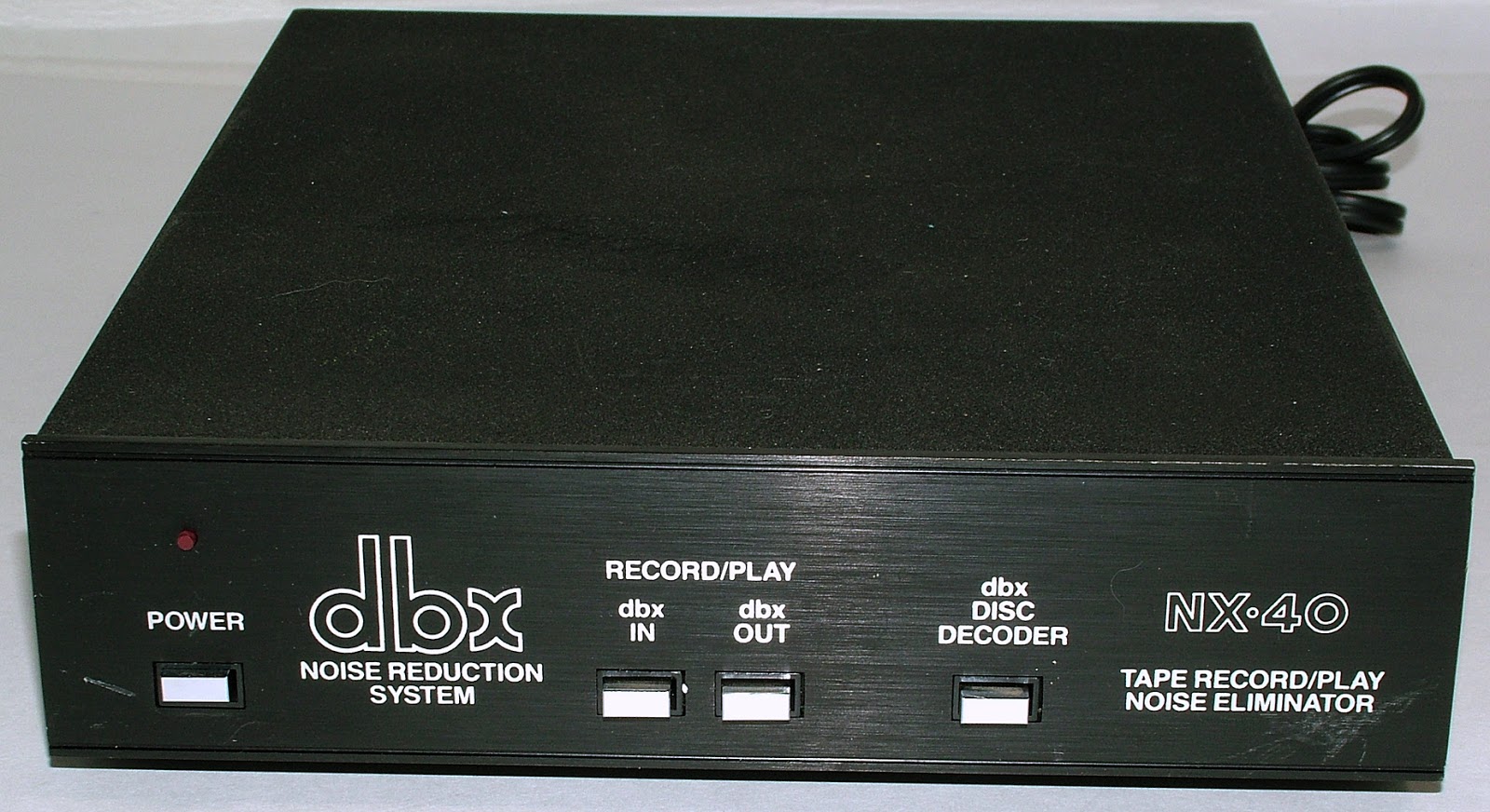
I had a dbx decoder some years ago, but do not remember the results. Here are photos of it:
It was fairly small and simple, I had it in late 2015 and sold it. This one was made from 1982-1986 and sold new for $160.
Keep in mind the size based upon the RCA terminals which are a standard 3/4" spacing, and compare the back to the one below.
Photographing shiny metal is very challenging. And the RCA terminals on this model are horizontal, but clearly it is larger.
This one, a dbx II model 122 and it's four channel brother, were made from 1976-1980 and sold new for $275. The four channel model was much more expensive.
I like it's design, especially the solid walnut wooden end panels. Normally, I open up electronics just to see what's inside. But this time, I left it alone.
I was able to buy it for the bargain price of $20. The seller assured me that it worked the last time he used it, but it had been stored for many years since.
Fortunately, HiFi Engine - Owners and Service Manuals had the owner's manual for free download. Because this one is much more complicated than the NX-40  I am glad I downloaded and printed it.
There was no room in my system to add this other than to the right of the turntable. 
I have a 7" TV attached to my OPPO universal player, which I use to make sure SACD and DVD-Audio discs play in stereo not surround sound. It has a tripod socket on the bottom for some reason and does not stand up otherwise. So, I adapted it to that piece of wood. Previously, the wood was perpendicular to the TV.
I searched through all of the classical and Jazz LPs and so far have found only three dbx encoded records, shown here. That is perhaps 60% of my LPs so I may find others.

Because my 1990's Dynaco PAT-6 preamp/tuner has fewer inputs than I need, I use this SONY A/V switch which works perfectly and silently to playback cassette tapes and my CD Recorder. Below shows how it was configured before installing the dbx.
Below is with the dbx II installed. As you can see, I believe better quality cables are a good investment and DO sound better.
To keep track of which way the signal would be going, I wrapped fiberglass electrical tape about the cables I was adding to the system for the dbx. I did not want to get them mixed up.
Before committing to use the dbx II, I simply hooked it up with the red cables. Above and below shows it in the system permanently.
The cables with the arrows I drew on them are one meter long, so I had to curl them one rotation to make them fit neatly. Double-sided Velcro, what a wonderful invention!
I snaked the thin brown AC cord from the dbx II around one of the cross braces and plugged it into the last free outlet in one of my Adcom ACE-515 power conditioners.
Here it is playing the record featured at the top of the article. Here are the other two I have but have not yet played.
I generally prefer classical music later than the baroque era as well as Mozart, Handel, etc. With exceptions, of course. But I did buy all three because of the dbx sticker even though I did not have a decoder. 
The one below, is the same one as at the top of the article.
As far as the Strauss family, I tend to not buy their music because so much of it was written for waltzes and is not exciting to listen to. However, the second side is a great tune.

So, what do I think of dbx? I, like Techmoan, was pleasantly blown away. I switched the "BYP" button on and off, and yes, the music is quieter by far, with the decoder off. 
But, like he said in the video, the music is so much more alive and airy. The soundstage is huge, closing my eyes I can see in my mind's eye where various instruments are located. I can hear musician's breathing.
I could go on and on with descriptions of my experience just playing this one LP. But, I won't. Suffice to say, I am so impressed that I went online and ordered several dbx encoded LP records! 
Two arrived today and I continue to revel in their incredible range! So, I just bought some others. Too bad few record labels were willing to buy into dbx. 
Prices are all over the place for them because there were so few made. I'm retired and on a fixed income, so I had to be choosy. 
Adding this dbx decoder, and it's very informative manual, to the system has encouraged me to play more records. So, it was $20 well spent.
  
Thank you for taking the time to read my humble words and viewing my images. It is your kind words and comments that keep me coming out with new articles.

Scott
August 17, 2019
#322


Going Old School Racing Sony Playstation2 in HD. Carbon Fiber Paddle Shifters. Retrotink too!

August 16, 2019
#321

Gentle reader,

I never intended to get into simulation racing. Oddly, it never crossed my mind. Even though after our young kids went to bed, Nancy and I "raced" each other on the primitive video game console we had way back then. Being a car guy all my life and loving sports car racing, I should have though of it.

NOTE: If you are viewing this on a computer, clicking on any picture will open a second window over this one. You click through or use your right and left arrow keys to look at the photos. They will be larger than seen here. If you are viewing it on a device such as a phone or tablet, I do not know if that works the same way. 
A coworker gave me a PC racing game around 2000 called Test Drive Le Mans. Since the 24 Hours of Le Mans is my all-time favorite race, I was intrigued. 

Later, my daughter bought me a SONY Playstation2 Slim and my son, Gran Turismo 3: SONY's "Real Driving Simulator". And I began the transition from PC to console. 
Soon after, I bought GT4 and the Logitech wheel set made specifically for it and the old PC one was donated.
I built two frames of structural aluminum with 1x12" wood to support the wheel and pedals. They were collapsible for storage. Below is one equipped with Microsoft's fine wheel and pedal set for the XBox 360.
My son and I started racing each other as well as individually racing the computer's AI cars.

My ever supportive wife bought me a nice gaming chair with pedestal and built-in 2.1 amplifier with speakers in the headrest and a "sub" beneath the seat.
I had to modify it with the thigh extension you can see here. I'm 6'3" with long legs and these were mostly made for kids.  

My son transitioned to an XBox 360 and Forza 3, then 4, while I stuck with my trusty PS2. I tried other racing titles with mixed results.
Eventually he moved out and I also switched to to a 360 and Forza 4 as well. The HD graphics were SO much better.

Forza 4 verses Gran Turismo 5  Is an  article I wrote some years ago, no photos except of game covers. I had my son-in-law's Playstation3 for a year while he was stationed in Okinawa and bought GT5 for it.

Eventually, the old PS2 would not recognize any disc except GT4 and the TV picture was crappy. So, I put it all away and forgot about it.

OK, enough background. Looking into the closet one day, I spied my PS2 Slim's box and for nostalgic sake, got it out. 
Well, it had completely died. No sounds, no image on the TV. Nothing. Sigh.

I started looking online (Amazon and eBay) for good working PS2 slim replacement consoles and bought one. 
Since I'd sold all of my PS2 wheels, I needed another one and bought the one you will see below that was actually made for GT5 on the PS3.
Well, the first console arrived and had issues, so I returned it. I forgot to remove my GT4 disc however and when I realized it, I just went ahead and bought another one for $5.00 via eBay.
And it's a good thing too. As that first console stated that my GT4 data on my memory card was corrupted (all those cars and credits!) and I had to erase it and start from the beginning. Crap.
WELL, the replacement game disc arrived and inside was the previous owner's MEMORY CARD!
He was GOOD! He had a large garage with some great cars, many with CRAZY horsepower figures.  And 2,600,000 in credits in his bank.

Below are photos of the screen showing his garage and cars. Starting with the MOST powerful and descending.
Page two:
Page three:
Page four:
Page five:
And page six:
Here is the new steering wheel I bought. One complaint I have (and others, too) about Logitech wheels is small shift "paddles" on the back of the wheel's spokes which can be hard to reach.
Above shows the "carbon fiber" paddle shifters I installed on it. Below shows the small lever one must press to shift up (right side of wheel) or down, (left side of wheel). 

Here is Microsoft's steering wheel with much more user friendly shift paddles, below:

Below, is the "paddle" that Logitech puts on their older wheels, between the screw holes. Their newer ones are much better and way more expensive.
Dynamic Paddle Shifters is a company that makes superbly engineered and constructed paddle shifters and other things to improve racing wheel/pedal sets. I HIGHLY recommend checking out what they sell. The prices are amazing as is the quality. I chose simulated carbon fiber finished paddles.
Here is one paddle installed. They even supply "wear strips" to adhere on the factory paddles. The screws are nylon so they should not cause physical wear on the wheel's shifters.
If you look closely above, the paddles are leaning way back from the wheel.
More evident in these photos.

Above shows them prior to my adjusting the screws/nuts supplied installed but loose. Note the smooth curves and lightening holes the drilled in them. Just like the real things.
Above shows after I adjusted them. There is still room for my fingers and the are exactly where I need them.
Much better placement now, as you can see.  
Logitech includes a shifter on the right side of the "dash" pulling back shifts up, pushing forward shifts down. Simulating a sequential racing transmission.

With the paddles being so long, one can still reach and operate them even while rotating the wheel. Much better than the original shift levers.

So, now I have a working Playstation2. But the picture is still crappy. First thing I tried was a "component" video cable. The PS2 puts out 480P video. The factory cable only has the red/white stereo audio plugs and yellow "composite" single video plug. So the component cable with red/green/blue plugs improved it, but not much.

Research steered me away from the simple and cheap Chinese ADC (Analog to Digital Converter) device and suggested: RetroTINK

RetroTINK goes beyond the mass produced Chinese ADCs by adding a "jitter" filter circuit and other things that smooth out the 480P signal when seen on an HD screen.

My XBox 360 is positioned console behind the TV. How it receives and sends signals to and from the steering wheel and the console, I do not know.

So there is no room to fit the PS2 setup back there, I placed it next to me on top of the shelf I built.
The PS2 Slim's name is obvious as it's much smaller than the original PS2. To do that, they removed the hard drive from the circuits and equation.   
The aftermarket component video cable is seen here (above and below), thicker than the original and grey/black web covered.
I wire-tied the yellow cable even though I could have just plugged it into the RetroTINK.
Component video cables above and the stereo audio cable on the right side.
A Micro USB cable power supply is needed for RetroTINK and the Type C mini HDMI cable to supply the digital signals to the HDTV.
Above, we are looking over the top of the TV and down at the inputs of the HDTV and other inputs.

Does the RetroTINK work as promised? It does, it is not HD quality, no but the picture is much better.

When I transitioned originally from PS2 to XBox 360, the learning curve was steep. Both companies use physics to have each car handle as lifelike as possible. Microsoft's physics are much harder to battle.

Going back to 2005 or so as I have, I find that it is somewhat easier to avoid sliding off the courses while racing on the PS2 with Gran Turismo 4. Plus, unlike Forza 4, if one wanders off track, in GT4 your car does not slow down like you drove into a lake. You simply bounce along the grass trying to get back on track like in real life.

The engine sounds have never been as realistic in any of SONY's Gran Turismo versions I have tried as they are in Forza. But one gets used to it.

I re-bought Enthusia and TOCA Race Driver 3 for the PS2. Both are more demanding that GT4. I have not tried either since RetroTINK has been installed. But am looking forward to it.

I hope you have enjoyed my trip down memory lane. I am. It's refreshing and although I spent more than I should have, it's worth it to me.

Thanks so much for taking the time to read my humble words and view my images. It is your kind words and comments that keep me writing and shooting.

Scott
August 16, 2019
#321

Super Rare December, 1975 24 Page Full Color Dynaco Dynakit Products Catalog!

  September 17, 2026 #552 Gentle reader, For those that are new to this blog: Welcome! I write about Nancy's and my passions, and no, no...