Alternate Discs Digital Sound Even Better? SACD DVD-Audio HDCD K2HD CD

December 27, 2018
#298

Gentle reader,

In the early 1980's SONY and PHILIPS got together to create a form of music that was immune to the inevitable wear and fading of LP records and the less-than-high-fidelity of cassette tapes and the impracticality of reel-to-reel tapes.
Digital recording was being used then, but converted to analog for pressing onto LPs. As a result, the tape hiss was gone from the records. Some praised the new digital LPs, others did not think they sounded any better.

The only portable music then was cassette tapes. Some felt those plastic encased slow running (1 and 7/8 inches per second across the heads) 1/8" wide tapes (in stereo, four tracks less than 1/32nd of an inch wide per channel) could not replace the true fidelity that LP records set as the standard. 

No, it was time to make digital music discs of some type. Believe it or not, digital video (with audio) discs had existed since the 1970's. Twelve inches in diameter like LP records, shiny silver on both sides. When made available for consumers, it was called Laser Videodisc or Laserdisc for short. But the technology was still new and had only begun to make it into homes. DVD discs were a long way off.

Thus the partnership was formed by two unlikely peoples, Japanese and the Dutch of the Netherlands. I will not go further into the history of the Compact Disc. Others far more knowledgeable than I have exhausted that subject.

"PERFECT SOUND FOREVER" was the advertising catch phrase for CDs. Like all new things when they came out they were expensive. And only SONY and PHILIPS in the beginning were making players. 

Alas, perfect they were not. In some cases, record companies wanting to catch the CD wave were pulling master tapes and recording them directly onto new CDs forgetting that the tapes were RIAA encoded! Thus, they sounded awful.

As time went by, there were moans from audiophiles and others decrying the limitations of CDs. Many claimed that they did not sound like the LP versions of the same album. They had no warmth or life. Some swore they sounded choppy.

Like the audio/video VHS verses Betamax video tapes, and much later HD-DVD verses Blu-Ray discs wars, a pair of new much higher fidelity music formats came out competing for buyers: SACD and DVD-Audio.

SONY and PHILIPS again collaborated on Super Audio Compact Discs. Digital Versatile Discs (not "video" like many think) although physically the same size of CDs hold a tremendous amount of more information over CDs due to much smaller pits and lands being used. SONY and PHILIPS chose to create audio-only discs also using smaller pits like DVDs. Both formats hold 4.7 gigabytes of music.
I have chosen to have this image to be full sized. Whether you see it that way depends upon the device you are viewing this on. It is one side of my 200 CD capacity disc tower. 
At the top are all of my test CDs. Many are ones I made from downloadable files from the French speaker maker, FOCAL. With Chesky's GOLD STEREO AND SURROUND SOUND SETUP DISC at the bottom of the group.

Below that are 22 out of 23 of my SACD collection. The one not seen is the six-disc boxed set of SACDs of the London Symphony Orchestra's LIVE performances of all nine of Beethoven's symphonies.

At the very bottom are my 19 HDCD discs. They are a form of CD that has been encoded to improve the sound over standard CDs. For an in depth look at all of the forms of storage that have come about for the five inch shiny discs, feel free to look here:
All About The CD, HDCD, and SACD Audio Disc Formats 

I have owned a great number of "Universal Players" many from Denon and OPPO as well as other brands. Plus, I have owned a number of SONY SACD players. Just now, when looking through my "SOLD" files I see players that I should have kept. Hindsight is so 20/20.

To simplify matters, I will show-and-tell you about the three advanced formats that I have in alphabetical order. So, DVD-Audio is first.
In the listening room system is an OPPO DV981HD player, I am getting mixed signals from various sources as to whether it plays and decodes HDCDs.
All of the formats and bells-and-whistles are printed on the top edge of the player. See? No HDCD is shown. 
Today, I added this tablet sized TV to the system to setup the OPPO to chose the DVD-Audio/Stereo playback instead of the DVD Stereo portion of DVD-Audio discs. First time I played one, DVD appeared on the OPPO player's tiny screen.
I had to plug the OPPO's AC cable into an unswitched outlet on one of my Adcom ACE-515 power conditioners. So that it will not lose the settings. I decided to keep the wee TV there just in case. 

The first DVD-Audio disc I bought, some years ago was the iconic soundtrack from Henry Mancini for the brilliant film The Pink Panther. I made a CD copy of it and later sold the DVD-Audio disc. Trying to find it now is...frustrating. Why are things we once had and sold now selling for SO much more?
To begin my new collection, I bought the one on the lower right. To be frank, it sounded like crap. I am not sure if it was me or a lousy recording. Or perhaps it was playing the stereo DVD portion. I am re-listening to it right now and so far, is sounds much better.
Beethoven's 9th symphony is my favorite and I have a LOT of versions of it.
I also like Brahms' 1st symphony. Especially the forth movement. 
This Beethoven is the latest purchase and I've listened to it again today and it sound's fantastic! 

Note, by the disc's size, how much larger these DVD-Audio cases are! Why? The Mancini was in a standard CD case. 

Next are HDCDs, there are several different names attached to the "HD" portion of the name. The above linked article will tell you them all. They are 20-bit recordings instead of the standard CD's 16-bits.
Here are all nineteen of them. Many different types of music. More than 5000 HDCD titles are out there, see:
Goodwin's High End - HDCD Recordings  
They play in all CD players. The extra four bits that are encoded into them will not affect standard playing. The players simply ignore that encoding.
In the world there are many coincidences. I am half-Czech on my mother's side. We have two TINY dogs, the smallest breed in the world in fact, they are Prague Ratters. We were told they were Miniature Pinscher puppies. And the three HDCDs above were all made by the City of Prague Symphony Orchestra. 
One of the most-recorded orchestras of all. They are very good and put out excellently performed and mastered music. 
One thing they specialize in is compilations. 007's music on the left, American TV score themes in the middle and a two-disc distillation of the incredible score from the three Peter Jackson films: The Lord of the Rings.
Speaking of film scores (scores are the music composed for the film, which add to the drama. Soundtracks are ALL of the sounds of the movie, sometimes music companies get that mixed up) these four are all HDCDs. 
I like Latin music and dancing. I cannot do either. I also love Big Band music of which a large portion is called Swing. The one on the right, is original recordings, so high fidelity, how?
In the 1980-90's, "Smooth" Jazz became quite popular, with many radio stations specializing in it. I came to love it and have hundreds of CDs and LPs from many artists. I also like what I call "traditional" Jazz, but do not "get" it like some people do.
It all started when I bought the one in the middle. Reference Recordings is a label and the professor Johnson listed on the covers is behind their success. But, just because in has their RR on it, does not make it a HDCD.

I tried a hunch. I turned on the little TV and the OPPO player. I then put a HDCD in and closed the tray. In a few seconds, HDCD appeared on the TV screen. So, YAY!, it plays and decodes HDCD discs.

Just like Darth Vader said in Star Wars, "There is another....". In this case, one of the more expensive CDs that I've bought. It came all the way from Japan.
"K2 HD Mastering CD" is on the top left, "24 Bit, 100kHz Mastering" in on the top right of the gold strip on the cover.
Manufactured in Japan. One can buy them locally via Music Direct. But they are not keen on discount pricing.
Again, I have chosen full size for this image, so that you can hopefully read all of the explanations as to how they improved the sound over standard CDs. 

These are the last two pages of the attached "liner notes" that came with the CD. It's case is actually a hardback book. Of course, it is too big to fit on a CD rack. These are serial numbered limited editions. This is S/N 0680.

And finally, the alternate disc format that I have the most of, SACDs. The first two albums, when I bought them, I didn't realize I was getting SACDs. 
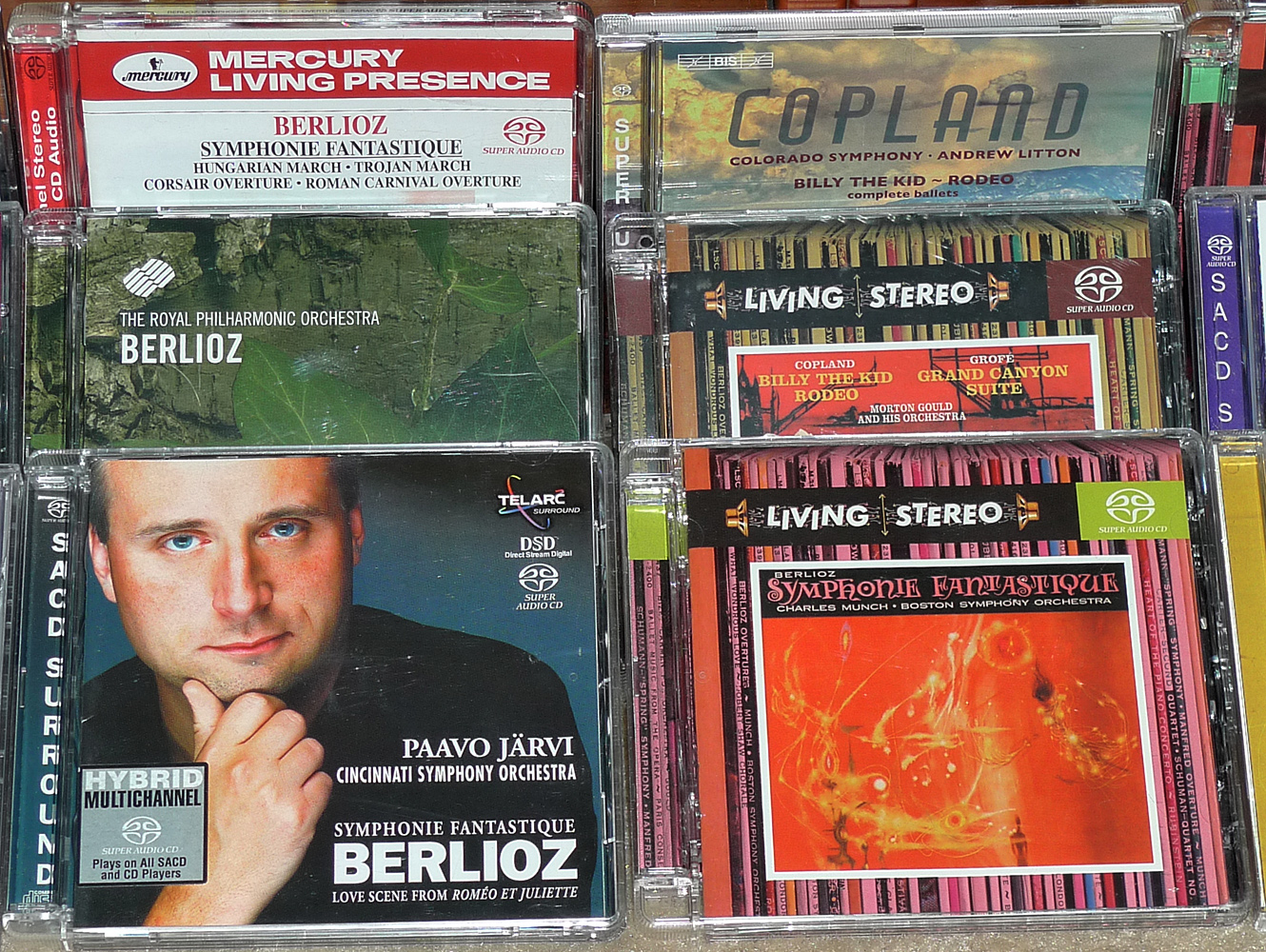
This is all of them. Mostly classical music with exceptions for some that feature music from films, plus silly sound effects.
The aforementioned box set of LSO Beethoven symphonies, plus four other performances.
Berlioz's Symphonie Fantastique is another favorite of mine as is a lot of Aaron Copland's music.
RCA Records has recorded a large number of their classic and fine sounding "LIVING STEREO" recordings on SACD. 
Gershwin, Mussorgsky, Tchaikovsky and more. Danny Elfman is well known for his film scores. I'm still not sure if I like this music he created.
TELARC has always been known to get the sound right with their recordings. Especially with Erich Kunzel and the Cincinnati Pops Orchestra. Four recordings from them above plus Sibelius on another label.

The two albums that I bought, not knowing they were SACDs, are; the Tchaikovsky 1812 on TELARC, (I have the extremely challenging LP, which at the time, was the most I'd ever paid for a record), and The War of the Worlds. I also have that on LP. 
You may recall a song called, Forever Autumn sung by Justin Hayward of The Moody Blues? It is from this album, which is narrated by Richard Burton.
The cool thing about SACDs is than MANY are Hybrid discs. They have two music layers. A standard CD layer with it's large pits and lands and beneath that, but readable through the CD layer, is the SACD layer. Often in stereo AND six-channel surround sound. 
SACDs only have analog output. That is to prevent them being copied digitally. So, to enjoy all six-channels, one would need a receiver with six-channel RCA analog inputs. 
See the "MULTI CH IN", above? Like that. They may differ in appearance or naming on your equipment.

So, the 1812 and War discs played fine in my CD players due to their CD layer. Once I looked at the cases and liner notes did I see: SACD and began to look into the format. 
We have often spent some of our Saturdays at the various thrift stores around here. Before I retired, I stopped at many of them on the way home from work. I spied the above box set of LSO SACDs, on the bottom shelf mixed in with the DVDs. It was STILL SEALED! $1.99 later and they were mine! 
Lastly, this is the DENON DVD-1920 that I bought to play all discs in the two systems that sits inches from me and this computer. It does not list HDCDs. The newer and more expensive models do play and list them on their faceplates. Including this beautiful silver one that I USED to have:
My DENON automatically displays which disc you have loaded: CD, SACD, DVD or DVD-Audio on it's display screen. In the case of my black one, it automatically loads the DVD-Audio source. 

Since the OPPO does not display the disc format (other than  DVD) I have to use the little TV to make sure it has chosen the correct format. When I have done so, the red DVD is not illuminated.

Final thoughts. Firstly, I think most CDs sound wonderful. I have a Nakamichi CD player and it is one of the better ones as far as quality of sound. I have more than 2000 LPs so am certainly a believer in their fine sound.

Secondly, can I, at 62, tell any difference of these extended range discs over the standard ones? Yes. I cannot point my finger at exactly what sounds better. I do know the bass is more realistic and what highs I can still hear sound more....present. Plus, the soundstage seems more robust. A music connoisseur I am not. But I know what sounds good and what doesn't. To me.

Now, if this article has peaked your interest, go ahead and buy a universal player, there are many used ones on eBay and other sites and in stores have new ones.

Make sure the one you choose has the ability to play the type of discs you want to try out. Most DVD players will only play DVD-Video discs and regular CDs. 

Once again, thank you SO much for taking the time to read my words and view my photos. It is your kind words and encouragement that keeps me cranking out these articles.

Scott
December 27, 2018
#298 


You Too Can Listen to HD Radio on a Budget.

December 19, 2018
#297

Gentle reader,

I recently wrote about FM radio, specifically about internal and external antennas. You can read about it here:

In that article, I brought up HD Radio, their web site can be viewed here:

After writing the article, I decided to dip my toes in the HD Radio waters again.

Insignia is a store brand sold by Best Buy. In most, if not all, cases it is rebadged products made by manufacturers that sell virtually the same item under their own name.

The radio below, I bought used, via eBay. A little worn, but it works perfectly, and it came in the original box with everything included.
This is a portable HD Radio, I wanted something that I could use as a source, when I saw it has a headphone outlet, I knew it might be just what I was looking for.
I have not listened to it's speakers yet. I simply used a 3.5mm-1/8" headphone plug to stereo RCA cable and plugged it into the AUX terminals of my Yamaha RX-496 stereo receiver.
You may be thinking, "What the heck am I looking at here?" Since I have a nice external antenna, I decided to attach this radio to it. 

Rather than take it apart, enlarge the hole and install a coax cable terminal, I used this old clamp. It's not really an alligator but more of a hippo clamp. I stripped the end of a RF coaxial cable. I covered the exposed insulated portion which had remnants of shielding with electrical tape. Then I slipped the inner wire under the screw and tightened it. I crimped the end of the clamp around the taped portion. Then I slid the previously installed heat shrink tubing forward to cover the crimp and heat shrunk it.   
I had one empty space left in this four-way HDTV-ready cable splitter. The gray nutted ones go to each stereo receiver (Yamaha and vintage Fisher) the yellow collared one goes to the 42" HDTV that I simulation race on. One of the ones on the right is the input from the amplifier (below), the other goes to the HD Radio.  

This was a thrift store find and what a difference it makes! Without it, the aforementioned TV does not find a signal. With it, a nice clear picture.
Here is the stand-alone tuner I once had. Sold under it's maker's brand name of Sangean with a different appearance.
It is well made and I may be looking for another one or perhaps another brand tuner someday.
Where I have placed the radio, really the only place I can put it, which is on top of the stack, makes it difficult to see the switches which are all on the top surface. For now, I lean it forward to see what I'm pressing.

But, in the mean time, I'll enjoy it. The radio has a nice crisp sound and once in HD mode, the sound is crystal clear. I love once again having the ability to listen to a multitude of stations with it.

Thank you SO much for taking the time to read my words and view my photos. It is your kind words and encouragement that keeps me creating these articles.

Scott

December 19, 2018
#297
 

FM Radio, A Thing of The Past? Choosing and Installing External FM Antennas.

December 12, 2018
#296

Gentle reader,

This is my second writing of this article. Some Blogger.com glitch erased everything. I do not know why. I just hope I am as brilliant this go round. Humble! I meant humble.
I belong to a number of FaceBook groups devoted to classic and vintage stereo equipment. Sometimes the subject of radio comes up, "Does anyone still listen to FM?" Or the subject of reception, "What do you use for an antenna?"
I have captured a number of images of analog TV "Rabbit Ears" antennas. This image is via wiseGEEK.com.
I use one similar to this RCA model on top of my retro floor radio (seen further down the article) and it does a good job. I cannot use the built-in amplifier as it creates noise. I suspect because the radio's antenna is a simple wire which I screwed to a 75 Ohm coax-to-300 Ohm adapter.

Terk is a company famous for it's antennas. Two of which are shown above, both I have used with mixed results. Bottom photo is via B&H Photo.com.
We live southwest of Washington, D.C. and Baltimore, Maryland. About 35 miles down I-95 from the Potomac river crossing into D.C. via I-395.
So, reception with an indoor antenna is not going to be very good. It depends upon the device. A SONY under-cabinet radio/CD player in the kitchen picks up D.C. stations just fine. And it has no visible antenna.

I put a TV antenna on the chimney on the other end of the house. It is one made for HDTV digital broadcasts. It works well and brings in every HDTV channel beautifully. Except FOX. Which is just fine with me. I added a lightning arrestor and ran a ground wire to a stake at the base of the fireplace.
I found this FM antenna on eBay, made and sold by a seller. I put it up a few years ago. He made it out of two car aerials in a bipole or dipole configuration. I can never remember which is correct. It worked well and even picks up HDTV broadcasts. My wife has a small flat screen TV in her "office" next to mine. Great picture, too. Who knew?
Detail shots of this antenna can be seen further down in the article when I show it's new location.

Parts Express: Speakers, Amplifiers, Audio Parts and Solutions  sells a number of antennas at reasonable prices. This omnidirectional FM antenna is one of them. It sells for less on Amazon, but I prefer to deal with companies rather than further enrich Jeff Bezos, whenever I can.
I did not put a lightning arrestor on the old FM antenna, but at the urging of my FaceBook colleagues added one to this, the ground wire is the grey one.
Our house faces almost due south. This room is on the front of the house, the listening room is on the back. My retro floor radio is what I use when I just want to listen to the radio on this end of the house. It sits in a corner of the listening room. Both photos that flank it I made on film up in the Blue Ridge mountains.
You may recall I wrote about upgrading the cheap factory 3-way speakers with the baffle and speakers from a vintage Citation speaker? It sounds terrific and the antenna, a Radio Shack unit, can be seen on top of it.

I was an early adopter of HD Radio when it came out. I bought an Insignia HD Radio tuner, a rebadging of a tuner made by a famous radio company, whose name escapes me.
I used it when the stereo was still in the living room and I ran speaker cables through the attic into this room, my "office". Hard to believe I used to have only one stereo.
Later on, I bought this SONY unit, it is simply a radio with no way to output it to a stereo. It sounded very nice and it got all the side bands or channels.
HD Radio, like broadcast digital HDTV (over the air television) have side bands or channels. Most FM HD Radio broadcasters have up to three channels. I chose HD Radio because that was the only terrestrial way to receive Smooth Jazz over the air. 
I even put HD Radio it in my car. Below are shots of my 2000 Audi TT quattro. Lest you think I'm wealthy, you are incorrect. I sold my two cars to get the cash ($10,500) to buy this ten-year-old car. 
I also had Sirius satellite radio. So, I came up with a way to tastefully add both receivers to the car, playing either through the cassette deck and one of those adapters, seen sticking out of the factory radio, above.
Do you like my handles? They look like miniature rack handles. The toggle switch was to switch between the receivers outputs. 105.9 HD2 was the Smooth Jazz side channel.


And here is my car. I can tell stories about it, but I wont. The thing about buying a car which was $40,000 when new, used, is it is still a $40,000 car when it needs repairs. I miss the car, but not the expensive things that went wrong with it. But man was it fast!

If you are interested in receiving HD Radio, click this link:  Homepage - HD Radio - HD Radio

So, I have shown you internal and external FM antennas below is a shot of the new antenna and the way I chose to attach it to the house. There are numerous brackets sold to mount an external antenna. Just search "TV antenna brackets" to see the variety.
I carefully measured and marked and using a LONG 3/8" drill bit drilled through the two studs that this vent is mounted to. Then used 3/8" threaded rod, sleeves and various other pieces to utilize the brackets that are actually holding the antenna pole. We have a metal roof which covers over the fascia boards, so it had to extend far out from the house.

The directions that came with the antenna stated to point the aerial that is pointing away from us (above) towards the stations. Since D.C. and Baltimore lie 40 degrees off of north, when Spring returns and my wife is home to steady the ladder, I will orient it to that angle and see if it improves reception.
I found this Trisonic broadcast amplifier at a thrift store. Does it add 36 decibels? I have no idea, but it makes a huge difference in receiving clear FM broadcasts. 
Despite Steely Dan's lyrics, "FM, no static at all." FM has static, it is more prevalent on older analog tuners, at least ones I have used, where newer digital-readout receiver tuners seem to filter it out.
You may have noticed the three retro radios on top of my classical LP records shelves? I used to have a bunch of them. Well, I found this Radio Shack branded one recently. I put it in our laundry/workroom. But reception was poor, it's semi-below grade. The "antenna" was a wire wrapped around the AC power cord. 
I unwrapped it and passed it through a hole in the back of the radio. A little better, but...........
I decided to try adapting the old FM antenna to it. Our natural gas supply pipe runs right through this room parallel to the back wall of the house near the ceiling.
I clamped the antenna to the pipe, facing the window. Details of the construction of this antenna can be seen by examining the photos. He secured the car aerials to the tube above with tiny set screws. Each aerial is 1/4 the length of mid-FM band wavelength. So, together, they are 1/2 the length.
I attached one end of a coaxial cable to the antenna's adapter and the other end to another adapter. I crimped one wire of that adapter to 1/2" of bare wire I stripped from the radio's antenna wire. Just for the heck of it, I poked the other wire into the crimp (below).
Reception is excellent since the antenna faces north. I'm pleased and these old retro radios tend to sound better than one would expect, since the speaker is in essentially a speaker cabinet. Plus, they are cool looking.

Well, do you think I have covered this subject well? Are you now inspired to improve your FM radio listening experience? 

WARNING: Do not attempt to climb ladders, work from ladders, walk or climb on a roof unless you are experienced at such activities and have followed ALL safety rules! Death or severe injury can and do occur when individuals attempt to work on or install antennas such as those I have shown you.   

You have been warned. I worked as a professional for forty-four years with electricity and have climbed more ladders than I care to think about. I never once got injured.
Once again, thank you SO much for taking the time to read my words and view my photos. Your kind words encourage me to keep cranking out these articles.
Scott
December 12, 2018
#296

Whatever Happened to the Police Cars in 1970's TV Show ADAM 12? We May Have Found One!

  August 1, 2026 #550 Gentle reader, I am in my 70th year on this planet. Therefore, I have lived in eight decades. We grew up (once our par...