Because it's All About the Bass: Upgrading my Gaming Chair's "Subwoofer".

Post #210
December 2, 2017

Gentle reader,

Once again, thank you SO much for taking the time to read my humble blog. When I started so  many years ago, I expected very few would ever even see it. But readership has passed 130,000 page views so far. I am truly humbled. Below the article are some of the posts that are most popular right now.

This post is a little off my usual genre. No collection here. No changes to the listening room. Just a small project that has been in the back of my mind for some time.

Notice in the title that subwoofer is in quotes? That's because the term is SO overused. A true subwoofer is designed to enhance or fill-in the bass notes that are lacking from stereo and/or surround sound front speakers. The prefix sub means below. As in subway being below the "way" or streets. Granted there is little bass in music below say 40 Hertz. But there are harmonics that go further and of course in movie soundtracks, there can be some very deep sounds.Yet, numerous .1 speakers are referred to as "subwoofers" when in fact they have small drivers in them completely incapable of producing true bass notes. 

Many years ago a coworker/buddy gave me some PC racing games. I'd had no interest in gaming at all then. Being 61 now, I do. Our generation did not have such things. We had board games, slot cars, model train sets, and other inside activities. But mostly, we used our imagination and played outside. Our kids however did grow up with video games, but they were primitive systems with terrible graphics. And of course boxy CRT TVs. The generations since are seemingly born with the innate ability to operate controllers and pick up the art of gaming rapidly. I watched my grandson's 7 year old cousin pick up a controller and within minutes was "driving" cars very well in Xbox 360's Horizon 2. Astounding.

So, anyway, one of these games was called Test Drive Le Mans. Since the 24 Hours of Le Mans race is my absolute favorite, I was excited. PC games are meant to be played with the computer's keyboard. Well, trying to "drive" a race car with a keyboard was nearly impossible for me. I soon found out about steering wheel and pedal sets for PC racing games and bought one. NOW, I was racing! But it was very unrealistic as one has to operate the car from above and behind it. I hate that!
My daughter a couple years later bought me a PlayStation 2 Slim and my son bought me Gran Turismo 3. Later I bought the 4th version and other racing simulations. Those can all be driven as if one is sitting in the car and looking out the windshield. Newer ones have actual in-cockpit views and the screen driver's arms mimic your movements on the steering wheel. They have force feedback which shakes the wheel realistically when hitting bumps and provides "steering feel" just as a real car. Plus the game designers include actual physics so the "car" reacts exactly like it's real counterpart does in the same situation. Makes for some realistic and challenging racing. I love it.

As time went by, my son bought an Xbox 360 and I tried that too. It was SO much better than the PS2 and had a steeper learning curve. Plus the cars sounded REAL, not like the PS2 games do. My wife, being the ever so supportive of my endeavors bought me a gaming chair which sits on a heavy swivel base, has folding arms and built-in 2.1 sound system with stereo speakers in the headrest and a subwoofer under the seat. The ".1" stands for the subwoofer in a sound system. Most movies are at minimum 5.1: Center channel for dialog, left and right front channels, left and right rear/surround channels and a subwoofer. These "surround" the viewers with all the sounds of the movie, like one encounters in a movie theater.

Below shows the new larger woofer fits just as well as the original smaller one did.
Here are photos of the chair. I modified it to fit my 6'3" frame. Since most of the target audience is teens and few are in the 1%* like I am, I added a steel subframe beneath and created a cushion for under my knees. The allows me to sit with the stereo speakers in the headrest next to my ears and my head on the headrest. *Less than 1% of the world's population is 6'3" or taller. I added cushions to the armrests since I sometimes spend hours racing.
Here it is from the top. That's Heidi on of our Dachshunds.
Below are a series of images showing the old 4" driver and new 5" driver. The box that contains the driver (speaker) is rectangular and made of MDF. Medium Density Fiberboard. They included a bass reflex port, the small round plastic tube that's screwed into the box as seen in the photo at the top of the article. More on that below.
Based upon the dust cap (small convex cover in the center of the cone) the voicecoils may be of a similar size. But I do not know this for a fact.
Note how wide the spider (yellow corrugated device at the bottom of the cone) is on the smaller original 4" driver is. Unusual. The spider keeps the cone and voicecoil centered so it moves smoothly with the sounds and music.
The 5" replacement woofer has a significantly larger magnet. It has the gasket on the front as speakers have had for decades even though the vast majority of drivers are installed from the front and not the back. The original driver has no flange (raised wall that holds the gasket) on the front and does have a gasket on the back.
A little explanation: Below a certain sound frequency, I don't know the number, WHEN the sound waves coming off the back of the cone (when the music drives it towards the magnet) AND the sound waves coming off the front of the cone (when the music drives it away from the magnet) MEET in the air, they CANCEL each other out and no sound is heard.
THIS is why woofers need a box to keep the front and rear sound waves separate. Sealed boxes are often used, but many speaker makers choose to make BASS REFLEX cabinets. That is what the small tube is for. Through a complex formula, designers choose the correct size box and length and width of the reflex port tube. The sound from the rear of the driver, once it exits the front of the port SHOULD reinforce the sound from the front. Did they do so in this case? I don't know.
The chart below came from a stereo magazine many years ago. Although 5" is not shown, 5.5" is. Extrapolating, we can assume the 5" cone is 85% larger than the 4" and thus can move that much more air. I tested it by hooking a portable CD player to the chairs amplifier. There is a LOT of air being moved by the cone and port tube!
Here is another view of the new woofer in place behind the grille. You can see into the port somewhat. It extends almost all the way to the back of the box. Is it in any way correct for this new 5" driver. Again, I have no idea since I have no specs on the new woofer.
Obviously, the opening in the box was too small for the new driver and I used an electric saber saw to enlarge it to 4 1/4" in diameter.  The original recessed area the 4" driver sat in needed to be filled to seal the back of the new woofer to the box. Foam rubber tape did the trick. To make clearance to reinstall the cover, I carved down where the squared "ears" of the new woofer could sit down into the wood then screwed it in place. I trimmed the plastic ridge on the back of the grille so it clears the ears and screwed it back into place as well.

I tested it by driving cars with large engines which thus have deeper engine notes. Sounds great. The new woofer was $5.00. Below is a photo of the chair's amplifier face. 
It's not that well made. I had to remove it and solder the power supply wires directly to the circuit board. It's Input port has failed and to my surprise, plugging into the Output port actually works! It is also a receiver, they included a battery powered transmitter that plugs into the TV and transmits on three frequencies to the receiver amp. Trouble is, it's on all the time and batteries die quickly. So, I have a cable with Left/Right RCA plugs on one end and 3.5mm/1/8" headphone plug on the other. In the case of this TV, it has no analog (RCA) audio output, so I have a Toslink optical-digital to analog converter between the TV and the game chair's amplifier. I may replace the whole original amplifier with a better amplifier board. The controls will of course not line up with the original knobs and switches, but that's nothing I can't overcome.

Once again, thanks for taking the time to read my blog,

Scott

December 2, 2017

Compete Redo Phase Two Stereo Components: Divide and Conquer!

Gentle reader,

I have done it again! Yes, what was a solution a week ago wasn't what I wanted after all!  It all began (again!) a couple of weeks ago when my second purchase of a PROTON AI-3000 II arrived unscathed and working flawlessly. I wrote about it here:

Well, not two days later, I decided to make it two PROTON systems on one rack. I wrote about that here: Complete Redo of the Stereo System! What, again! But, I didn't do my usual posting of the link in my Facebook stereo/audio group pages. Perhaps I knew then, it wasn't the answer.

Here's the thing, I have a lot of favorite components. One of which was the LUXMAN PD-264 turntable. As I wrote, when played through the "3000", unless I turned the bass all the way down, I was getting acoustic feedback. You know, if you can see the woofers moving in and out at such a low frequency that no music exists. It's hard on the woofers.

Also, as I wrote, one of those favorite components is the Nakamichi CD changer which is an awesome player. Nothing like putting in five CDs in and having HOURS of music without changing a disc. Also, I missed the Dynaco's 200 watts and the PROTON 1100 preamplifier's versatility and it's infrasonic (rumble) filter.

So, I tore it all apart again. For the first time, I chose not to put the Dynaco ST-200 power amp on the top shelf and also removed the speaker switch from use as well. Not only that, I decided to move the 3000 into this room. I'd had a stack of components or two occupying the topmost shelf of the steel and glass computer desk in prior years.
What's there now? Starting on the top is the LUXMAN turntable on the left and Denon turntable on the right. The latter being my main one with an Ortofon 2M Red cartridge on it, direct drive and fully automatic. The Luxman has an Audio-Technica AT12XE cartridge. I was able to find a NOS new A-T stylus for it. Great little vintage cartridge that gives the Red a run for it's money. Plus, since I installed a Q-UP on it, no more possible wear by having the stylus in the end groove going round and round.
Next shelf down and for the first time, not (physically) on top, is the super rare Panor-era Dynaco Stereo 200 power amplifier. To the right is the PROTON 1100 preamplifier which is one of the finest of the many that I have owned. Don't think that I'll ever snap the matching PROTON power amp, though.
Next shelf down is the TDK CD recorder with the OPPO universal player ensconced atop of it. To the right of that is my beloved Nakamichi CD changer.
Bottom shelf has the two Adcom ACE-515 power conditioners stacked. No shortage of AC plugs full of clean power! And finally, my JVC 3-head cassette deck. 
Notice anything missing? The "umbilical cord" as my wife refers to it, pair of speaker cables that snaked up the left corner to the terminal plate in the ceiling. Since I was moving the 3000 into my home office, no sense in sending the music from the listening room into this room. The 3000 has built-in a superb tuner, CD player and excellent auto-reverse cassette deck. Plus, although I don't like it when others place their turntable on top of their receiver, I could move the LUXMAN in here. The classic rock/pop and soundtrack LPs are in this room after all.
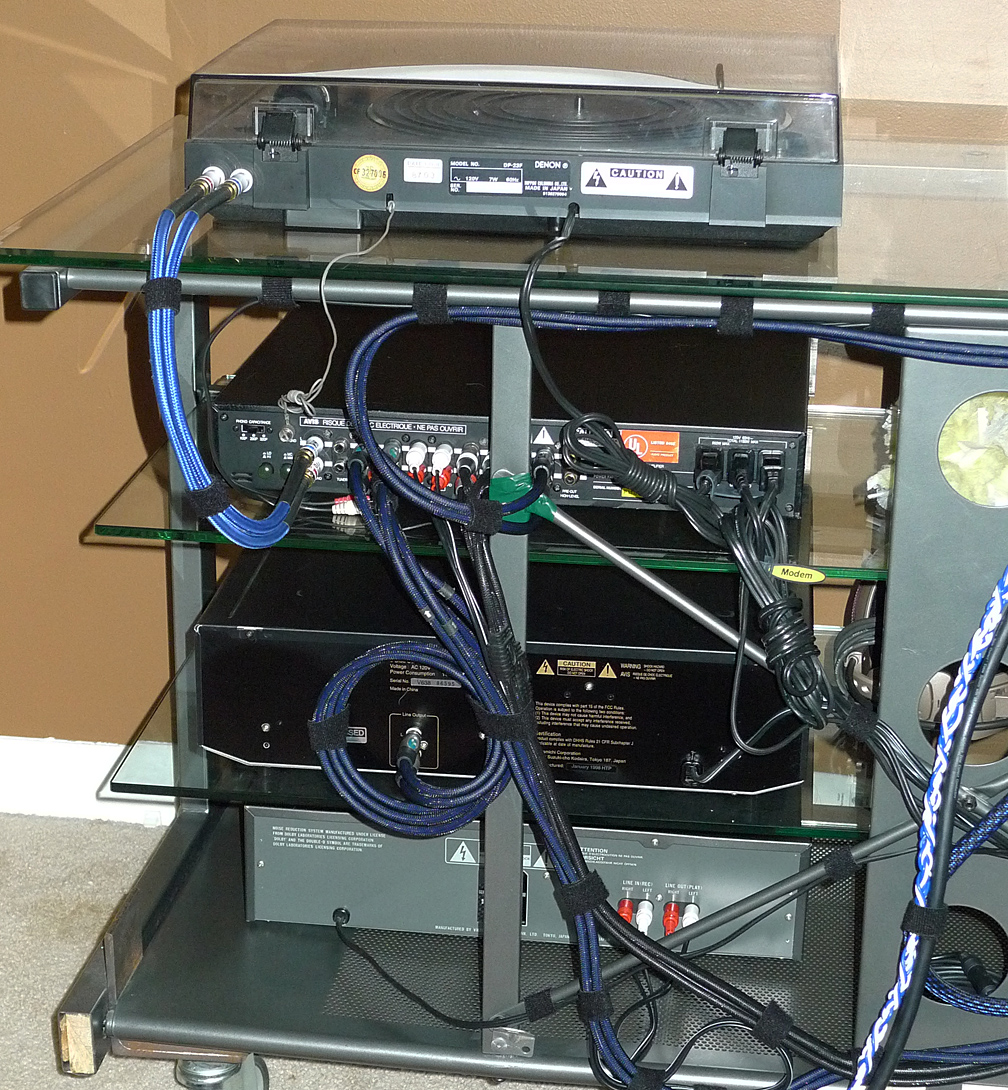
When I have posted pictures of the back of my rack, people freak out. Why? I simply modified the shelf/rack with heavy duty casters. Makes it SO much easier to pull the whole shebang out and work on it, or in my case, redo everything! Than any other possible method of getting back there.
Light blue cables are all I have left of the plethora of Liberty Cables Z-500 units I once employed. Darker blue ones are Monster Cable models, but I don't recall which ones. Thick black ones are another brand, I can't recall which. They are the "Tape 2" in and out connections to the TDK CD recorder. And for the cassette is two pairs of "cheap" cables I had to buy to use the Dynaco PAT-5 since they made it with all the RCA terminals so close together. The two that are looped are a digital coaxial and toslink optical cables from the OPPO to the TDK recorder. I know that I don't need both, but I had them, so why not plug them both in.
Thick power cables are PANGEA brand AC-14s. The blue one to the Dynaco is their standard one and the grey-ish one to the OPPO is an AC-14SE model. While it looks like the speaker cables are Velcro-tied to the power amps AC cable, they are not. It is what I term "An optical delusion".
I am very strict about keeping AC cabling separated from signal cabling. Makes a difference and this double-sided Velcro stuff is terrific for organizing everything.
Should you choose to take a closer look at the setup, below are both halves for your further inspection. OH, one thing, since the 1100 preamp has only one PHONO input, I keep the LUXMAN's RCA cables unplugged. Should I wish to use it, I simply unplug the blue ones and plug in the thin ones. The PD264 actually ADDS the 60Hz hum if I attach the ground wire to the preamp! Weird, right? But true.

And below, is a closer view of the front. Note my complete vintage Discwasher record cleaning kit plus the two additional pads for rinse and dry. I only use them for dirty records. If they are just dusty, the Swiffer 360 does the trick in removing all the dust.
The thick black speaker cables are Monster Cable Z-Series and go to the Klipsch KG4 speakers. The braided blue and white are BLE Design units that go to the Dynaco A25XL speakers. I have removed the now-unused gold-tone hooks (visible in topmost photo) from the chair rail since they are no longer needed.  
Whether there is anything to it or not, I choose to keep the speaker cables off the floor. I don't go into the snake-oil "cable elevators" or whatever they call the silly things that keep cables off the carpet, though!
Above, we have the PROTON AI-3000 II all-in-one receiver occupying the top shelf next to the CPU that once held my EPSON scanner. It now rests atop the HP printer. I prefer a separate scanner and printer because stand-alone units tend to do a much better job than all-in-one scanner/printers.

I put a steel dipole FM antenna on a mast that rises above the peak of the roof. I have an inline signal amplifier that between the two really pull in distant FM stations. Plus, it is a good enough antenna for a small digital TV my wife has in HER home office down the hall. Great HD picture! 
Speaking of a great picture, my wife is seen below the painting in the photo below to the left of my oldest daughter. She is also partially seen in a photo on the right side too.
Finally, the last photo shows the BOSE 301 Series V speakers my wife bought for me several years ago. I added three-way binding/banana terminals to them and mounted them with flat screen monitor-type brackets.   This allows them to be adjusted in many directions. Being up high, they really sound great.
Not seen are the large Cerwin-Vega! LS-12 floor standing speakers. I am using the umbilical cord cables from the 3000 to the speaker switch and from there to the BOSE are the pink (Why pink?) Monster Cable speaker cables. To the C-Vs are the smaller BLE Design braided cables.

One last thing, is the SONY HD Radio that I removed to make way for the changes in here. I was an early adopter of HD Radio. I bought car stereos (remember when you could replace your car stereo with a better one?) equipped with HD Radio and a home stereo tuner with HD Radio. The side channels, similar to the side TV channels one can get over the air, are wonderful. I haven't decided what to do with the SONY yet.

Whew! That was a lot of work yesterday. But I am super pleased. Having the 3000 right next to me allows me to reach and turn down the volume should the phone ring. Plus, it encourages me to use these speakers more that I used to.

Thanks for looking,

Scott
November 11, 2017 

Complete Redo of the Stereo System! What, again? Yes, again!

Gentle reader,

Firstly, thank you SO MUCH for taking the time to read my blog. It is SO wonderful to have readers that GET me!

Yes, I know that just two days ago, I completely redid the stereo system. But, in my defense, I did intimate that I would probably make some more changes in the future. I just didn't think it would be this soon. Either.

Plus, with all the work I'm doing fixing the house up. Well, you know me, being slightly OCD, I couldn't stand to have something not working. I mean, I TOLD you I discovered the left channel of the Dynaco PAT-5's phono section suddenly stopped working. I also told you my work around.

Well, it wasn't right to have this fifty year old once state-of-the-art preamplifier sitting there just being used as a speaker selector. 

Here's the real issue, ever since I put the LUXMAN PD264 turntable on that wall shelf, and mounted the solo Dynaco A25 speaker beneath it, that .5 system was suffering from serious acoustic feedback. I couldn't play records very loud.

So, it occurred to me, "Duh, the turntable AND speaker shelf are screwed to the same stud!" I thought that was the problem. So, I took the folding shelf and the speaker shelf off the wall, and as you can see, moved the LUXMAN to the components shelf. 

Well, you won't believe it, there is STILL feedback! I thought about it some more, and concluded that since the all-in-one PROTON AI-3000 II has NO infrasonic (rumble) filter, that MUST be the problem. See, the PAT-5 preamp has one and the PROTON 1100 preamp has one, but the PROTON D540 integrated amp does not either. So, I plugged the LUXMAN turntable into the D540 and tried it. No feedback. "A-HA!". OR so I thought.

Not so fast. The problem was NOT solved. You see, I plugged the LUXMAN turntable BACK into the "3000" and tried it again. Feedback was still there. Then I looked at the tone controls. I tried reducing the bass level. Feedback went away, until I started adding back bass.

And yes, I did add sorbothane feet to the turntable. Made not one whit of a difference! SO, I concluded that the PD264 is PRONE to acoustic feedback. Unless there is a rumble filter.
So, anyway, how does it look? Yes, you are right, MUCH better. No longer overcrowded, like when it was 2.5 stereos on one rack. And yes, there is a certain symmetry to it as well. Yes, there is more "air" around it too. Space between the rack and the speakers. Thanks for saying so. I feel better. Oh, you want to know what were the changes I made?
First off, did you notice that I once again have two Adcom ACE-515 power conditioners? Yes, I did sell the second one, but that was years ago. You still remember that? Sheesh! I did buy a second one. Blah, blah, blah. ANYway, above is the stack of components that I have reintroduced. 
They are: Bottom to top, just to be different, the aforementioned ACE-515, actually that one is the one I've had for years. As I mentioned last time. I really want to be able to record CDs, so added the TDK recorder back in. The OPPO universal player sits upon it as the ONLY digital source for the second, (yes, I still have TWO systems!) stereo. Above that is the PROTON D540 I mentioned. The Denon turntable is connected to it as is the JVC cassette deck. What JVC? See below.
 
Above, is the right stack. The new-to-me ACE-515 supplies this stack's clean AC power. The PROTON AI-3000 II that I am still excited about and very pleased with the sound. Above that is the JVC cassette deck that is hooked to the LEFT stack, since the "3000" has it's own, built in. The LUXMAN turntable is attached to the "3000". I just have to remember to turn down the bass when using it!
Above is the left channel's speakers. The Klipsch KG4s are driven by the 3000, the Dynaco A25XLs are driven by the D540.
Above is the right channel's speakers. And yes, that fan IS new as is a FEMALE Japanese Samurai "action figure". Not shown, obviously. More on those in a future post. I cleaned a lot of the dirt off this A25XL's woofer, but it is still somewhat dirty.

One other thing: I have moved the speaker switch to the top shelf, between the turntables. the D540 supplies it. I replaced the grey (or is it gray?) Monster Cable M-Series short cables with the better (and longer) Monster Cable Z-Series cables. Doing so reminded me what is annoying about the PROTON D540: the non-banana speaker terminals. Oh, they LOOK like they accept bananas. Don't let them fool you. They do not. So, I carefully stripped the Z-cables and equally carefully pried apart the two sizes of copper wiring so that I could snip off the "flux tube" inside each. Then I inserted them into to bare-wires-only holes and tightened them within a millimeter of their lives.
So here is what's leftover. My four former-Minimus speakers, my solo Dynaco A25 ( I KNOW what you're thinking, "What about having a 'mono only' system?") the SWTPC stereo power amplifier, the crippled Dynaco PAT-5 preamplifier, The PROTON 1100 preamplifier, the Nakamichi CD changer (love it!) the OTHER "3000" with the non-functioning CD player, the Panor-era Dynaco ST-200 power amplifier and the 12" subwoofer.

So, did you figure it out yet? C'mon, I've given you all kinds of clues! Give up? For the first time in YEARS, I am not using a separate preamp and power amp. PLUS, NO Dynaco components (except the speakers, they don't count) either! What has become of me? If Amy Farah-Fowler were real, she might be considering taking out my brain and examining it. I suspect my wife has thought the same thing. Which is why I no longer mention the changes I've made to the stereo system.

Thanks for looking,

Scott 

Trying the minimalist route: PROTON AI-3000 II All-in-one Stereo Reciever and NOTHING ELSE!

Gentle reader,

Yes, it has been a long time since my last post. I've been incredibly busy remodeling our house. So, busy, it seems like that is all I ever do.

As you know, I have become a PROTON audio fan since buying my first D540 integrated amp some time ago. In fact, I've been compiling images from various sources of the many home audio equipment they made back in the day.

One component in particular has intrigued me. They made an all-in-one stereo: Stereo receiver with the usual AM/FM tuner, albeit, this tuner is supposed to be incredible. Plus they built in a fine CD player AND a cassette deck too. All in one, well not compact, it's quite large and heavy, but it is less than the standard 17" width.

In fact, they made three models, first was the AI-3000. It was made from 1988 to 1990 and retailed for $1250. Making it the most expensive PROTON product one could buy. It included two matching speakers. But I have read the speakers aren't that good. Next came the AI-3000 II, although my Orion Audio Blue Book also lists an AI-3000 IIS as well. Whether that is a typo, I do not know, but no information was found on an "S" model. The II came out in 1991 and was made for two years. The book lists a third called AI-3200, which were from 1992 to 1994.
Almost every photo of these I have seen, the door that flips down is missing. The few, that have them, the sellers wants a LOT more money for. For a friggin' piece of plastic?

This is actually the second one that I bought. The first arrived having been dropped en route and the CD player wasn't working. Full refund allowed me to buy the one above which is an improved model: Much better CD transport and some added box on the back where the earlier (by serial number) one has a blank back panel. A riddle to as to what lurks within the mysterious back box which can been seen further down in the article.

One thing I wish was different, the cassette deck is auto reverse. Much more convenient for sure, but once you've heard cassettes on a 3-head deck, there's no going back.

As the seller stated, everything DOES work on this one and I have been giving all the circuits a workout.

Here is what the system looked like before I started disassembling it last night:
TWO and a half systems crammed into the rack with TEN speakers available for use. It had gotten crazy. You may recall my quest to reassemble my first stereo from 1976? That plus the addition of a mono channel is the extra system and a half. BELOW is what it looks like now:
HUGE difference, wouldn't you agree? I tell you this, that rack is a whole lot easier to move now! Below are all the components removed, plus in the stack is the other AI-3000 II:
TOP to bottom are: OPPO universal disc player, PROTON preamplifier, TDK CD recorder, which I have yet to use, Nakamichi CD changer, which is AWESOME, PROTON D540 that acted as the mono power amp, PROTON AI-3000 II with the bad CD player that was NOT part of the system, Dynaco power amplifier and the 12" subwoofer that I used to use with the smallest speakers at the top of this electronics totem pole.
I converted the photo above to black and white for fun.
Speakers above, both I have previously written about. They are formerly Radio Shack models called Minimus 7W and Minimus 11. All R/S components are long gone. Well, OK, the woven Kevlar woofers are R/S units from a pair of Optimus speakers that have a huge cult following.
Above are all the various cables not being used at the moment: Three PANGEA AC-14 power cables, one for the subwoofer, one for the Dynaco amp and the darker one is an AC-14SE which is for the OPPO. Next are the Monster Cable Z-Series jumper speaker cables that I have removed from the path from SWTPC amp to Dynaco PAT-5 preamp's speaker selector circuit. Beneath those are the smaller BLE Design braided speaker wires, beneath those are the Seismic Audio speaker cables that I bought to get the 1/4" mono plugs for the SWTPC amp. Next is the pair of digital (one optical, one coaxial) cables that linked the OPPO to the TDK CD recorder. Beneath those are the thick Radio Shack cables that I found and were the analog input cables for the TDK. Next are the 1/2 meter Liberty Cables Z-500 THX Certified cables that were PROTON preamp to Dynaco power amp leads. Beneath them are the Monster Cable (don't remember the model name/number) that served the OPPO and Nakamichi's output to the preamp. Last pile are various other RCA interconnects.

NOW, here is the improved connection intimated above from SWTPC amp to Dynaco preamp:
The foreshortened Seismic Audio cables send the signal to the PAT-5's Amplifier input 3-way binding/banana terminals. The "A" speaker terminals only have the lamp cord mono speaker wire in the left terminals. The Monster Cable Z-Series speaker cables are in the "B" speaker terminals and lead to the AMAZING Dynaco A25XL speakers for stereo duty. And YES, you do NOT see the phono cable plugged in, because it is too short to reach while the rack is this far away from the wall.

This arrangement is so much simpler and more elegant than the monstrosity I had set up prior. WHAT was I thinking? 

Below is the rear of the PROTON AI-3000 II. I added the speaker selector switch box from the previous kit to this so that I can power two sets of speakers with the 3000. The Klipsch KG4s in the listening room and the Cerwin-Vega LS-12s in this room. I've been listening to the C-Vs all day as I've been editing photos and typing this. I think they sound fantastic. Maybe some, or perhaps most Cerwin-Vega speakers are Mid-Fi,  but the LS-12s are Hi-Fi.
The AI-3000 II has two RCA inputs: PHONO and VIDEO, plus PRE-OUT! Yes, my faithful readers, it can also be used as an all-in-one PREAMPLIFIER! Who knew? I have not tried it and wonder if somehow the unit is designed to turn off the power amp portion is plugs are inserted in those terminals? 

YES, there IS the mysterious added on box I told you about. There is some lettering I can see, but it yields no clues.

SO, how do I like the AI-3000 II? Very much indeed. Of course I am using the speakers and cables that I have been using prior, and since those were powered by products from the same factory in Taiwan (the 1990's rebirth of the Dynaco brand, PROTON and NAD were all made there) the sound is quite similar. Very dynamic from records, CDs and even cassettes. 

Now, get this: The maximum output per channel is 22 watts! Yes, that is IT! But remember, the SWTPC amp from the 1970's also only puts out 25 watts per channel. The key to the extreme volume without distortion is the speakers: The Klipsch KG4s and Cerwin-Vega LS-12s are extremely efficient. The more efficient (measured as X decibels from 1 watt (or 2.83 volts) at one meter in an anechoic chamber) the less amplifier power is needed to play very loudly. This is vital for classical orchestral music as the music has tremendous range from quietest to loudest passages.

MY plan is to enjoy this simplified stereo for as long as possible. Eventually, I am going to want to record CDs for instance or listen to SACDs and HDCDs. But in the mean time I plan to enjoy the simplicity of the PROTON AI-3000 II All-in-One receiver.

One problem was discovered in this endeavor: The Dynaco PAT-5 preamplifier's LEFT channel PHONO input has ceased to work! I tried the LUXMAN turntable with the 3000 and both channels work. So, it is the PAT-5 at fault. Sigh. ANY DYNACO fan out there know how to fix it?

Based upon my findings of the one Phono channel input not working, today (the 29th) I pulled the rack out again and disconnected the RCA cables to and from the PAT-5. I moved the power cord for the SWTPC amplifier to the Adcom ACE-515 power conditioner beneath it to the one below the JVC cassette deck. I leave the ACE-515 on the right off, so the PAT-5's passive Speaker connections and switch is still usable. It is not using any AC power at all.

Thanks once again for looking,

Scott

October 26, 2017 
 

PART TWO: What can one do with a single speaker? Why not make a monophonic system! Mono? Sure, Mono LP records!

Gentle reader,

Just yesterday morning, September 24, 2017, I posted the following article: 
The photo above was added on September 27, 2017 to replace the original photo. It features the single Dynaco A25 speaker is now mounted (and secured with Blu Tack) on one of the wall mounted TV shelf. The bracket is similar to what TVs in Hospital rooms once used before the advent of flat screen TVs. 

WHILE it appears that the speaker is tilted to the right, it is not. It's a result of using a wide angle lens. When I first took photos and then looked at them, I thought that it was tilted. So, I pried the speaker off and checked with a level. It IS level. When the speaker is pointed straight ahead, it does not look so tilted.

I have two and they were originally bought to hold the BOSE 301 speakers my wife bought for me.  The image below is from 2010. You can see the "umbilical cord" speaker cables. My wife came up with that moniker. The big speakers are DCM models with 12" woofers. I don't recall the model number.
I removed the large nut that secures platform to the wall bracket. Underneath the large washer seen below. Underneath there are four or five holes that one can choose for tilting the platform and once tightened, it will not slip from your chosen position.
I also rotated the platform so that the folded-up edge is no at the back to stop the speaker from sliding off. 
I don't know if Peerless Industries still makes these wall mounted stands. I was about to add both of them to the to-the-dump things in the back of my pickup and glad I didn't since it solved the slipshod method I'd used for the speaker when it was on the floor.

The photo below was taken without flash because with flash, many components are too bright in some parts and too dark in others. Thus, the "photoshopping" of the image to lighten it has digital noise. Nonetheless, as shown in both photos above, I chose to position the PROTON D540 beneath the wider Dynaco Stereo 200 amp for the simple reason that the ST-200 amp's left channel gets warmer than the right, thus the muffin fan. Plus, the speaker switch is semi-permanently attached to the amp with Blu Tack. So, even though it is wider than the D540, it needs to be on top.

BEFORE I GO FURTHER, THE SOUND is MUCH better than the previous setup. To begin with, I rooted through my wiring drawer and pulled out a section of plain-old lamp cord. Sometimes called zip-cord. About six feet long. For the D540's end I simply stripped it about 1/2 an inch The Nakamichi "bent pin" plugs, while of great quality, stick up above the back of the D540, so I did not use them. The D540's speaker terminals are not banana plug capable. The speaker's end of the cord has a pair of Nakamichi banana plugs. 

There are many that strongly feel and have even done double-blind testing to prove to themselves, that there can be no improvement in the sound of music by replacing inexpensive wires and cables with aftermarket "audiophile" versions. Some have stated to me that they use solid core house wiring, the kind that's inside the walls and ceilings of your house, as speaker wire. That is of course their choice. If they think that is the way to go. More power to them.

In the case of my recreated 1976 stereo and now this mono-only offshoot, I have had to use what I feel are inferior cabling. Yet, it does not sound bad! In the stereo, I am using top-of-the-line Monster Cable Z-Series speaker cables. I KNOW they sound better than almost anything I have tried over the decades. 

Yet the prime example here, I proved to myself with the twisted pair Monster Cable twisted-pair speaker wire, sounded lousy. And the simple lamp-cord wires do not.Who knew?
This photo is a stark contrast in signal carrying choices. The thick, braided THX Certified interconnect cables which tie the PROTON 1100 preamplifier to the Dynaco Stereo 200 power amplifier are within inches of the simple lamp cord that I am using from the PROTON D540 to the solo Dynaco A25 speaker in this monophonic subsystem.

In my task to neatly incorporate the mono amplifier into the already crowded shelves I decided to try something different. At first, as stated in the previous post, I took the signal from the Dynaco PAT-5 preamp (the silver one) OUTPUT 2 terminals to the CD (marked DAD, Digital Audio Disc) inputs of the D540. For this iteration, I decided to take it from the TAPE 2 outputs to the DAD inputs. My thinking was this: the PAT-5 simply converts the weak signal from the turntable and amplifies it to be passed to a power amplifier. Using the tape-outs bypasses any adjustable amplification and/or modification by the PAT-5's controls. This eliminates the volume, balance and tone controls. Thus allowing the D540 to use it's own controls and circuits. In other words, the PAT-5 is a straight wire with gain. The signal from TAPE OUT is of a constant level of volume.

You may be thinking, "Why doesn't he take the cable from the turntable and hook it directly to the D540?" I thought about that, but that would entail reaching around the back of the PAT-5, unplugging the cable by feel, threading it up to the phono inputs on the D540 every time I wanted to play a mono record. Not practical. Plus, I don't have room for yet another turntable.
I mentioned "shorting" plugs, sometimes called "dummy" plugs. Those are the objects plugged into the Phono inputs on the D540. You can see clearly the "cheap" RCA wires here as well.
This photo also contrasts the cheap RCA wires and the when-new expensive Liberty Cable RCA cables. Note also the PANGEA AC-14 power cable that supplies AC power to the Dynaco Stereo 200 power amp. PANGEA products are excellent upgrade items for a tiny fraction of the competition's costs. They perform well and have rave customer reviews.

I've written, in the past, about the connection between NAD, PROTON and the Panor-era Dynaco components as having all been made in the same Taiwanese factory. And that in at least one case and probably more, that certain components were sold with the same model number with either the PROTON or Dynaco nameplate. Look at the two serial number stickers and how the unit's name/number is the beginning of both serial numbers. The fonts are the same and both stickers are yellow. One appears lighter, but they are the same yellow. Coincidence? I think not.

The following photos are shots that show some of my established ways of connecting everything and the choices of cables. The first photo shows what the Legend LE412 speaker switch looks like from the rear. I made changes to it. Originally, all the terminals were like the ones beneath the "Amplifier" label. Note that "R" is on top and "L" below. Well, the terminals, top-to-bottom are the industry standard 3/4" apart to allow use of "double banana" plugs. I rearranged all the wiring and plugs years ago so that red was on top and black on the bottom. Note the double banana plugs in the amplifier inputs. Well, over time and my constantly trying different things, the inexpensive three-way banana-binding posts, that the Legend people chose started breaking. In the past, I replaced them with heavier duty ones. As you can see. Their plastic knobs were to thick to be so close to each other, so I had to make them smaller in diameter. Looks lousy, but it works.

The grey speaker cables are part of the Monster Cable M-Series. This particular series had no markings for polarity. Red Sharpie to the rescue.
Above and closer in the shot below, shows the details of the rear of the Southwest Technical Products Company compact stereo power amplifier. See how they used "phone" (mono headphone/microphone) terminals for the speaker cables? Someone replaced the factory AC cord with the white one in the past, too. Again, the contrast in size of the cheap RCA wires at the left and the thick Liberty ones at the right. Yet both do the same job.

Above is a very clear shot of the rear of the PAT-5 and the cheap RCA wiring. It is patently obvious just how close together the RCA terminals are in this shot.
I should have properly made new cables using the shiny phone plugs soldered directly on the M-C Z Series speaker cables that send the amplified signals from the SWTPC amp to the speaker INPUTS on the PAT-5. But, I was in a hurry to get it together and simply crimp-spiced the two pairs of cables together. I will correct that in the future. 
To take the strain off the phone plugs above and the PAT-5's plugs on the bottom, I decided to support the loops of heavy cabling as you can see with a loop of Velcro-type binding wrap over the framework of the shelves. 
You can see the difference between the well made, attractive and grippy Nakamichi banana plugs and the much simpler (and insulated!) banana plugs from Parts Express. Why Nakamichi chose to make what is normally insulated covering for banana plugs out of metal, I do not know. I found out they are all metal when one channel cut out and I found two Nakamichi plug bodies had briefly touched. Fortunately, the Stereo 200 has high speed circuit breakers that reset themselves after such incidents. I believe the Dynaco PAT-5 is the only preamplifier made to incorporate speaker terminals and switching into a preamplifier. 

A NUMBER OF readers have brought up the question of why I would bother to set up a strictly monophonic system when I can listen to them through two speakers. 

Well, I have over 2000 LP records and a few ten inch and 7 inch ones too. OF that number, over 400 are monophonic. The majority of my Big Band records are mono. Thinks about it, stereo was not commercially available until the late 1950's. So, until then and much later for most people, music coming out of ONE speaker is all those people knew. 

Today, I was picking out Big Band records and listening to them through that one A25 speaker. I was getting into the spirit of the times when that wonderful music was what SO many people listened to. 

So, that is why.

Well, that's it for now. The weekend is over so back to work on redoing the kitchen.

Thanks for looking,

Scott

Earbuds In-Ear Verses Over-Ear Headphones Which Ones Sound Better?

 October 8, 2026 #553 Gentle reader, I have been in the best-sounding-enjoyment-of-recorded-music-I-can-afford, hobby for fifty years. I do ...