Unique PROTON D540 Integrated Amplifier has entered the Listening Room

Gentle reader,

Firstly, (yes, that IS a word) my wonderfully supporting wife will surely be shaking her head as she reads this. If you follow my blog, thank you so much! I have bought, enjoyed and passed on to others a lot (a whole lot!) of audio gear, photography gear, music, well, a lot of things. 

My wife and I both have the collector gene. She doesn't do so much anymore and I definitely have slowed down. Occasionally I will buy something unique, like the Philips speakers and Technics integrated amplifier seen in the last two posts. 

I just finished cleaning out several things and passing them on to others via eBay. The huge and heavy Technics made it safely to New Jersey and the new steward, Ian, is thrilled:

I started my interest in good sounding audio equipment in the mid-1970's. Quadraphonic was all the rage then. What is quadraphonic? It was the precursor to surround sound. Two rear speakers would provide ambiance or maybe other instruments would appear behind you. All I could afford was a cheap system that had a built-in 8-track tape player that also played quad tapes. Electrophonic was the name. At the time that was the only quad format that truly used for separate sound sources. It came with four cheap speakers.

There were competing companies trying to dominate the quadraphonic scene: SQ, QS, EV, CD-4 and DY. The last was Dyanco's answer to fancy circuits. Sansui's format prevailed in that Dolby used their form of quad decoding to come out with Dolby Pro Logic for movie sound.

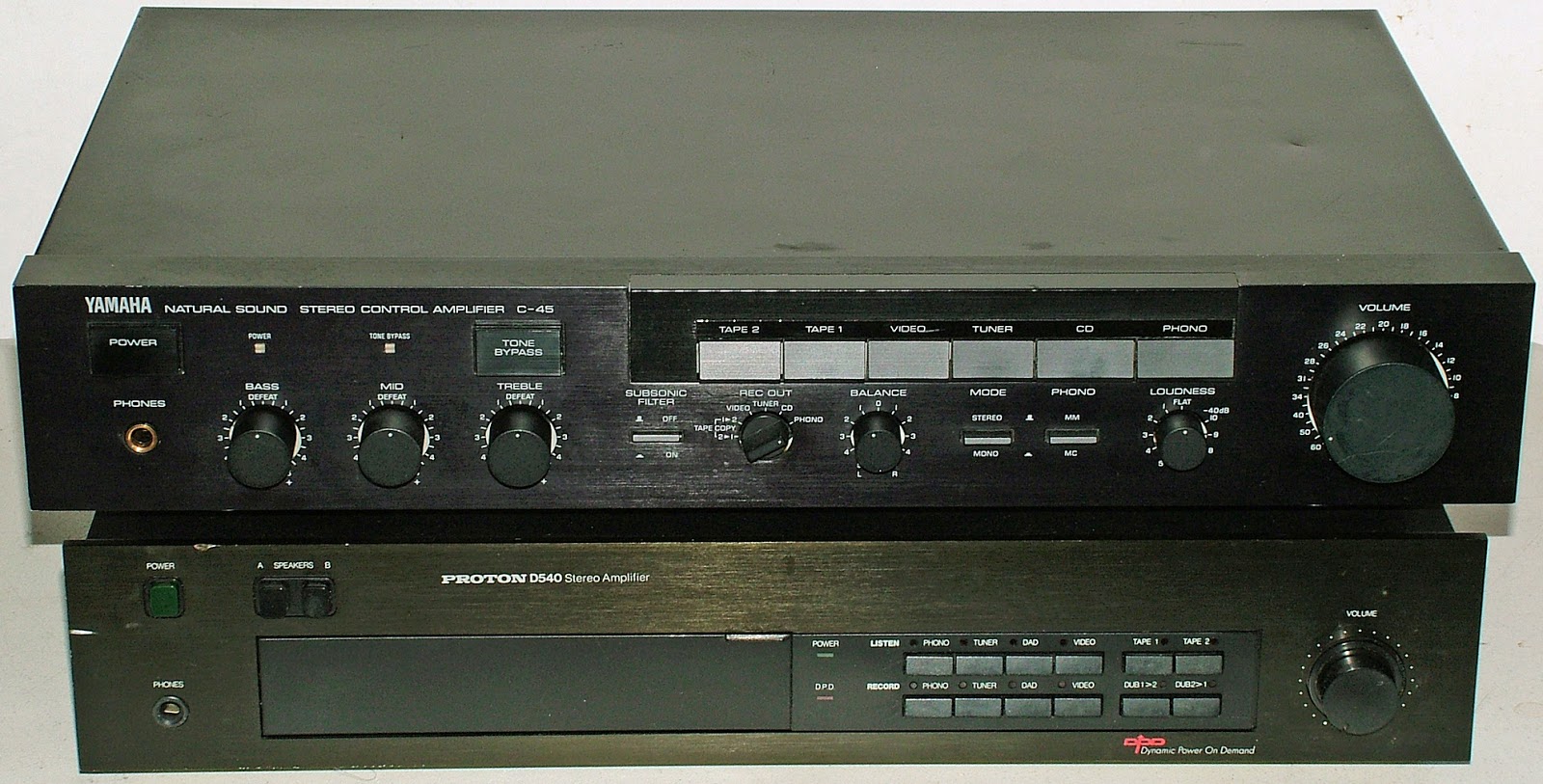
Below shows the new-to-me PROTON D540 amplifier beneath the YAMAHA  C-45 preamplifier I've been enjoying for a while now.
One more thing about quadraphonic sound. Long ago, I came across a massive Sansui quad receiver at a thrift store and bought it. We used it with our VHS player as a surround sound provider and it decoded the sound perfectly. We were in awe watching Operation Dumbo, I think it was called. A Viet Nam gun boat was chasing the hero and the elephant in a boat (hey it was Disney and the 1980's) they fired and we heard the boom and the shell flying over our heads. It was AWESOME! From then on I was going to have a theater-like experience when watching a movie. Here is a Sansui similar to the one we had:
Back to the story. Once I started making money at my first job, I was an apprentice car mechanic at a Mobil station in Denver, Colorado. I started researching what kind/brand of electronics I wanted. 

Kids, believe it or not, back then, there was NO Internet (at least for ordinary people), no cell phones, no Google. What did one do? Went to the library. Read magazines about your interest.  Asked around. But mostly, we went to the library. I settled upon Dynaco for the preamplifier and another company (based upon price) for the power amplifiers. 

Still with me? MANY years later, I found a Dynaco A/V receiver. Here is is:
It was unlike any Dynaco component I had ever seen. So, thanks to the Internet, I was able to determine that it was in fact a PROTON component sold as a Dynaco. The PROTON model was AVS-2583. Other than the name, they were identical. What's called "Badge Engineering" in the automotive world. 

That's when I found thought that PANOR was possibly part of PROTON. Or the other way around. I have yest to find the connection. PANOR bought the rights to the Dynaco name and began making audiophile quality tube and transistor stereo components and their own updated versions of Dynaquad:

I had enlarged the spring terminals to accept banana plugs. I hate spring terminals. Only the cheapest equipment has them for speakers. Dynaco came out with a better version that had all three-way binding/banana post terminals.

PANOR made tube preamplifier and one transistor model called the PAT-6. My original 1970's preamp was a PAT-5. The PAT-6 also has a tuner in it. It has only a few inputs and I need at least five, six is better. So the PAT-6 was out.

So that got me to thinking. My power amplifier, as you know, is a 1990's Dynaco Stereo 200. It was made by PANOR and is the same size as their top-of-the-line Stereo 400 and actually was more useful. Perhaps there was a PROTON preamplifier from the same era that I could buy and try out.     

Well, I don't think PANOR made a preamplifier,* but they did make some integrated amplifiers that contained "Pre-Out, Main-In" RCA terminals. My research revealed the model D540 would fit the bill. First off, here is a link to a site that has some history of PROTON:
*Until I found this site, which lists a preamplifier, that is. It is called A-1000, there is also an 1100 and they are quite rare. 
I chose to make this picture large so you can see the different approaches each maker chose for the front panel/controls. The PROTON is almost plain in execution. See that DPD symbol on it on the right side? That something PROTON came up with. I have a contemporary review from Stereo Review magazine by Julian Hirsch which completely explains the way it works He said, "The Proton D540 is not only the most powerful '40-watt' amplifier we have used, it is one of the few of any rating whose capabilities begin to encompass the dynamic properties of live music."

Found this: "Winner of the 1987 Audio/Video International Magazine Hi-Fi Grand Prix Award." on this site:
Proton D-540 solid state amplifier

Here's a link to a brief review:

They designed the power amplifier section with two transformers and sets of capacitors. In normal operation it is Class A. When a crescendo (I love that word, say it out loud: cre-shen-doe) happens, super-high-speed switches cut in the second transformer and it provides the needed power, up to 150 watts into 8 ohms, 280 into 4 ohms and a staggering 530 watts into a 2, yes a TWO ohm load! It will last up to 1/2 second! It revolutionized audio thinking. Hirsch concluded that this design practically negated the need for large heavy expensive and power hungry amplifiers. It was more than capable of meeting 99% of music needs for a fraction of the size, weight and price of far more powerful amps.

But, I bought it as a preamplifier. Some more photos of both front and rear:
The less often used controls are behind the door on the front. BTW, I bought the original owner's manual from the same seller. Very glad I did because there was much to learn.
Above shows their different approaches to choosing what can be recorded while listening to something else. Yamaha: a small knob, PROTON: duplicate push buttons. My Adcom GFP-565 preamplifier used identical large knobs side-by-side to accomplish the same task.
The smaller sized PROTON, which is much heavier contains all that the larger Yamaha has PLUS all the power amplifier components too. Their unique design shrunk the normal component's footprint.
Only the Phono inputs are gold plated on the D540. 
These speaker terminals, which at a glance look like three-way binding/banana posts are in fact just like the Technics: For bare wire only.
ABOVE are the terminals I told you about. Those U shaped metal pieces connect preamp to power amp. A.C.C stands for Anti Clipping Circuit, since CDs can contain much more sound energy than the average LP, they added this protective feature. Just in case. The Bridging switch allows one to make the stereo power circuits to act as one much more powerful mono amp. 
Note the choices of turntable cartridge it provides for: Moving Coil; high and low output. Moving Magnet three levels of capacitance. While the Yamaha has the former, it does not have the latter.
The manual tells one to put "shorting" RCA plugs into the MAIN-IN terminals so the power amplifier circuit will not turn on. I'd sees the things before (LONG ago) but did not know their name or what they were for. The Technics had them in the Phono inputs and I kept them. Little did I know that a couple weeks later they would be needed.

I used contact cleaner spray on all the external connections which is why it looks like something wet got on the rear panel. It did.

Now, the sound? I do not claim to have "golden ears" but my humble ears have quickly decided that this PROTON D540 sounds phenomenal. I glad I took the advise of someone posting on an audio website's advice to buy a PROTON.

Back to the Dynaco-PROTON connection. After an exhaustive search, I found a connection, at least as far as the golden 2583 A/V integrated five-channel amplifier goes. I have been finding a LOT of pictures of PROTON equipment. It has got me to thinking, new research project, maybe?

Some web sites state that the PROTON factory in Taiwan also made NAD components. Both the PROTON D540 and Dynaco Stereo 200 have very similar black anodized aluminum face plates.
And here they all are "in situ" as the Latin once said:

I'll hang on to the C-45 for a while. But once again, the D540 is definitely a keeper.

Thanks for looking!

Scott

PS The page view number is quickly closing in on 100,000!

Amazing Philips Speakers: Model MCD908. Beautiful, well designed and awesome sounding!

Gentle reader,

Mere weeks after finding the super-rare-in-the-USA, Technics integrated amplifier of which I blogged last about, a second trip to the same source yielded a gorgeous pair of speakers made by Philips, a world renowned electronics maker and more. Also, co-creator along with SONY of the Compact Disc and Super Audio CD, plus so much more.

These are a vital part of Philips MCD908/37 audio/video system which combines a tube preamplifier with a Class D digital power amplifier to provide audiophile quality sound and movie viewing with a classic look. Here is their own site touting it:

Well, a perusal of various audio and video sites give mixed reviews of the electronics portion of the system, but rave reviews of the speakers. One fellow wrote something along the lines of; forget the stereo, but get the speakers! I did not put quotes around that statement because it is an approximation of what he wrote. I'm using all kinds of cool words today, aren't I?

As you no doubt know if you follow my blog, I am in love with the tiny wooden speakers that were once Radio Shack's Minimus 7W models. I made a couple posts about the task of upgrading them with everything going except the cabinets. 

Well, let me tell you, when I A/B compared those beloved little speakers to these gorgeous Philips MCD908 models, the latter blew them out of the water. I was shocked, shocked (!) at how amazing these Philips sound and yet saddened that my precious little speakers have been overthrown so easily by these newcomer upstarts!
But all is not lost!  No, it is not. For I have decided to operate the little ones with their woven Kevlar mid-bass drivers and Folded-Motion-Transformer ribbon tweeters in series with the subwoofer.  Below, since I couldn't quickly locate a photo of the rear of this subwoofer, is a picture of a JBL one I once owned:
The way that works is one connects speaker cables from their receiver/amplifier to the high level in as seen above. The sub's amplifier separates the bass signals below the frequency you chose so that it, and only it, reproduces that musical section of the total frequencies of the music or movie soundtrack. Every frequency (sound) above that cutoff is sent through the high level out terminals to the left and right speakers. Combined, hopefully, is a seamless sound. Your small front speakers and amplifier is spared the work needed to reproduce bass notes/sounds they cannot deliver. Thus the subwoofer with it's own amplifier designed to ONLY produce low sounds does just that and the other (front or stereo) speakers put out all the other higher notes/sound/dialog.

Now you may be thinking, "Wait a minute, what about those huge Cerwin-Vega speakers, didn't you just go to all the trouble of reintroducing them into the system?" Right you are and I congratulate and thank you for paying attention.

Yes, those large LS-12 Cerwin-Vega speakers with their signature red woofer surrounds. I have moved them aside, I have done this before. I admit I am toying with the idea of perhaps, oh, I don't know, maybe thinking about, uh, selling them. "What?" you may be thinking, "But you always wanted some Cerwin-Vega speakers as every fan of big speakers does!" Right you are. Again. They are safe for now and merely are facing the walls to prevent Mo the cat from sharpening his claws upon their grilles. One of the reasons I do not use grilles on my speakers.

So, anyway, here are two photos of the den system as it stands today. Why two? The first was taken with my Nikon DSLR with powerful flash bouncing off the ceiling. The other with my venerable Fujifilm FinePix  S7000 which has such fantastic macro abilities using it's pop-up, much smaller flash. Which do you prefer?
 Big difference in the images, don't you think?
Anywho, or is it, anyhoo? Spell check doesn't like either of them. Huh? What did you say, the word is: 'anyhow'? Why right you are. Moving on. Here are the speakers as imaged by the Fuji S7000. 

Their front and side faces are high gloss rosewood. The top piece is 1/4" thick dark tinted poly-carbonate, such as Lexan brand. No rings from someone setting their drink on top of a speaker here. No sir, well done. Also, the bottoms are flat black painted with built-in rubber feet.
 Left pair above, right pair below. Note the curved cabinets.
 From the rear. Proper three-way binding/banana terminals. 
Now a more exact detailing of these speakers, which are definitely keepers. Specs from the Philips link above reads: "3 way, Ribbon tweeter, Dome mid range, 5" woofer, Gold-plate (sic) speaker connectors, Speaker grilles detachable".

No further information from their site. The sound is rich and detailed with surprisingly deep bass output. The small dome speaker is actually a mid-range/tweeter with the ribbon tweeters actually being "super-tweeters". Being 60, I have sadly lost the ability to hear the higher frequencies, but what I do hear blew me (and my little wooden creations) away!

So, these are definite keepers. Sound aside, they are very attractive too. What happened to the rest of the components? I have no idea. While I would like to have a tube amplifier, they are way above my price range for either vintage or new stuff which is still being made and sold to this day.

As I noted above, I have wired the subwoofer to work as designed. I used the black Monster Cable Z-Series from the "B" terminals (bottom ones) on the Dynaco Stereo 200 power amplifier. 
But first, I reconfigured the gray (Monster Cable M-Series) jumpers with the Monster Cable dual-banana plugs being plugged directly into the "B" terminals and the shorter black Z-Series cables plugged into those bananas. The other end of those jumpers plug into the inputs of my speaker switch. Note the #1 outputs are empty. So theoretically, I can plug the Cerwin-Vega LS-12s or other speakers into them without disturbing any other cables/plugs.
The other end of the shorter Z-Series cables plug into the high level inputs on the subwoofer. The longer Z-Series cables are plugged into the subwoofer high level outputs. The other ends being plugged into the little wooden speakers. Thus the burden of deeper music is removed from the small speakers and handled by the subwoofer. 
Whew! I actually strained my lower back rewiring this whole setup by sitting on the subwoofer and trying to work sideways. 

On another note, our daughter offered us their oldest flat screen TV seen below which is a Panasonic 42" plasma unit to us when I mentioned one of the things preventing me from buying an XBox One is the 32" Samsung I was using had inoperative HDMI input. 
The nice thing about it, besides it's being free is the larger image looks correct as far as scale, and the steering wheel as seen from my perspective lines up perfectly with my wheel. Pretty cool. Plus, It's easier to get into and out of the racing seat and I have more shoulder room. Can't get to the window anymore. A small price to pay. Image is great. Sound output is HDMI only, so I bought a small DAC converter that inputs HDMI digital and outputs analog stereo sound and composite video. The latter is unused. That way, I can soon use the seat's built-in sound system.
The scene above is at the start/finish line at the Nurburgring in Germany. I am "in" my Ferrari F-40. I chose yellow, as so many Ferrari cars are painted red.

Finally, below is the Technics SU-VX800 is for sale on eBay. Here is a link to it as of today's date of January 22, 2017. Restored Technics® SU-VX800 Integrated Amplifier XLR, Phono: MM/MC Class AA | eBay
Thanks for looking. I hope I didn't confuse you too much. 

Scott 

Rare in the US: Vintage Technics SU-VX800 200 watt Integrated Stereo Amplifier

Gentle reader,

You may find it strange what I am about to tell you. Sometimes I get a thought, I call it "a little voice" that tells me to do something. Experience has shown that if I listen to that "voice" and do what it suggests, good things happen. Such as I hear on the traffic report, moments after taking an exit earlier than my normal one, I hear on the traffic report about a huge backup that begins just down the highway. If I ignore it's suggestions, I quickly realize it. I could tell you many other examples. Am I crazy? No I prefer to think it is a guardian angel.

That being said, that voice suggested that I stop at Goodwill. I deliberately have gotten out of the fun, but sometimes expensive, habit of touring thrift stores many days of every week. I have PLENTY of records and CDs. I am very happy with my sound system. Do I really want to fill our house with other peoples stuff? But, I know about that voice. When I ignore it's suggestions, I soon regret it.

So, I did stop and shop. I always head to the electronics department first. First look around, I didn't see it. Then it caught my eye. It's an integrated amp that I have never seen before. Made by Technics, a company that is once again building nice equipment to get back into the market it once did so well in. Model number is SU-VX800. A big and heavy beast with lots of knobs and switches and no cheap spring terminals on the back for the speakers.
My ORION AUDIO BLUE BOOK states that is was made in 1991 and 1992. It states the watts-per-channel at 125. Also refers to it as a "MILITARY" UNIT. It retailed for $320 when new. On the front it has "Class AA". Supposedly Class A is the highest quality of sound. So this must exceed that! I will see about that.

This link will take you to HiFi Engine's page about it:
Technics SU-VX800 - Manual - Stereo Integrated Amplifier - HiFi Engine

Specifications

Power output: 110 watts per channel into 8Ω (stereo)
Frequency response: 20Hz to 20kHz
Total harmonic distortion: 0.007%
Damping factor: 80
Input sensitivity: 0.25mV (MC), 2.5mV (MM), 150mV (line)
Signal to noise ratio: 67dB (MC), 79dB (MM), 100dB (line)
Channel separation: 50dB (line)
Output: 150mV (line)
Speaker load impedance: 4Ω to 16Ω
Dimensions: 430 x 158 x 429mm
Weight: 17kg
Year: 1991
Price: GBP £450 (1991)

Note the price above? All the units I found for sale on eBay and other sites are NOT in the United States. So how this baby ended up here, I do not know. But I'm glad it did. Frankly, I've been feeling the itch for something new to play with and this one fit the bill. Note also that one can choose between a moving magnet and a moving coil cartridge for their turntable with this unit.

It was quite dirty inside and out and an odd color, not black, nor certainly not OD green (military color) either, but somewhere in between. I still had in my bag in the car my "testing equipment" which is: cassette tape, RCA stereo interconnects cables and two speaker wires. With those, I can test most audio related things I come across. They had a nice (and overpriced) cassette deck there and plenty of speakers to choose from. Like a lot of the nicer equipment, this one has features that one has to decode to figure out why there is no sound. This I did and found both channels and several inputs worked although scratchy sometimes. Nothing some contact cleaner couldn't clear up. Here's what the back looked like:
Sadly, the speaker terminals are not banana plug accepting ones.
Yep, missing a foot.
 Made in Japan, not elsewhere, like China.
 Yes, those are XLR inputs! My first. Those funny looking things in the phono inputs are plugs.
Here's an odd feature: AC inlets and outlets directly above the speaker terminals. What were they thinking? A removable AC cord/cable and adjustable voltage makes it more versatile for use in many countries around the world. Of course, those ARE USA type AC outlets, however.

It took it apart to see what's inside and to clean it inside and out. I can't locate my contact cleaner designed for audio equipment, so will have to get some. And a foot or feet too.
The contact cleaner I do have, tried to remove the black on the sticker atop the large and heavy transformer above and below. Serious aluminum heat sink for the power transistors. 
Check out the copper on the transformer. Me thinks that is for show.
Here's a close-up of those large power capacitors:
Dirt on electronics, especially circuit boards can be difficult to remove.
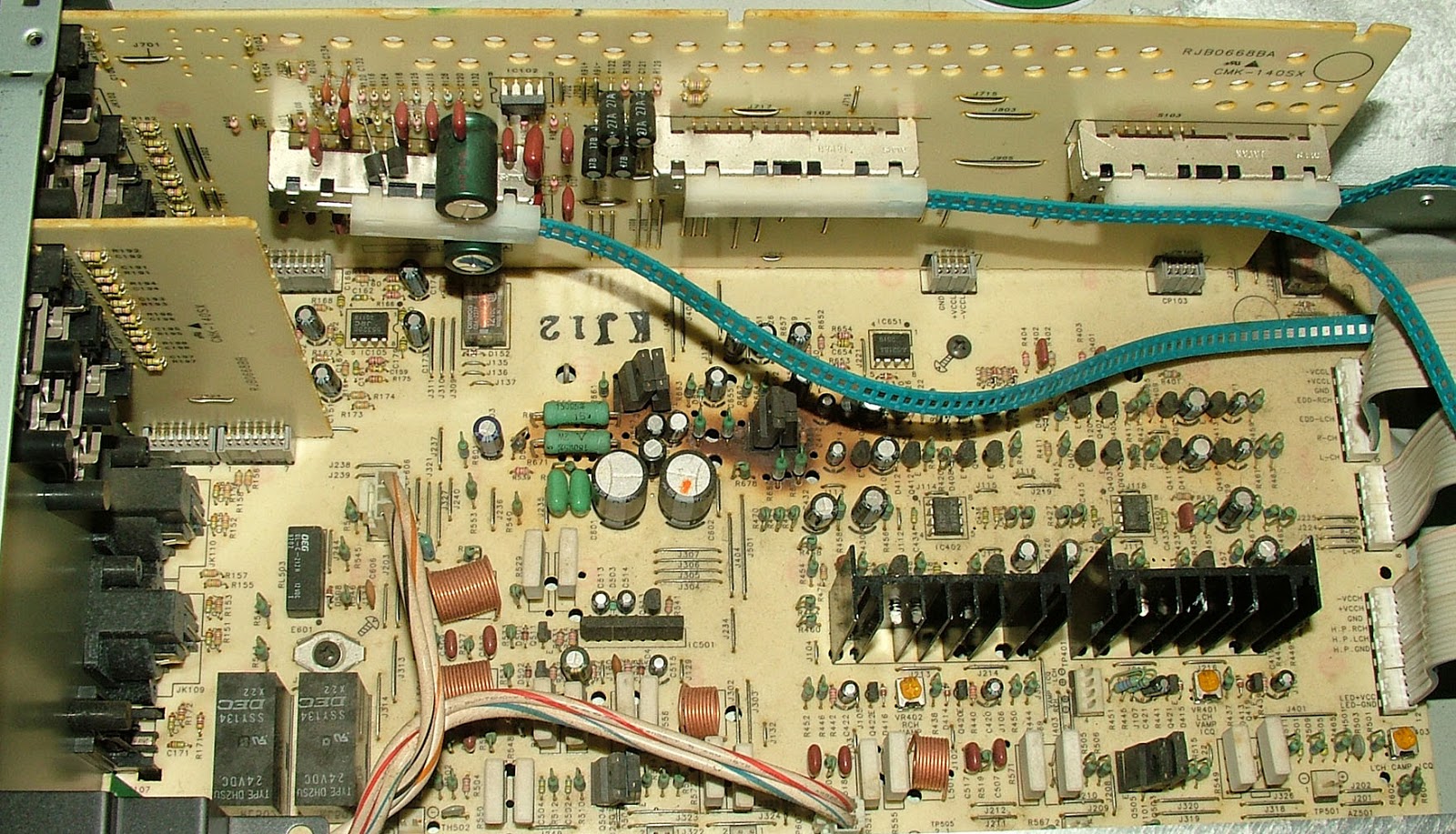
An odd thing is the obviously overheated section around two upright transistors. Whatever they do, if it is in fact damage, doesn't affect anything I have found so far. Perhaps previously repaired.
Below are photos of it now nice and clean and back together. I removed the Dynaco power amplifier (and all the accoutrements I had atop it) and placed this heavy and large beast in it's place.
The volume and big switch knobs are solid metal. The smaller five are plastic. I removed all eight and cleaned them too.
I made the photo above full sized so you can see all the choices one has on the front. Extended Direct Drive is for choosing a source plugged into either the XLR or RCA terminals. What it does exactly, I do not know. I plugged my OPPO into those RCAs and played a SACD and boy did it sound great! Unless playing through those press that button until the LEDs go out and select your source from the far right knob. Neat that one can record one source while listening to another one.

Many of today's high end audio products have XLR inputs and outputs.
Built in bi-wiring ability. Very nice.

Above and below shows the factory thin AC cord and a nice adapter that allows one to use an aftermarket "audiophile" power cable instead. Which is what I did.

So, here it is "in situ" as the Latin states. I was switching from phono to CD to E.D.D which were each playing music. I've been using it all day and aside from an occasional scratchy sound, it sounds, wait for it, fantastic! 
Above you can see the oddness of the AC on top of the speaker terminals. One must use only bare wires for the speakers. I'd love to replace them with proper three-way binding/banana terminals. And yes, I did see the right phono plug is not completely plugged in. It is now.
You can more clearly see the Pangea AC-14 power cable plugged into the adapter in the photo above. I have not tried the stock, skinny cord except in the store. 

UPDATE: I have completed the restoration. All electrical contact locations, controls and all surfaces inside and out have been cleaned with various chemicals and lubed if needed. I ordered new feet from China and they arrived today. The completed beast is below:
 

Conclusions: I could live comfortably with this fine amplifier. However, I love my Yamaha/Dynaco pre/power amplifier combination and their sound, power and versatility. This Technics SU-VX800 Integrated Stereo Amplifier is big, heavy and packs a clean and powerful punch. I plan on enjoying it for quite a while before passing it on to it's next steward.

Steward? Yes, since we only live on this earth for a short while, we never actually "own" anything. Especially land. Therefore, I feel we are simply taking care of things which we acquire in our lifetime. Most things, "durable" items included like cars, are made, sold, bought and if not wrecked, eventually recycled into new cars. 
That being said, special things, such as cars, cameras, electronics, watches, artwork, and jewelry and other things that might hold or exceed their original cost should be passed on. Thus I feel strongly about taking care of things that I have and do nothing to them that could not be undone later on. I take my stewardship seriously.

Thanks for looking!

Scott
 

I bought a NEW Yamaha CD Player! Build Date of April, 2026. Check it Out!

  August 19, 2026 #551 Gentle reader, Most of you are aware that I have been in the home audio hobby for fifty years now. Thanks to the thri...