JBL Subwoofer and rewired with Monsters, again!


Gentle reader,

WOW! Over 45,000 page views! I SO appreciate you're taking the time to read about my obsessions, I mean collections! "Yeah, that's the ticket!" Quote from the liar on Saturday Night Live a L-O-N-G time ago.

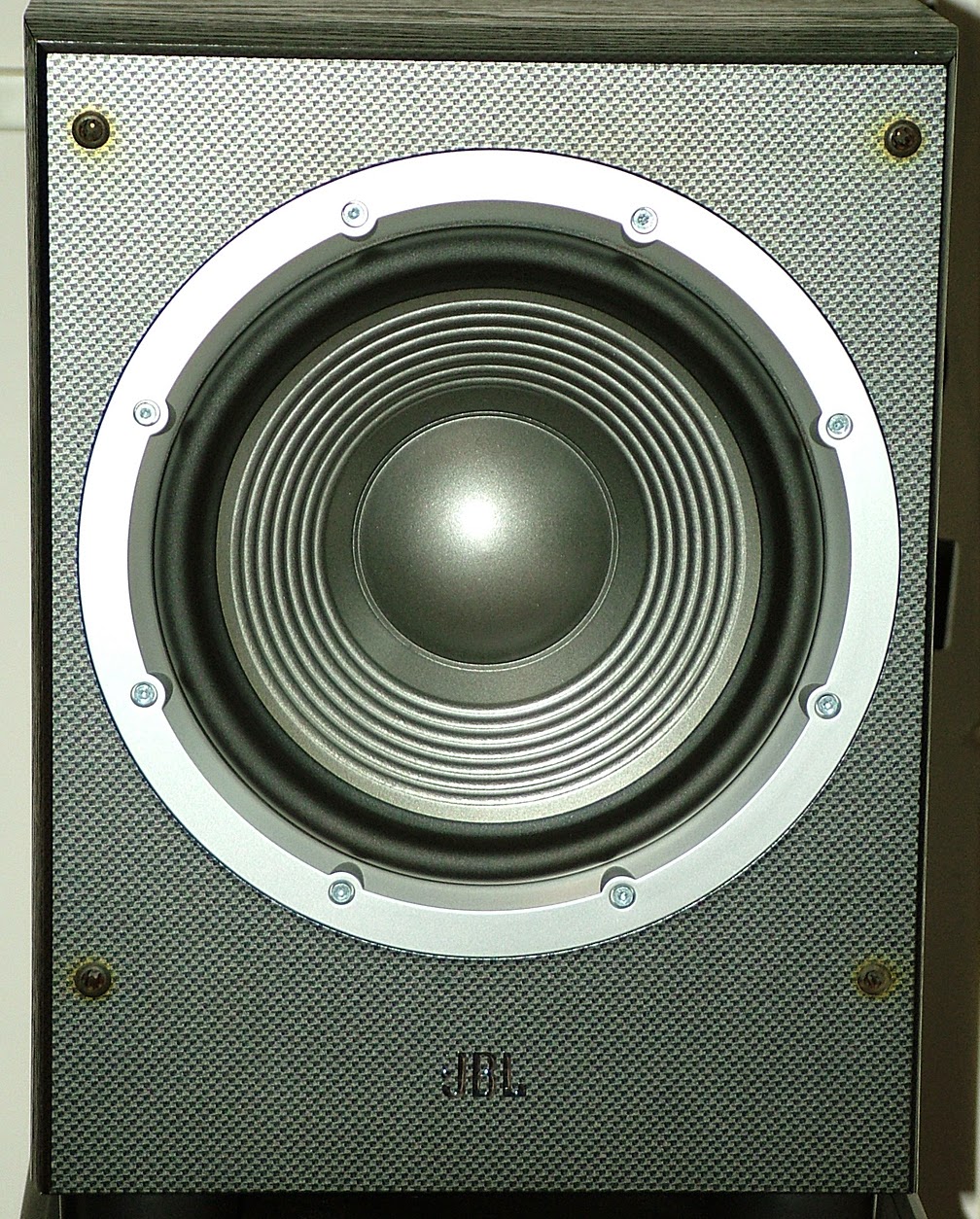
First off, I found another subwoofer at Salvation Army. Got it at a great price. Reviews are mixed for these JBL Venue Series subs. Based on what I read, the fact that this one still works indicates that it is a survivor. It replaces the Klipsch which was also a "Sally" find. 

Both have ten in woofers. I don't recall the Klipsch's specs, but one reviewer stated the JBL sounds much better than the Klipsch ten-incher. 

I like the fact that it is front-firing verses bottom firing of the other four subs in the house. It has that metal grille which brings some brightness to the mostly black components in the living room.

Below, shows each unit's reflex port. The JBL's is appears larger, but it may be that the flare is wider than the Klipsch's. JBL's port fires down, Klipsch's fires to the rear.
JBL's amplifier is rated at 150 watts with peak capability of 300 watts with a low of 27 Hertz.

Neither has speaker level outputs which makes me wonder why they have a crossover adjustment knob. JBL has a separate LFE RCA input which eliminates having to use a "Y" cable if your receiver only has a single RCA output as our Yamaha does.


JBL's woofer is more stylish looking since it is on display. Convex center cap verses Klipsch's concave. Both have rubber surrounds which make for longer life. No decaying of foam surround.
Now that that is out of the way. I was able to get some more used Monster Cable M Series speaker cables. They feature fine multi-strand wires for high frequencies and thicker single strands for lower frequencies. I attempted to make them bi-wired by separating them, but it was very difficult to get them into the speaker pants, so I nixed that idea.
Above is the fait acompli. I'm not sure if that Latin spelling is correct. Can't tell the difference? Neither can my wife. I KNOW it's there. 
Above is the older less modern Monster Cables on the left entering the bigger 12" subwoofer with the new M Series on the right going out to the Polk Audio Monitor 30 speakers of the six-channel surround sound SACD system. I plan to get some more of the connectors on the left to replace the ones on the right.
Above shows the double-banana plugs at the rear of the SONY receiver. Note the different look of the old verses new. If I can get another six to eight feet of the M Series cables, I'll replace the last two cables.
Above is the cables on the right side. Below is the ones on the left of the cabinet.
Below is the cables going into and out of the ten inch sub one the left. The light gray pieces are the speaker "pants". 
Lastly, note that I removed all the music/history books from this shelf as well as the FM/AM antenna. I never listen to the radio through that system, so why have the antenna?

Finally, once again, thanks for taking the time to look at and read my blog.
Scott 

Today, I finally got a chance to listen to both systems. O. M. G! They both sound AWESOME! Such clarity, tight bass, high and wide soundstage. Gotta love it! And I do.

"New" "Executive" stereo. "Antique" CD Player, and more!

Gentle reader,

Once again, thanks for taking the time to read my blog and the photos that go with it. I really appreciate your kind words. Glad to know that you're out there and that you enjoy my efforts.

Recently, I decided to simplify my life. Again. I know, I've done it before and told/showed you all about it. I think that I just keep it complicated but in different ways. My long suffering wife would agree.

Firstly, and yes, that IS a word, I came across another vintage-looking electronic component. You may recall the "floor radio" in a recent post. I'm still enjoying that and in fact thinking of selling the rest of the radio collection. Well, all but the Halicrafters. Below is the "Antique" CD player/radio. It's an Emerson. There are many companies that have produced modern versions of the classic radios that yesterday's generations enjoyed and relied upon for their news and entertainment. Yes, children, there was a time when NOTHING had a screen. That is except for windows. That's house windows. You know, the kind you look out of. No TV, no smart anything, no tablets, no phones that weren't attached to a wall with wires. No air conditioning, well, I could go on and on. Below, pretty isn't it?


Above, you think I was making up "Antique Compact Disc Player"? You lift the tab and place the disc on the spindle. Lower the arm and it spins it up to read the disc. Then press play. Works well and sounds surprisingly good.
Above and below you can see the speaker grille cloth behind the fancy woodwork. A pair of 4" drivers lurk behind. I never tried to hear if it is truly stereo, but it probably is. With the speakers angled 45 degrees, one could obtain a fairly nice sound stage.

The one problem is that it doesn't have the usual wire that sticks out of a hole in the back that functions as a FM antenna. So, after much searching and testing, I found the right terminal to attach a wire for this black antenna. It was one of a pair on an amplified Radio Shack TV antenna. More on that later. As you can see, it rotates and of course extends to standard length. It greatly improves reception and sensitivity. Sounds better as well.
So, what about this "Executive" stereo? Exactly one week after finding this Emerson (25% off Wednesday at the Salvation Army store) I found what I feel is the ideal replacement for the stack of Onkyo equipment I had here in the "office" next to me. They have traveled across the USA to their new owner in Arizona. He's quite happy with them.

Below is the Panasonic SA-PM19. It is not listed in my 2002 Orion's Blue Book of Audio equipment, so it is newer than that. The little TV is not part of it.
Below as you can see, the speaker wires are long enough to separate them by at least eight feet. I don't have the desire to do so as you will find out below.

Above is a non-flash photo of the units. Inside the front panel at the bottom is five CD trays. It has an AM/FM stereo radio tuner with 15 station memory. Also, on top is a button and a panel that pops open when the button is pressed. Inside is a cassette player. When I think about it, this is the modern version of the plastic fold-up record player I had when I was 17, forty-one years ago. There were cassettes then, but they were for voice recording at that time. 8-track tapes ruled then. Sheesh do I feel old, now! Anyway, I thought that little fold-up record player, all-plastic, too, sounded just fine. That is until I visited my new friend, Phillip's house and heard a real stereo.........
Above and below is the little 7" digital TV that also was a thrift store find. It's digital so it picks up all the TV stations. Well, with a roof antenna it does. Nice picture too. It was in the original box in new condition. Who donates new stuff?
Above, the AM antenna that came with the Panasonic serves dual-duty by propping the TV up a little more. I could tune just 2 AM stations, both Spanish language. 
Above, note the eight speaker terminals with the unusual blue and white colors. Turns out, this kit has two amplifiers, one for bass and lower frequencies and one for mid-to-high frequencies. This is called "Bi-wire" by the Audiophile crowd. The Polk Audio Monitor 30 speakers I just got are made for bi-wiring have been others that I have owned and enjoyed.
Above, you can see the custom shortened wires and the splitter that sends the signals from the FM antenna I put up on the roof. The TV gets great reception from it. FM used to be located between channels 6 and 7 in the analog TV days.
Above you can see the bass reflex port on the rear of each speaker. When they do that (speaker makers) they often align it with the rear of the tweeter, for some reason.
Above, you can see the foam surround "mid-bass" driver and cone tweeter. Don't poo-poo cone tweeters. They work very well. In fact, that's all that BOSE uses. The BOSE 301 speakers in here use two cone tweeters and they sound amazing.

Looking back through older posts, I found the one constant as far as the listening room speakers are those 301s. I moved them in here to make room for the older Polks and now the new Polks that replaced them. I blogged about the ingenious way I mounted them on the walls in here. Also in here are the solid oak speakers that I bought and improved. They are subject of another older post. ANYWAY, since I sold the Onkyos, I had no way to drive them. Thanks to the vast amount of wiring I had in the attic that originally was used to "pipe" music in here from the stereo that was once located in the living room, clear at the other end of the house. 

Note the twisted blue/silver wires in the photos below. In case you're wondering, the pretty girl on the left is my older daughter at 13, the gorgeous brunette on the right is my wife at 29. She's still gorgeous, twenty years later.

Above is the terminal that was once behind me and above my left shoulder. What was in this spot once was my first attempt at sending sound in here. THAT was when the stereo was once in the dining room. And my wife thinks I keep changing things!
Above, with STAR WARS out of the way, you can see the speaker switch and attendant wiring. It may look confusing, but a pair of wires comes down and in and one pair goes up to the BOSE 301s and unseen is the two that go down to the oak speakers. 
Thanks to the modern DYNACO Stereo 200 power amplifier in the den/listening room which has two pairs of speaker terminals, I can have two, four and even six speakers all playing at once. Cool, huh?

If you look at older blogs, the most popular of which can be seen above/right, you will see the other speakers and amps and such of which I wrote today.

Thanks for looking,

Scott

New Polk speakers, JBL subwoofer and wiring tweaks

Gentle reader,

Thanks for stopping by here to see what I've been up to. There have been many changes in the den/listening room. I'll start with the audio ones.

A few weeks ago, I mentioned that I'd found a like-new late model Polk Audio center channel speaker. Since they are selling new ones for less than $90 on ebay, I decided to keep it. Just as well as I discovered the woofer on the old Polk Audio central speaker had frozen and would not move! 

I sold some things on ebay to finance the purchase of matching late model Polk Audio speakers to match, sonically, the new center channel unit. To my delight, I found a "previously enjoyed" pair on ebay and won them for $61.00. Here the room is with them:
Yes, the face/drivers color is slightly off, they nicely contrast with the Axioms below. The important thing is that they were designed to match sonically with the center channel. These are model 30s, they make model 40s that are basically the center channel standing vertically. However, and you no doubt have noticed this, the 30s have the tweeter on the bottom. "What the heck?" That is the way they are designed to work. Plus, if you look closely, they line up horizontally with the tweeter in the center unit. Yeah, I planned it that way all along. ;-) Here's some more photos comparing the old and new Polk Audio Monitor speakers:

Basic two-way design. Note that the tweeter, now unprotected sits as close to the woofer as possible. Note the tiny reflex port on the old Polk, below the woofer. Speaking of woofers, they have rubber, not cheap "foam" surrounds, so no worries about them falling apart in later years.

See how large the reflex port is on the newer model? Note also the twin terminals.
The twin pairs of three-way binding/banana terminals have jumpers connecting them. This is for "Bi-wiring" the speakers. Ideally, one would have TWO stereo power amps from the same maker.  One putting out, say 50 watts per channel, the other 200 or so. It takes way more energy to drive a woofer than a tweeter. So, remove the jumpers, pull the caps out of the bottom terminals if using banana plugs, and run TWO pairs of wires to each speaker. The wires from the bigger amp to the woofers, the smaller amp to the tweeters. Some cable makers produce single cables with four wires in one unit for bi-wiring purposes. Not cheap, though.
Although the older units only have spring terminals, Polk Audio at least made them 3/4" apart and with holes large enough to accept banana plugs. So what are banana plugs? See below:

Above is one Monster M Series cable I bought via ebay to use in the main system. Why? In order to utilize the JBL subwoofer I found at Salvation Army:
Take a careful look at the photo above. Note the "LINE LEVEL IN" and "HI LEVEL IN" terminals. The former, is directly from your receiver or preamplifier outputs. In a home theater receiver, they usually have one or two RCA outputs marker "SUBWOOFER". Connect one or a pair of cables from there into the RCA inputs and you'll have all your Bass come from the sub. Another way, if you want to control where the Bass comes from is via the latter larger terminals. From your front channel speaker outputs, or in my case from the stereo amplifier, run speaker wires into the input terminals. Pay attention to polarity, and left or right. Red in red, left in left, etc.
These are the cables that originally plugged into the Dynaco power amp to feed the Axiom speakers. Below is the new cable cut in two with banana plugs and new speaker "pants". If you go two pictures up, in the close up you can see the difference in size of the total plugs. The important thing is the banana tips are always the same size. I got this cable cheap because it was only one and the insulation on the + side was gone.
No problem, red electrical tape to the rescue. These M Series cables have a mix of thick wires and thin wires. Monster thinks that the high frequencies will travel the smaller ones, the Bass, the thicker ones. True? Who knows. The only plugs I had the would fit these wires are Monster's units the screw on like wire nuts.


If you look closely at the two photos above, you can just see that there are two red and two black wires in each cable. These would work for bi-wiring. I bought some new Nakamichi banana plugs, but they would not fit the cables AND the covers. I'll find some use for them, I'm sure.
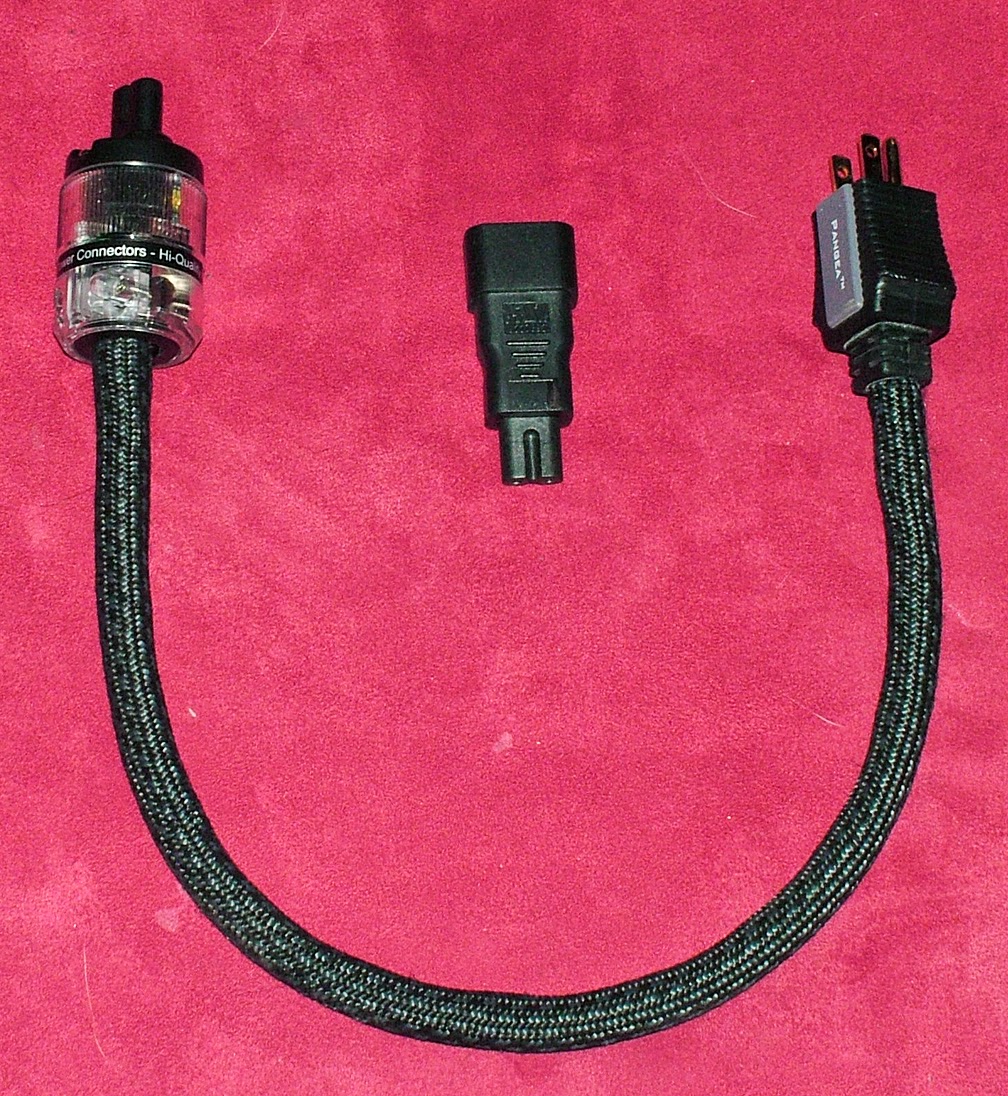
(Above is the Belden/Hubbel cable for the JBL, the AC-9 for the Dynaco and the Pangea AC-14 for the other (12") subwoofer. Note how BIG the AC-9 is!) I had a power cord/cable that I'd made for one of the CD units with Belden 19364 cord and a Hubbel plug plus an Asian IEC plug. Since then, I scored another Pangea power cable which replaced the one I made. So, I removed the stock zip cord plug on the JBL and installed the Belden. It was made to have a three conductor cord, so I soldered it in.
Above and below you can see the power cable plug I had to adapt to the massice Pangea AC-9 which has 7 gauge wiring and is huge. The plug came via ebay from Hong Kong. It was a job to make it work. One of the connections broke somehow in the factory molded on plug.
Above shows all four speaker cables attached to the Dynaco amp. The bottom ones (twisted blue and silver) travel into this room, the "office". More on that in a future episode.
Above, although it looks a mess, it is what I had to do to fit the new cables. So, in conclusion, the new ones come FROM the amp, TO the INPUTs on the JBL Sub, the OUTPUTs have the original Monster cables with the braided sleeves that connect to the Axiom speakers. I've been playing with the crossover frequency and Bass volume to find the right balance of Bass verses rest of the frequencies.

Below, is a Pangea AC-14SE cable I got via ebay with an IEC to C7 adapter. Looks funky and perhaps straining the cable.

Above and below are the two pieces. Note how small the three IEC terminals are. Those 7 gauge wires have to be attached to the female version of these. 
Below, is the newly completed cable with a purpose built AC7 plug.  Again via ebay from Hong Kong. I knew these plugs existed out there some where. One can buy Pangea and other brands of cables with an AC7 plug molded on, but they aren't cheap.


I ended up removing the ground plug from the male plug, it was no longer needed and I had to plug  it into a two-terminal outlet as you can see below.
Since we are in the den, prior to all that I'd done above, I decided to get the LP shelf off the edge of the Asian rug, it made the shelf tip back and just looked wrong. 
Above, to the right, you can see the rug is free of the shelf. I had to empty the shelf and move the heavy oak filing cabinet in order to move both off the rug. I also had to get it out from under the stereo shelf so that I could move it towards the left wall.
Note what the wall to the left of the shelf has on it right now, above.
Above is the corner where the filing cabinet used to be. Note the authentic Battlestar Gallactica recruiting posters to the right of the window and the new location of the sunset photo I shot from Skyline Drive MANY years ago.
Finally, above is the new home for the blue painted (why did the previous generation paint nice wood?) oak filing cabinet that someday I'm going to strip and refinish. As noted above, the floor radio sits in the corner now with the black and white TY cat on top.

Thanks for looking and suffering through my obsession! Over 30,000 hits so far!

Scott


I bought a NEW Yamaha CD Player! Build Date of April, 2026. Check it Out!

  August 19, 2026 #551 Gentle reader, Most of you are aware that I have been in the home audio hobby for fifty years now. Thanks to the thri...