Finally got a SCAR! Full auto 6mm! Plastic balls, that is.


Gentle reader,

If you've been following my blog, thank you! If you've stumbled across it, welcome! Regardless, thanks for stopping here and taking a look.

As a kid, I played Army. In fact, I'd signed up for JROTC in high school, but my dad talked me out of it. This was in the thick of the Viet Nam war. It was just as well as I was skinny and could not gain weight. As it turned out, when I did sign up for the US Air Force, they found I had a heart murmur. 

It has since gone away and once middle age approached, the weight gain, wasn't a problem either. Sigh. Well, 6'3" and 185# is right on. But to quote Paul Simon, "Why am I all soft in the middle?"

But I digress, we played Army with a Daisy cowboy style rifle and a wooden/metal trainer rifle that looked the part but didn't make a sound, which the Daisy did. Here is a link about the various toy and trainer rifles I collected then sold a few years back:
The Robb Collections: The Toy & Trainer Rifles collection
Here is a link showing my ISSC MK22 FN SCAR lookalike rifle which is chambered in 22LR:
The Robb Collections: ISSC MK22 rifle fully "tacticool"

So, now you have the back story. I had not heard of AIRSOFT or AIR SOFT until a few years ago, but am into it now. I started with a simple "spring" Viet Nam era M16 rifle. It works like a pinball machine. You pull the cocking lever, a pall pops up into the chamber, you pull the trigger and the spring-loaded rod you cocked releases and shoots the ball out. Pretty slow, but it works. For more on Air soft, Google it. 

Then I bought one, and eventually four gas blow back air soft pistols. They use various pressurized gasses to shoot the balls out and they cycle the slide like a real pistol. See:
The Robb Collections: More on the Airsoft pistols
I sold all of them although one buyer never paid so I kept it. My nephew was shooting it as fast as his little fingers could, magazine after magazine until it finally stopped working. Since then I've bought a copy of a Glock 17 and have six or seven magazines for it. 

Now, my wife is into real guns, so eventually she was able to get me into it. My interest has decreased as I don't like going to the range. If we lived out in the country somewhere that I could safely shoot in our back yard (like I can and do with air soft) I'm sure I'd still be into it. ANYWAY. 

As to the subject of this blog, I finally bought a used air soft version of the FN SCAR L or Mark 16 rifle which some of the US Special Forces use and my nephew Matt has one. See:
The Robb Collections: 22 caliber guns
Now you have seen what a real, black FN SCAR looks like and what my ISSC MK22 looked like before I got it out of it's New York/California mode. Below is what the D-boys SCAR looked like when I got it:
Note the required orange tip that lets people, especially police, know it is not a real weapon, but the commonly used "pellet gun". Although pellet guns use metal ammo and can kill, air soft uses hard plastic balls which in the right circumstances might kill, but how? 

The tip, which is a flash suppressor designed to reduce the flash seen by the person shooting so they can see down range and/or not be blinded if in low or no light. That tip was broken, and even though it threads on and off, they had pegged it in place. Didn't even slow me down. 

I'd bought a locally made fake silencer for my G17. It goes on in place of the flash suppressor or "hider" and uses 14mm CCW threads. Well, the G17's barrel retracts when shot, so I couldn't use it. In fact, I hoped it was just over 6mm inside to act as a barrel extension, but it is bigger than that. Looks cool, but does nothing. So, to my delight, it screwed right on to the SCAR air soft. Note how short the barrel is? It came new with a longer barrel and this short one. On the real military version, they use the short barreled models for "clearing" rooms in structures. Easy to move around and a bad guy, if he tried to grab the barrel, has little to hold on to. So, without further ado, here are pictures of my 22 rifle set up like a sniper might use and my air soft rifle set up for close combat. 


I am buying a new metal safety orange tip for the air soft so that I don't have the neighbors calling the police on my. This gun is called: AEG. Air soft Electric Gun. It uses a "gear box" which moves the balls and cocks and fires a piston which shoots it. This model shoots just under 400 feet per second and averages 15 rounds per second. That magazine holds 300 rounds. I always wondered why they sell bags which hold thousands of balls. Now I know. Full auto is FUN! 

They also make these that are gas blow back. In that case the bolt cycles as well. Technically, one could ignite the gas as it leaves the barrel behind the round, but I think that is a BAD IDEA. 

Below are many pictures that show comparisons of the two rifles. One lethal and legal, one just for fun, but I wouldn't want to feel a hard 6mm ball traveling 250 mph hitting me. People, a LOT of people, full grown people, really get fully into air soft. It's cleaner than paint ball and no one gets more than welts if they get hit in an unpadded area. I recently came across a video of 2000 people in an air soft battle! Google it. It looks so fun!

One thing you might be thinking or wondering, "Aren't air soft toys? All plastic?" Yes in that they are not real guns they are toys. All plastic? The cheap ones, yes. This one has all metal where the real one does and polymer where the real one does. In fact, I just weighed them. As they are ABOVE, the air soft weighs 9 pounds, 13 ounces, the ISSC, 9 pounds 10 ounces. That's with the all metal bipod attached. 

Note, aside from the serial number, the air soft has no decorations. Fabrique Nationale Herstal has authorized some air soft companies to replicate and decorate them, D-boys isn't one of them.

ISSC's sights are quite different from FN's. Both sets are fully metal. The air soft's are both adjustable.

The air soft has what is called "selectable fire". See the three positions above? No civilian legal, military style rifle is select fire. Semi-automatic which means one trigger pull, one bullet. 

Again, ISSC's site doesn't match FN's.


ISSC added details and decorations to further remove itself from legal action from FNH.


Both are ambidextrous and allow for moving the cocking lever to the opposite side. ISSC made for six location choices. Also note the side rails are longer on the ISSC. I put rubber rail covers on it.

ISSC has added a small rail under the gas block which is ideal for bipod placement.
All I've done so far with the SCAR clone is shoot up the snow in the back yard. We have a metal roof and discovered what those little things are along the bottom of most metal roofs: Snow stops.
The recent heavy snow came crashing off the roof front and rear, testing out dog's nerves and the integrity of our deck. So, I was shooting out the back door. 

Since then, I bought some blaze orange tape and marked the fake silencer so that anyone seeing it will know that it is NOT a real firearm. I went ahead and marked the old toy Daisy air rifle and vintage M16 with the same tape so that no one will think any of the grandsons have anything but a toy in their hands. Safety first and always!

Thanks for looking!

Scott

Some recent changes to the den audio systems and in the home office too.


Gentle reader,

Thanks for taking the time to look at and read my humble blog. It truly thrills me to see that almost 40,000 people have done so!

Starting with the photo above. I found a SONY SACD changer at my favorite thrift store. It's the third one I've had. I decided to keep this one as it is a dedicated music player rather than a DVD player that also plays music, plus, being a changer, it can play much longer. It only has the six (5.1) channel analog outputs, no stereo only and digital and optical out for plain CDs.
The photo above shows where I put the OPPO universal player that WAS in the surround system. OPPOs are renowned for their excellent sound and picture. It plays HDCDs as well as all other formats of improved digital audio discs. I decided to sell the SONY DAT and the OPPO uses the inputs the DAT was using. I found the DAT just too complicated.
 Above and below are pics of a pair of speakers I found yesterday at Salvation Army. I'd never heard of Axiom, but turns out they've been making top quality speakers for excellent prices IN Canada (not China!). I've found and read numerous rave reviews of these M3Ti speakers.  Note
the puckered reflex port on the back. An Axiom patented design.
Above and below, you can see that the cabinets are tapered. This greatly reduces standing waves in the cabinets as only the baffle and back are parallel. 
Above and below compares them to the POLK speakers that are the front three for the surround sound system. Right now, they are occupying the shelves that the Polks normally do.
The Axioms have aluminum woofer cones and titanium tweeter domes. Thus the "Ti" in the name.
Below came today. Pangea is a brand of bargain priced high-end audio cables that used to be exclusively sold by one catalog audio company. Now they can be found elsewhere. I got the beast below and two of the smaller blue ones via ebay. Despite the "9", they are in fact 7 gauge conductors, thus the thickness.
Below is a comparison of the 14 gauge cable that the big one replaces. I bought an adapter so that I can use the 14 gauge one with one of the disc players.
The normal sized cable that comes with most stereo equipment is 16 to 18 gauge with no shielding.

Below is the adapter attached to the AC-16 cable's IEC output end.
To show you just how BIG these new cables are, above they are plugged into the Adcom ACE-515 power conditioner. The left-most wire is a standard lamp cord. The next one is similar in size to a heavy extension cord. As you can see, they are MASSIVE!
Above, below and below that are pictures of a direct drive Technics turntable I found a couple of weeks ago at Salvation Army. It has an Ortofon cartridge which can be seen in profile in the last picture. I prefer direct drive. No belt to stretch or break. Quartz locked speed too. It's going to find a new home soon too.


Lastly, below is another OPPO (same model) that I got for ten bucks at another thrift store. Missing the cover for the USB and SD slots, but so what. It replaces the Samsung I had moved in here to replace the Sony DVD/SACD/CD player I'd had in here. Both are in new homes, thanks to ebay. 
If you are interested in reading a couple reviews of the Axiom M3Ti speakers, here are some links:

I'm planning on keeping these speakers, they really do sound phenominal! 

Thanks for looking and reading!

Scott 


A "Modern" Dynaco Amp, Onkyo cassette and Amplifiers I have known

Gentle reader,

One thanks once again for taking the time to look at and read my blog. If you have done so for a while, you may remember that I started my audio journey in 1975 by building the then top-of-the-line Dynaco PAT-5 preamplifier from a kit. Dynaco was a top-flight audio company with a long history of making high quality great sounding equipment at a reasonable price. Made even more so by creating kits that the buyer built themselves. The factory assembled PAT-5 retailed for $400 in 1977 ($1,540 today) and the kit was $240 ($923 today). Prior to doing so, I had rarely soldered, I was 18 at the time. The directions were excellent and I enjoyed many years of great sound with that pre-amp.

For and excellent history of Dynaco, including breifly, the last company that bought the name and created state-of-the-art audiophile equipment. Dyna Company History 

I have only owned their modern version of the "Quadapter" that Dynaco came out with as an economical answer to the competing companies four-channel surround sound circuits. The "QD" series, again were an economical way to enjoy surround sound without having to buy a new receiver or amplifier. See below:


I have another one that I replaced all the spring-loaded terminals with proper 3-way binding posts so that I could use double-banana plugs.
A little rough looking, I admit but much more useful  and provides a better connection.

Anyway, I have coveted the modern Panor-made equipment and wanted to replicate the original PAT-5 preamp and Stereo 400 power amp I once owned with the newer equipment. When they do come up on ebay, I can never win one. 

For example, the modern Stereo 400 II power amp from 1992 retailed for $1,000 ($1,661 today) and the PAT-5 Series II from 1993 retailed for $750 ($1,209 today). 

Panor recreated or improved upon Dynaco designs such as: Stereo 70 Series II tube power amp, $995 in 1990 verses $170 as a kit starting in 1964 later available built for only $10 more. 

The most expensive power amp that Dynaco made prior to Panor was the 416A from 1977 which retailed for $950. At 208 watts-per-channel, it was powerful, large and very heavy. By the way, that's $3,653 in today's dollars. Cheap compared to most current audiophile 200 watt power amps.

To my delight, on ebay, a fellow in Ontario, Canada was selling a circa 1994 Panor/Dynaco Stereo 200.  Rated at 100 watts-per-channel retailing for $595 in 1993 worth in 2002 on the used market according to my 2002 Orion Audio Blue Book $312. List price in today's money: $935. He started the auction at $100 and I got it for that price. Took almost a month to get here, but arrived safe and sound. Sound's wonderful too!

Below is a visual comparison between the Dynaco Stereo 200 and the 130 watts-per-channel THX Certified Kenwood KM-X1000 power amp I've been using for a while now. Another ebay buy.

Both have thick solid aluminum fronts. The Kenwood has a whisper fan in the front and only the on/off switch. The Dynaco has level controls for each channel and a speaker selector switch.
Above shows that the Kenwood is deeper than the Dynaco.
The Dynaco is unusual in Audio equipment in that the AC input location is on the left verses the usual "industry standard" of being on the right. The industry did this so that all AC wiring can be kept separate from the signal carrying wiring which could pick up the 60 Hertz hum of AC current from the power cords. The Dynaco's is a standard IEC receptacle which allows for using a ready made audiophile power cord of your choice.

I replaced the factory cheap AC cord on the Kenwood with one I made from Belden's 19364 shielded cable. I will be making a power cord from the same cabling after the Holiday shipping frenzy has passed. I do not sell stuff on ebay after Thanksgiving because there are just too many packages moving around during the holidays.

I took the covers off each to make some comparison photos for this blog. Dynaco first.
Very neat construction, as you can see. Note the empty spaces marked on the board. These are for components used in the twice as powerful Stereo 400 II amp. Plenty of room for air to cool the heat sinks.
Note two descrete channels with very little shared. In this case, a Point for Dyanco. Better separation of the channels, little chance of "cross-talk".
Single AC transformer, called Toroidal. Toroidal transformers are far more expensive than traditional standard square one and reputed to sound better. Another Point for Dynaco.
Very thick heat sink for the eight power transistors. Holes in the bottom of the chassis for the cooling air to come up and over the heat sinks. A Point for Dyanco as far as heat sink size. 
                                                             Now for the Kenwood:
The components completely fill the chassis. The holes for air in the bottom are much smaller.


Note dual transformers, one for each channel. A Point for Kenwood there.  

Components are not discrete here. Both channel share everything. Minus one Point for Kenwood.

I did not make a photo of the Dynaco's transistors, but the Kenwood's are larger. Does that mean anything? No. They put out 30% more, so that may be why. By the way, a 3 decibel increase in volume (twice as loud) requires a DOUBLING of amplifier (watts) power. Therefore, the Dynaco Stereo 400 can only play 3 decibels louder than the 200. They Kenwood can play louder, but how much so? I do not know.

The Kenwood, being larger and having two transformers, weighs considerably more than the Dynaco does. Again, that doesn't mean anything. Their weight might be much closer had the Kenwood a single transformer.

Now as you may recall, I replaced the thrift-store-found SONY home theater receiver in here with an Onkyo A-RV401 integrated stereo amplifier made from 1991-94, which retailed for $410 then. Also found the next week, was it's matching T-401 digital tuner which retailed for $200 then. 

Last week, I found an older but still (R1) cassette deck, model TA-2120. Made from 1988-89 and it retailed for $220 then. Here is a photo of the stack. Less than $10 to buy. It works perfectly.
The photo was shot from this chair where they are all within easy reach. The top component is the SONY universal player for CD and SACD use.

AMPLIFIERS THAT I HAVE KNOWN (AND OWNED)

 While I would like to show you in chronological order, the amplifiers that I have enjoyed since 1975, that would take far longer for me to look through all the pictures I have to find them. I will start with the original Dynaco PAT-5 pre-amplifier:
It is partially hidden buy the plants. This is after leaving the "prior life" (our former marriages) but before marrying Nancy. Also shown is one of the Dynaco A25 speakers. I can't tell what brands the other components were. Above the PAT-5 is an FM-5 tuner.

My first power amplifiers were also kits, but I couldn't afford any Dynaco units so bought two SWTPC Tiger .01 mono amplifiers. I found a wonderful web site all about SWTPC products and here is a link to the Tiger .01: .01 | TigersThatRoar  Nice trip down memory lane for me, this site!

Everything seen above, save the PAT-5 and A25 speaker were thrift store finds, most likely. This photo is a scan one ones made with my first real camera: Olympus OM-10. I bought it from a pawn shop in April, 1995. 

The equipment that follows is in ALPHABETICAL order as found in archival photos in my computer.

First off, is the Adcom GFA-585 250 watts-per-channel, it was powerful, large and very heavy. It and the matching preamplifier and power conditioner were all found in Salvation Army for $149.99 for the set. Was I psyched that day! The GFA-585 sold for $1,200 in 1990, that's $2,140 today.

Note the huge toroidal transformer and two completely discrete channels. Each channel uses TEN T03 type transistors. The Tiger .01: two of them.

So, you may be thinking, "Why don't you still have it?" Good question. I turned it on one day and found the left channel didn't work. Found the fuse blown and the speaker's woofer unable to move.
An autopsy of the woofer revealed the voice coil had melted. This indicated a serious problem with that channel. A search found Adcom power amps to be prone to the large blue capacitors leaking toxic fluid. So rather than facing a possibly costly repair I sold it on ebay. 

Next up is the cute, tiny but awesome AIWA compact components that my Barber GAVE to me! They were nasty with nicotine and dust, but cleaned up nicely. Each is not much larger than a car stereo. I've featured them before, so won't get into particulars. Below, all cleaned up:
They are housed in an optional cabinet that AIWA made for them. 
Next, I have a Denon stereo receiver, the DRA-425R. From 1988-91. Rated at 50 watts-per-channel. Retailed for $450.


Nothing that fancy, but take a look at that heat sink assembly! The tube is bolted to the actual heat sink the transistors are on and has a fluid that carries the heat over to the larger fins. Cool!

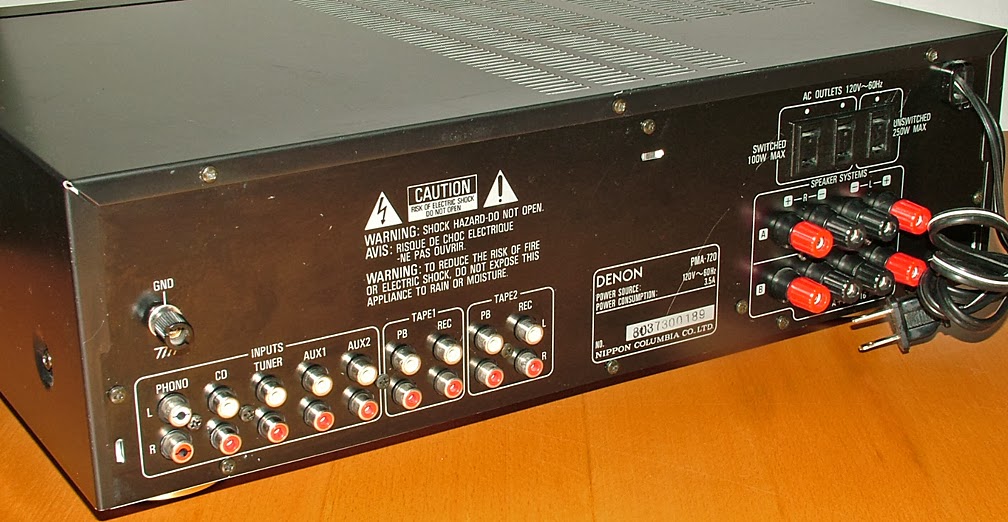
Looking through the many pictures, I see that I have owned a LOT of Denon equipment! Next up is the PMA-720 a stereo integrated "Optical Class A" amplifier. Made from 1988-91 and retailed for $450. Rated at 90 watts-per-channel. 

As you can see, a toroidal transformer and the four capacitors of a split power supply. 

Now, thanks to ebay, I was able to finally own that huge Dynaco Stereo 400 200 watts-per-channel
amplifier. I bought another PAT-5, the Stereo 400 and another FM-5 tuner. 
Didn't I tell you it was big? It was a bargain, too! 
Above is the rear of the PAT-5. I actually had three of them. Below is the interior shot of one of them. One had been modified by someone of note. I can't recall his name, nor whether this one is stock or modified. Remember this is a preamp, so no power transistors, etc.

You can see the color difference of the two of them above and below.
Below is the rear of the Stereo 400.


Prior to owning the above Stereo 400, I had a unique (one-in-the-world) Stereo 120 converted to Dual-Mono. It was rated at 60 watts-per-channel. See the manual below, followed by front, rear and inside photos:


As you can see above, he added a second transformer, capacitor and power supply board. All in the very tight chassis. Talk about heavy!

I'd forgotten about the Dynaco surround sound receiver pictured below. It doesn't appear in any Dynaco paperwork I've ever seen. In fact it was a "badge engineered" version of another company's unit. 


It's model number: 2583 does not compare to other product names nor is there any information on Dynaco ever having made a home theater or any other receiver.

Next was an unusual find. Fisher was once known for very nice equipment, but like so many other great names, they were sold and bought and the quality of their equipment suffered.
 It is a CA-9335. No listing in Orion but a similar unit is the CA-9050 which was part of a system as was this unit. See the three little connectors below? They hooked with special cables to units in the system. It was the way to have a stack of components that looked good, but in fact were only marginal in performance.
Another thrift store find was the Harmon/Kardon (another of those brands that have seen better times) HK-3500 receiver. Made from 1990-93 and retailing for $550, it was rated at 50 watts-per-channel.


The ONLY TUBE equipment I ever owned was one that has been widely copied. The INDEED tube headphone amplifier used a triode tube to drive both channels. I was not impressed. 

In January, 2011, I found a bunch of goodies all at one store:
Some of them I have written about before. The Spendor LS3/5A speakers (bottom pair) were as far as value, one of the BEST bargains I ever made: $10 for the pair. Retailed for $1,295 a pair!

My first and so far only encounter with purely digital equipment was the following JVC RX-402B digital hybrid receiver. I had nothing at the time that put out HDMI so could not test it. 

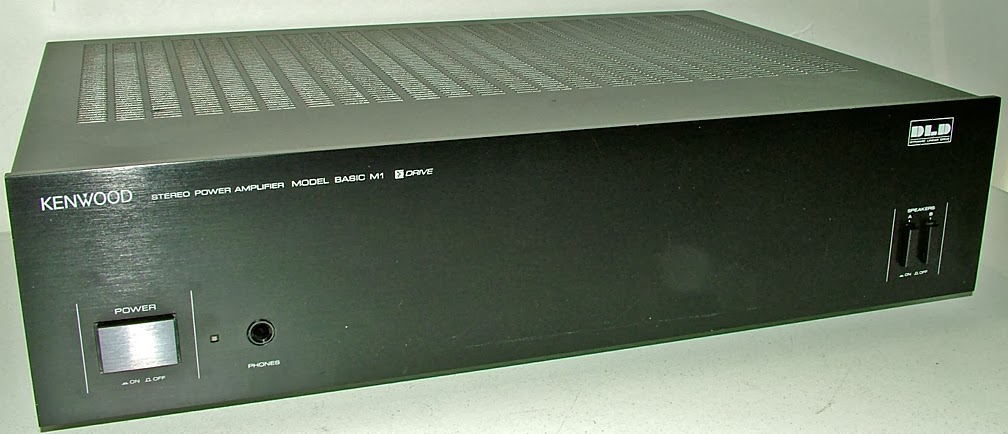
Next in the list is another Kenwood, the Basic M1 power amplifier, Made from 1982-84 and rated at 105 watts-per-channel.
 It was designed to "read" the feedback from the speakers and make some adjustments to work better. Snake oil? I don't know. It required a separate third wire to each speaker.


The one-and-only Marantz unit I ever owned was this nice Model 2220B receiver. Made from 1974-77, it retailed for $350 ($1,655 today) and put out 20 watts-per-channel.

Check out how neatly everything was arranged inside. Marantz continues to this day making products with high performance and high pricing.

Above are the stereo pairs of T03 type transistors mounted on their heat sink for cooling.


One of the most sought after kit I managed to buy were Mitsubishi's line of "Dual-Mono" equipment from the late 1970's. Comprised of either a receiver, or tuner/preamp combo and a separate power amp. Three were available rated at 75, 100 or 150 watts-per-channel. I had the latter. 

Above is the front of the power amp and below is the rear. 

Above is the power amp mated to the optional meters. Below shows them separately.

Above is the meters and below, the front of the preamplifier.
The preamp could be mated to the power amp instead of the meter. The connections were on the sides to facilitate this. Made for a huge and HEAVY unit!

Below is the AM/FM tuner. All came with these large handles often associated with rack mountable equipment.


The only other Mitsubishi equipment I have known is what was called "midi" larger than the mini ones like the AIWA equipment above, but smaller than the standard 17" wide.


Comprised of a integrated amp, cassette deck and tuner. They also made a matching full size turntable. They were all linked by those little black wires. Designed to alert the amp when a source component was turned on. The amp switched automatically to that source.

Next up, and I don't know why I don't have a photo of the front, is a NAD 7240PE receiver. Made from 1986-92 and rated at 40 watts-per-channel.It used "Power Envelope Circuitry"


As you can see, it had "pre-out main-in" RCA connectors so that it could be used as a pre-amp or power amp. 

I have found a number of vintage Pioneer equipment, I won't document them all here, just the nice separates below: 

I have had at least four different SX series receivers as well. Orion does not list the above equipment.

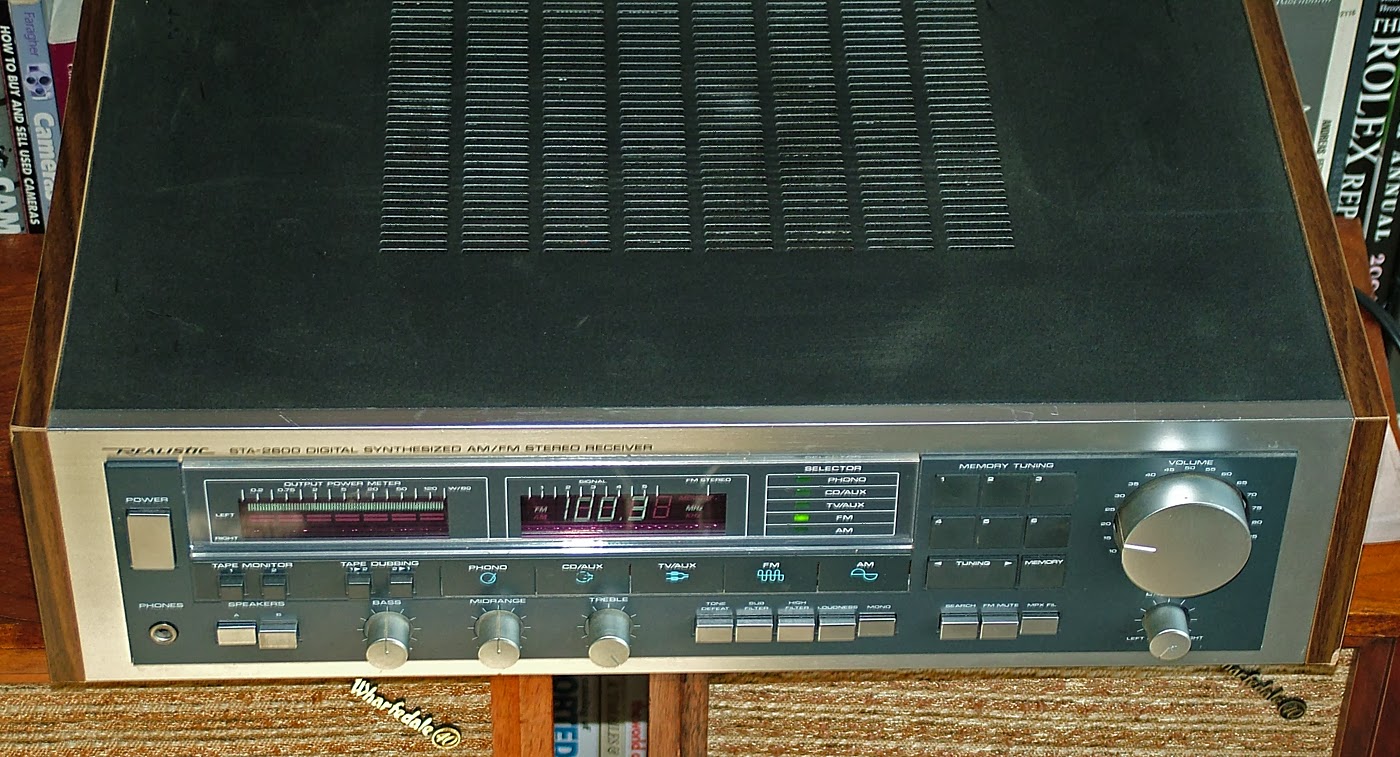
Radio Shack used to be known for something besides cell phones, they used to sell their own equipment under the Realistic and Optimus brands as well as other names.


Something I found at an outdoor flea market was the Rotel power amp below. Model number RB-980BX. Sold from, 1992-97 and rated at 120 watts-per-channel or 360 watts in bridged mono.


 Through the vents, above you can see the toroidal transformer and heat sinks.
Under Radio Shacks Optimus brand was this nice STAV-3470 home theater receiver. Made from 1996-97 and rated at 110 watts-per-channel. 


Featured above in the January finds is this awesome Sansui Au-717 integrated amp. Made from 1977-79 it retailed for $550 and was rated at 85 watts-per-channel. 


A pair of Sansui components that were sadly damaged in shipment were based on an earlier pair with different model numbers. Thus these were called "Classique". No info in Orion. 


Below is a photo of a Sansui Quad receiver that was our introduction to surround sound home theater. I'm not sure if it is the exact model. It was very wide and heavy. The circuit Sansui used for Quadrophonic is what Dolby later used for their early surround sound for home movies.
A unit made for professionally installed home theater applications, I found on ebay. Made by Sherbourn it was rated at 75 watts-per-channel.


Again, not much larger than your average car stereo power amp, it packed a lot of quality in a small space. 

SONY has made a number of pieces that I have had for a while. 

Below is the SONY that I used to have in here which the Onkyos replaced. Had I the remote, I might have replaced the Yamaha in the living room with it.


Well, that's all I'm going to list today. I also had several Yamaha home theater receivers of various sizes and vintages. The one in the living room works and sounds great so I see no need to replace it. WHEW! This was a lot more work than I though it would be. Thanks for your patience!

Scott 

Multi-Channel Audio Digital Converters in Use. 2000 SONY STR-DA5ES is Back! Part One.

November 3, 2026  #555 UPDATED 11-3-2026 Gentle reader, First of all, thank you SO much for your continued reading of my blog! When I began ...