The Music. i.e., LPs, CDs & Cassettes

Gentle reader,

I want to thank you for seeking out and reading my blog. For the longest time I thought only a few people were looking at it, but it turns out a LOT of you are. So, again, THANK YOU!

Today, after the fierce storm we had in the last 24 hours, it is quite cool, almost Fall-like outside. I decided to  use  the time to
count the music I have accumulated. It turns out to be WAY more than I thought!

Immediately above, are the LPs located in here. The room I've called: Office/Library/Museum. But now, want to call my "Study". That harkens back to the 1960's or perhaps earlier. 
Anyway, on the top, the four rows facing you are all the Classical LPs. They total: 529. 46 of which are mono (one channel) verses stereo; two channel.

Below on the top shelf, left to right are Jazz; 304 of them, followed by 21 Al Hirt, 44 Herb Alpert plus one box set of his, including many foreign Herb Alpert releases. Then 14 Baja Marimba Band and then 4 Tijuana Brass salutes or parodies.

Bottom shelf is Big Band (including Frank Sinatra) 131 of them plus 8 box sets. Then International LPs: 19, Comedy: 46, Misc: 16, movie soundtracks and TV soundtracks, the kind that have music featured in them, but NOT the scores: 49. Then 19 LPs of Rock/Pop that are mostly Nancy's. Also in the bottom right box are all the Beethoven's 9th Symphonies (15) and Berlioz's Symphonie Fantastique's. (23)

BTW, that cabinet was made with the help and instruction of my then-girlfriend's father, way back when I was 19. I'm 55 now. He was quite the wood worker. It's made of white walnut, sometimes called butternut. From the kind of walnut trees that grow the edible walnuts.  All the wood he had was from his own trees. Quite the unique fellow, and I'm told still alive.
 Above in this tall tower which holds 400 but in fact has 387 CDs are the Jazz and movie score (commonly called "Soundtrack") CDs. 133 Classical and 234 Jazz.
Above, and I think I missed some of these in my tally, are box sets of Beethoven's Nine Symphonies, as well as the CDs in the original two or more "jewel case" boxes. What a pretentious name! I felt it nice to have books related to collecting and learning about music flanking them. Cool clock, huh?
Above in this interestingly shaped tower are the, from top to bottom: 13 HDCDs, 15 SACDs and 15 Beethoven's 9th Symphonies. Yes, I really like that one!
Above are from top, left: Modern Pop/Rock, with Big Band below. Top, right: Classic Rock, with Herb Alpert at the bottom. He is still making music, stuff now is Jazz. Great stuff, too.
Above is the 100 cassettes, I didn't break them down by genre. About 25% are Nancy's. Below are the 100 Classical CDs. When I get new ones, I have to decide what goes.
Above is the LPs in the den. Top row left to the white slip 2/3rd of the way over are the 202 classic Rock LPs. Then to the end on top and continuing to the box sets on the bottom are the movie scores. The box sets are all classical, 42 of them. Mostly all nine of Beethoven's symphonies.

NOT SHOWN:

Second-to-Lastly, LPs that are in transition from being bought, listened to, but not put away, there are 23 of them; 17 Classical, 1 Big Band, 1 Pop, and 5 Jazz. 

Lastly in here are 37 CDs and 3 LP box sets plus three LPs that are to be donated or traded, possibly sold. Various genres. 43 total.

What's the Grand Total? 2276! Possibly a few more that I missed. When did that happen? I've been buying music since 1973. My first LP was the Jefferson Airplane's first album. Surrealistic Pillow was the title. I still have a number of LPs from those days. I gotten rid of thousands of them too. It's an obsession. A HOBBY! I meant, a hobby!

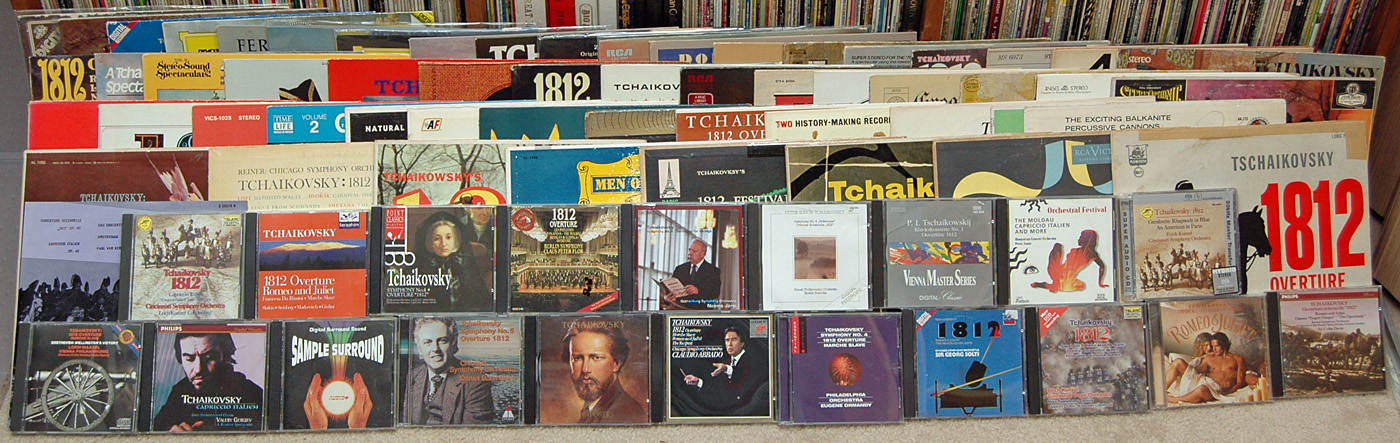
NOW: Some photos of groups of music. Like all 52 1812 Overture LPs plus however many CDs, all Beethoven's Symphonies and Berlioz's Symphonie Fantastique's. 

I've been "sitting on" these photos for a while and decided rather than make a new post, to add them to this one. I have since gotten more of each artist's work, but have not updated the group images. You get the picture. Heh, heh, heh.

Below is the 1812 Overtures in various formats.

 Next is the historical recordings of Beethoven's 9th Symphony.
Below is the rest of  Beethoven's 9th Symphonies. In LP, CD and SACDs.
And now the boxed sets of all nine of Beethoven's 9th Symphonies. Same formats as above. There are a few more now.
Below is the older mono versions of Berlioz's Symphonie Fantastique. Spell check does not like that spelling!
Next, the stereo in LP, CD and SACD.
Just a few different versions of Aaron Coplands works.
Below is the mono versions of Dvorak's 9th Symphony.
And last the stereo in LP and CD, plus SACD versions.

Thanks for looking!

Scott

Some Improvements to the Den's Audio Systems

Gentle reader,

I know that I JUST posted another blog a few minutes ago, but wanted to get this all down while it was still fresh in my mind.

You may recall that I set up a separate stereo in the den specifically to play 78 RPM records. Being they are all mono, kind of silly to call it a stereo, but the rest of the components are stereo, so there.

I also a short while ago bought a small power amplifier to power the BOSE 301 speakers as well as the Wharfedale Diamond 7.1 speakers. 

They all were powered by the main Kenwood power amplifier, but I felt asking it to power six speakers was too much. What I didn't know at the time was how small the Sherbourn LDS2/75 power amplifier would be. The seller was new to eBay and did not indicate physical size. The price was right at $60. It has to be remotely triggered to make music. Either through detecting an incoming signal, or a 12 volt DC signal. Well, the former didn't work, so I adapted a 12 volt DC transformer to it. The transformer is turned on by the main system. The Sherbourn does have a power switch on the back which must be on as well. If I only want to listen to the oak speakers I rebuilt, I leave the Sherbourn switched off.

Above is the whole shebang. It is playing a 12 inch78 RPM record as I made the image. It may not look any different to you, and definitely not my long-suffering, audio-system-confused-wife. But it is different.
Above you can see that the Pioneer equipment has been replaced by the Mitsubishi MIDI equipment that no one wanted to buy from me. My wife had put that rack in the den for some reason, and I found it to be quite strong. I first attached the Sherbourn amp to the bottom of it, then stacked the Mitsi's less the non-functioning cassette deck on top. Then the wooden shelf that was directly on the floor before on top. The Sony CD player on top of the wood shelf with the Dynaco QD-1L on top. Note, no speaker switch. The QD-1L divides the signals quite well, directing out of phase signals to the Wharfedales in the back of the room.
Below is a close-up of the front of the Sherbourn. Here is a link to a PDF of the owner's manual for the Sherbourn: LDS2-75B_Owners_Manual.pdf (application/pdf Object)
Below, you can see the Wharfedales are right at the wall, where before they were right behind my chair. I'd rolled back the Asian rug and run the speaker wires under it to the Wharfedales. This allowed me to move them back out of the way as well as correct a bump in the rug that was on the right side and bothering me. You can see the PS2 steering wheel/pedals assembly and racing chair waiting patiently in the alcove.
Here's the view from the doorway. Much easier to get in and out of the room and less likely for my son's cat to knock one over.
Below, you can see the system with the cassette deck that replaced the Denon that I sold to a fellow music lover. Yes, that is a Swiffer. I find it does a dandy job of removing dust from records. If they are truly dirty, I clean them with all the Discwasher stuff next to the headphones.
Below is the 100 cassettes on top of the 100 Classical CDs. I have more as you shall see below. That gorgeous skin was bought in Thailand back many years ago by my late, dear friend, retired Army Colonel, Bill Arps. His widow wanted to throw it away! I saved it. My wife "mounted" it on a background and slightly stuffed it. She even added some "eyes" made more for a stuffed toy animal. Moe, one of our cats was walking all over it as she worked on it. When he saw the eyes he JUMPED three feet straight up and tore out of the room. We laughed so hard we cried. BTW, the skin is from a Fishing Cat. That's it's name. Google it.
Here are the rest of the Classical CDs. All the Beethoven 9th Symphonies are on the left as well as box sets of all his symphonies. On the right are some boxed sets of Classical and Jazz.
Below are the LPs that are in the den. Top shelf is classic rock, then movie scores which continue on the bottom shelf. Then the boxed Classical sets. Mostly Beethoven's complete symphonies. The vast majority of the LP collection is right here next to me in my "office/museum".
And lastly below is the radio collection. Only the two rectangular ones on the top ends are vintage tube radios. The rest are solid-state (transistor) replicas. On Sunday evenings I tune into old-time radio on WAMU 88.5 FM. Love that stuff!
There you have it. The changes/improvements I made yesterday to the room/equipment. 

Thanks for looking!

Scott

Cosina Voigtlander Camera Comparison

Gentle reader,

Although this is another beautiful weekend, and I should be outside doing things, I mowed the front lawn after lunch and gave myself a heck of an Asthma attack. Pollen doesn't make me sniff and sneeze, it apparently makes me cough and wheeze.

So, I've been cleaning the house making changes/improvements to the smaller audio system in the den, and making/editing photos of some eBay-to-be items.

One of said items is an almost new, in the box Cosina C1 purely manual simple film SLR camera. This one was made in 1996 and made in Japan. A fact they noted all over it and the lens. I found it at Salvation Army on Wednesday. T'was $14.99, but Wednesdays are 25% off days.

The other camera I'm going to compare it to was also made around then but is called Voigtlander Bessa R. Voigtlander (there's supposed to be an umlat above the O) went out of the camera business some years ago. Cosina of Japan bought the rights to the name and produced numerous cameras that use Leica, Nikon or Contax lenses in both bayonet and screw (threaded) mount. The Bessa R, the first they made is Leica screw (M39) mount. I have tried to bookmark the official importer's web page, but for some reason, it won't let me bookmark it! So, Google it if you really want to know more.

The Bessa line of cameras were the first affordable modern interchangeable lens rangefinder cameras that have a built-in TTL meter. FED made later model Leica M39 cameras with a selenium meter on the front of the body, but it did not read the light through the lens which is what TTL means. Now, Leica has made top-of-the-line interchangeable lens rangefinder cameras for decades. They never made one in M39 mount with a meter of any kind, however.

OK, now that I've established what the Bessa R is, BTW, my wife bought it for me! Gotta and DO love her! This was in the mid-late 1990's. 

First, price: The Cosina retailed for $299 with lens, strap and case. The Bessa R, JUST the body, retailed for $599. A case of paying for the name perhaps, but it was an exciting new camera and the dealers were pricing it accordingly.

Below are various photos of the two for comparison. It is quite easy to see that the black Bessa R was based on the Cosina C1s model. The "s" stood for self-timer which the C1 below lacks.


I have numerous lenses for the Bessa R. None are Leica brand. I did have a Summarit 50mm f1.5, but sold it when various sources stated that the Contax Sonnar 50mm f1.5 was a superior lens. My lenses are shown below. The one that is on the camera was more recently purchased. It was the standard lens on the Soviet Zorki 4K camera. It is a 50mm f2.0 Jupiter 8. The Jupiter 3 is 50mm f1.5. I have one in chrome. The black bodied ones are expensive which is why mine is chrome. All the Jupiter lenses are Soviet copies of the Contax Zeiss lenses.


The lenses range from 28mm, (Japanese) 35mm, 50mm, 85mm (the fat one, all Soviet) 100mm (Canon, Japanese) and 135mm (Soviet). I used to have aside from the Summarit mentioned above, a Leica 135mm Hecktor lens, but sold it as well. It was slower than the Jupiter lens, the one on the right. Slower meaning the maximum aperture opening was not as wide as the Jupiter 135mm. Therefore it required a slower shutter speed at maximum aperture.

Finally, if you are interested in buying the Cosina C1, let me know or look for it on eBay. 

Thanks for looking!

Scott
 

The Toy & Trainer Rifles collection


Gentle reader,

I was looking through photos and came across all the photos of the toy and trainer rifle collection I'd amassed then later broken up and sold all but four of them.

Trainer rifles were invented so that recruits had something to carry and drill with, but that didn't keep real rifles from the troops that were overseas fighting. They functioned like the real ones but were incapable of loading or firing a round.

Below is the real walnut rifle rack with my official US Navy trainer rifle at the top. It is the same size, shape and weight of a real one. I have no other photo of it to feature. Next is the Airsoft M16-A1 and the only Daisy air rifle. Top and bottom are examples of what my brother and I had and played with as kids in the 1960's.

First off, a trainer rifle is a non-firing replica of a real military rifle. The usual subject was the 1903 Springfield rifle which is a bolt-action rifle that requires opening and closing the bolt every time before shooting. Having never held a real one, I don't know if they had a clip or magazine of any type. If not, they were not much better than Civil War rifles, i.e., load one bullet, fire, remove the empty shell, repeat.

Below is two views of all the various trainer rifles I once had.  All but the one second from the left in the first photo have bolt actions.


Some had a "bullet" inside them bolt. It was wooden, painted gold and mounted on a spring so that when you closed the bolt, it disappeared. Below, the wooden factory bullet. At bottom is a real (less propellent) 30 caliber shell/bullet that I put in one of them.


Below is the hand-made ones. The top is for shooting rubber bands.
The middle one is the oldest I believe. No telling how long ago some resourceful parent (I don't want to be sexist and say, "Dad") made it.
The bottom is really cool: "OFFICIAL U.S. ARMY ALLIGATOR GUN". How cute.

Now for the ones that are the loudest. Made by Daisy, ("You'll shoot your eye out, kid.") makers of the Red Rider BB gun. Same gun, except it shot BBs. These just BANG with air and a nice little kick. Boy did we love that one when we were kids.

I kept only one for myself and grandsons to play with. Daniel got the one with the red-painted end. What he did with it, I have no idea.
Now, a really cool one made entirely of bamboo. It was hand-made, commercially or by a loving parent, I don't know. The little lever is a crank. Spin it and it hits something inside that makes a rat-a-tat-tat sound. VERY clever.


Next is a very vintage version of the M1 Carbine rifle. It was automatic and had a clip or magazine. Generally carried by officers during WWII. It used the same 30 caliber bullet of the M1 Garrand, but had a shorter barrel and was much lighter in weight.


Note the sling was mounted on the side rather than the bottom like most rifles of the time. I think because of the magazine being on the bottom, the sling would have been in the way for loading. 

Above is an example of a real sling attached to a toy/trainer rifle. The shooter would loosen the sling, wrap it around their right arm to help brace it to their body. Also, it would be looser than above for shoulder slinging.


Seen above one that was western and called "Frontier" was mostly plastic with pot metal portion that comprised the business part of the gun. 

Below, for comparison is the smallest of the collection at less than a foot long and all plastic. Supposed to be a M1 Garrand, but called "Bolt Action", which the Garrand wasn't. I don't think so anyway.


What I titled "Mediums" are smaller than the standard trainer rifles. Most have lever action cocking. The top one being a cheap, probably Chinese-made all plastic one. 

Below are the ones I called small. The top one is a pump-action shotgun. The bamboo, an Indian rifle and at the bottom, one that "breaks" open and the middle for loading. Were it real, that is.

Below is two views of the more modern, M16/AR15 assault rifles. The top one being my Airsoft M16-A1 which is full-sized and based on the original (A1) M-16 of the Viet-Nam war era. The middle one, I still have. It has a nice rrrrrrrrr sound when the trigger is pulled. The bottom one, by far the cheapest and it just clicked when fired.


Below is the last I will feature. I actually bought it at a real gun show. The classic Thompson sub-machine gun which in real life fires the 45 caliber Colt ACP pistol round. 


I thought that I had a photo of all of them stuffed into the cabinet that now house what's left of the camera collection and large die-cast cars, but I can't find it. So, here are three shots titled: "All of 'em" 

This is all of them.
These are a mix of military and western.


This is a mix of various kinds.
Below is a photo I just came across. It shows all the toy and trainer rifles in the wooden case that I built originally to house the Beanie Babies collection:

Note the papers in there? They are period advertising or manuals for the trainer rifles.

Thanks for looking!

Scott


Earbuds In-Ear Verses Over-Ear Headphones Which Ones Sound Better?

 October 8, 2026 #553 Gentle reader, I have been in the best-sounding-enjoyment-of-recorded-music-I-can-afford, hobby for fifty years. I do ...