Vintage and Modern HO Scale Railroad Cars. Excellent at Collecting Dust!

January 25, 2021

#415

Gentle reader,

In the days of yore, last Century, many children around the world longed to have a model railroad set to play with. 

My family never had one, my brother and I liked cars, so, in the 1960's our parents surprised us one Christmas with an Aurora Model Motoring HO slot car set.

However, near the end of the last Millennium, we bought a simple figure 8 HO train set for us and the kids to play with. 

Where we lived, the basement had a large laundry/utility room and since we already had HO slot cars and now trains, I devised a set of two "tables" made from four foot by eight foot plywood with one inch by four inch barrier walls all the way around.

The bottom table had hinged legs on one end and the other end rested on a workbench top. The upper table was designed to "nest" right on top of the bottom table. To play with slot cars, only the bottom one was lowered. To play with trains, both were.

I created a series of ropes and pulleys so that one could raise and lower one or both tables. When they were raised, they were up against the ceiling. Which is what you see here:

That is our daughter who is now 33 with three children. You can see the ropes and one of the four smaller pulleys which were in each corner of the tables.
Here are some of the new and older cars we bought at hobby shops or the annual train show.

When we moved from that townhouse to our present home, we did not have a room which we could dedicate to our HO activities. So, the trains, track and structures were stored in the attic for several years.

After the kids moved out and stopped moving back in, one of the two shelves I built for the two of them stayed here. It held a number of things over the years, finally I dedicated the top four shelves to display the rail cars and locomotives. I put a plexiglass cover over the front of the shelves to keep little (grandchildren) fingers from trying to pick up the train cars. I had hoped that we would someday make space for trains or cars to be played with.

Where I placed it, it was too wide for the wall behind it, but I dealt with it.
I was focused on the Porsche poster for another article, so the locomotives are out of blurry. I have NO idea what that white wavy thing is at the top right in the photo!
 
Since we have been buying, collecting and racing 1:64th scale diecast cars, we have amassed more than 2000 of them. 
Nancy did not have a place to display hers and I, after redoing this room to make it more user friendly and aesthetically pleasing, I decided the shelf needed to go. Giving it to her filled the need for both of us. 
The locomotives took up the entire top shelf, so I started with them. After removing as much dust as I could using a combination of a Swiffer 360 and canned air (which is really a refrigerant) I began photographing each one.

Soon I realized that with Nancy downstairs preparing a place in the family room for the shelf, I just needed to get them off of it, clean the shelf, then get her help getting it to the family room.
So this is all of the cars which we still posses. A total of 84. The vintage ones were Nancy's fathers as was much of the track. 
I tried to arrange the many box cars like a spectrum of visible colors. The length differences surprised me. Having worked on subway cars for 35 years, all seven types were the same length: 75 feet.
The oldest ones have wear and weathering and plain old dirt. They also have more details than newer ones, including sliding doors. 
This "Chattanooga Choo-Choo" is unique to me in that both the locomotive AND the tender are powered.


You can see the metal wheels on the tender and the wires to it from the locomotive.
All of the steam rolling stock are solid metal and some quite weighty for their diminutive size. That's 9.8 ounces. 
Once I employed my lighted magnifying glass and realized this was a PRR* locomotive, it solved the mystery of why one of the tenders has no standard coupler on the front of it and the other PRR locomotive does have that type of coupler.
*Pennsylvania Rail Road.


The PRR locomotive's weight, below.
The following set of photos is the other PRR locomotive, which we do not have a tender for. 
The lettering fonts being the same is what caused my initial confusion.

The camera had focused not on the middle of the cars, but further back.
Here, you can see the dust I did not notice until editing these pictures and the lack of a standard coupler on the front of the tender.
Which is why I was delighted when I saw the keystone with PRR within it on the other locomotive for which this tender is now mated. Unlike in these photos.
The combined weight of the mismatched pair.
Since Nancy's family was from Virginia, it would make sense for her dad to choose local (if no longer in service) railroads.


It is interesting to me that the back of this locomotive has no access point to get coal from the tender. Might it be a yard locomotive?
And here is it's weight.
I abandoned the photographing of individual vehicles after these engines and concentrated upon finishing removing most of the dust and carefully packing them away. Again.
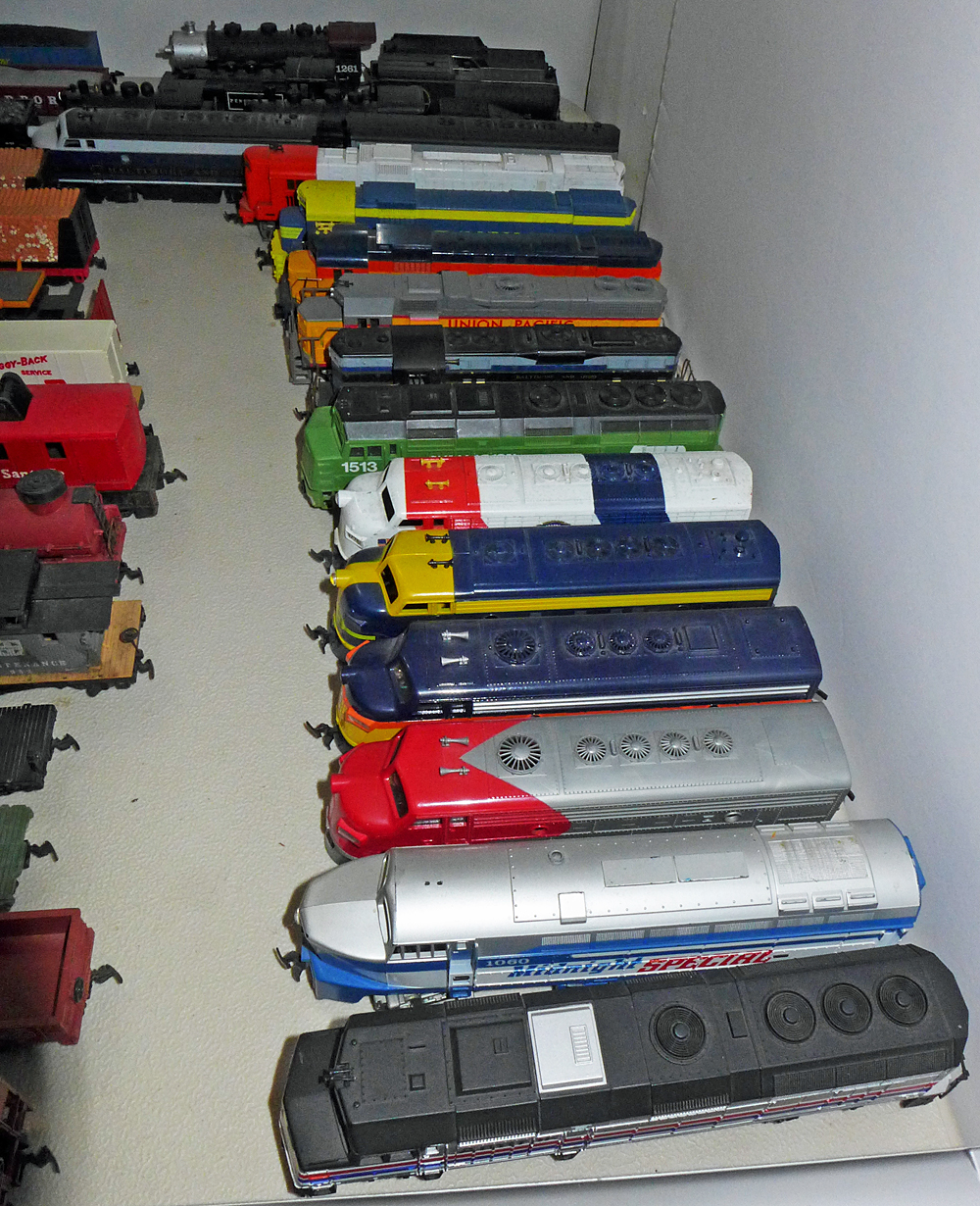
The steam and largest/newest diesel-electric locomotive starting and the left end. The B&O pair are both locomotives, but the farthest car has no real cab.
Again, I could tell the age and/or quality of similar looking locomotives by their heft and material used to make them.
We bought the Amtrak set at a train show. Two much older passenger cars to match the steam locomotives. The Chessie caboose is missing a truck and the Virginian hopper is missing both trucks.
We had a bunch more cabooses, but must have sold the rest. All of the "cabeese" above in a 2009 photo. 
Union Pacific box car is the largest by far, and it's silver roof stands out. The worn paint of the one in the middle show's it was her dad's. 
 
Two coal cars with a gravel car in between. A triplet of tractors and two logs cars. The one to the right of those tilts to let the logs roll off to the side of the tracks.
I'm not sure what kind of car the top left one is. The beige colored piece is designed to rotate upward on pins, but one is broken off. 
A pair of Santa Fe semi trailers predate containers being shipped by rail. The maintenance cars you will see more of below. The flat car is quite heavy due to a sheet of steel beneath the floor.
The different lengths of the red boxcars is quite evident in this group. 
Top row starts with that flat car, then another tractor car, sans tractors, I don't know what the low-walled cars are called and four hoppers between them. On the brown one, the doors open.
Tankers with five being of similar size, but different designs and the really long one being for Exxon products.
And the last of the boxcars, again showing size disparity.
As promised, the maintenance cars. The Santa Fe crane car is really interesting. 
I had two loose axles and the solo truck from the Chessie caboose, so I put them on the car above. 
Note "Virginia & Truckee" on the dark red one. But it refers to the other Virginia, as in Virginia City, Kansas. 
See:V&T Railroad for more information. 
You can see the log cars and three tractors in this photo and the side of some of the diesel locomotives. 
A closer look at the B&O diesel pair and the super long Illinois Central Gulf locomotive. 
The rest of the diesels, the "Midnight Special" reminds me of the locomotive in that silly Gene Wilder/Richard Pryor film Silver Streak. It bothered me that the name of the fictitious railroad was Amroad, it seems to me Amrail would have worked better.
A long view of all 84 of the cars, sans the two truck-less ones.
This series of pictures are all from 2009. It gives you better views of many of the cars at angles not seen above.


Cattle cars.
The green/black Burlington Northern locomotive is all plastic and SO lightweight as a result. Cheap, for sure.

A San Francisco cable car, a vintage-looking electric street car and one of her dad's box cars that has seen better days.
All four of these were his.

The Forest Lumber tilting car, above.
Again, the length difference between older tankers and the much newer EXXON one.

I am a box keeper, so I am certain, somewhere in the attic are all these boxes safely stored.
Various cars and engines arranged upon the carpet when it was much never than now.
Whew! Well, that is it for now. The cars, all 84, are all safely padded and packed into sealed boxes in the attic awaiting that day, probably after we have left this mortal coil, when younger hands than ours slice the tape and open the boxes to see what is inside.

Please take a moment to click or tap the FOLLOW button which is at the end of the long list of article dates near the first PRR steam locomotive. That way you will receive notices when new articles come out.
 
Also, feel free to comment here below or on Facebook.
 
Thanks!
 
Scott & Nancy
January 25, 2021


GMC Typhoon and Syclone. All-Wheel-Drive Sleepers. Faster Than A Ferrari! In 1:64th Scale

January 20, 2021 

#414

Gentle reader,

General Motors was the first North American car manufacturer to add a turbo-supercharger, better known as turbocharger or simply as turbo, to a gasoline engine passenger car. 

It was for the 1962 model year and the cars were the Oldsmobile F-85 Jetfire V8 coupe as well as the Chevrolet Corvair Monza Spyder.

For more on forced induction engines, check out this excellent article:
History of the Turbocharger | Articles | Grassroots Motorsports

But never before these unique vehicles had an American passenger truck with a gasoline engine been outfitted with one.

Excellent photo courtesy of DRIVINGLINE.

For at-the-time reviews of these then-new vehicles check out these Motorweek episodes on YouTube:

1991 GMC Syclone | Retro Review - YouTube

And: MotorWeek | Retro Review: '92 GMC Typhoon - YouTube

Like the Model T Ford, the Buick Grand National and (mostly) Chevrolet Cosworth Vega, you could get it in any color you wanted as long as it was black.

The next year, 1992, GMC premiered the more passenger friendly Typhoon. Based upon their S15 small SUV. There were a number of colors available many in two-tone. 

Hot Wheels recently came out with their version of the 1991 Syclone. By the way, they spelled Cyclone with an S because Ford owned the Cyclone name for vehicles.

I snatched up the Hot Wheels Syclone when I spied it in the bin in our local grocery store. Nancy later found a red one online. 

However, Mattel has not yet produced the SUV version of the Syclone, called the Typhoon. So, I turned to Greenlight. 

Greenlight, as you know makes premium diecast vehicles not meant to be played with. As a result, they have more painted details and rubber tires on plastic wheels instead of one-piece plastic wheel/tire combinations which are much better for speed.

Greenlight artisans have carefully painted all the lights and even the GMC grille badge. I do not have the steady hands to try and do so on the Hot Wheels Syclone.
Like many Hot Wheels cars, the wheels are vastly oversized and they had to enlarge and flare the wheel openings on the body to accommodate them.

Also, as is often the case, the Syclone is larger than 1:64th scale.
Greenlight and other premium brands mostly strive to make their 1:64th scale vehicles "True 1:64".

I made these shots to show what I could of the interiors of the two to highlight the difference premium makes.

And lastly, the chassis, like so many Hot Wheels of late, the Syclone's chassis is plastic whereas the Greenlight is diecast metal. Frankly, the tires on the Greenlight Typhoon ARE larger than they are on the real vehicle.

For a more humorous look at the Syclone and Typhoon, check out this video:

GMC SYCLONE / TYPHOON - Everything You Need to Know | Up to Speed - YouTube  

I know he is just trying to be funny, but sometimes I roll my eyes at his antics. Still, an informative video. 

Jeremy Clarkson on Top Gear did a review on the Syclone and took it to a local drag strip to challenge others to races.

I thank you for taking the time to read my humble blog. It is a labor of love.

Scott & Nancy

#414

NOTE: Please take a moment to click or tap FOLLOW located way down the page at the bottom of the long line of article's dates. Also, feel free to leave a comment below or on Facebook.

William E. Butterworth III The Hunting Trip. A Book Review and Ode to an OUTSTANDING Author. AKA: W.E.B. Griffin

 January 19, 2021

#413

Gentle reader,

I have been an avid reader ever since I learned to read. I'm 64 as of this writing and have honestly read thousands of books. 

If I like an author, I find, buy and read every book which I can find that they have written. 
 
Such is the case of William E. Butterworth III, also best known as W.E.B. Griffin. He wrote something like 160 books under his own and several other names including, but not limited to the M*A*S*H series of books as Richard Hooker.

For a much wider look at the late author (who died in 2019 at 89), please go to this web page on Wikipedia: W. E. B. Griffin - Wikipedia 

The Hunting Trip is the last book he wrote under his own name. I first began reading his books as a child. Below are four I bought as an adult out of nostalgia. I have one bookshelf devoted solely to beloved books from my childhood.

Fast Green Car is first in a series of many books about cars and racing them of which he wrote. It came out the year my wife was born, 1965.
Crazy to Race, next in the series came out in 1971, followed by:

Return to Racing the same year. Next in the series is Return to Daytona which I do not have. 
Dateline: Talladega came out in 1972 and while essentially about stock car racing, it is from a young reporter covering the races' point of view. I can still remember the scene in which our hero was positioned inside a curve behind the guardrail when an out of control car is careening directly at him! The photo he snapped just before diving out of the way brings him attention.

Mr. Butterworth III's middle name was Edmond, by the way. He was born November 10th, 1929 in Newark New Jersey. 

The Wikipedia article clearly shows how his own life experiences during WWII and in the Korean war directly influenced his writing, especially under his pen name of W.E.B. Griffin. 

He began the The Brotherhood of War Series (U.S. Army)  series in 1981 which starts with The Lieutenants. It continues through the ranks as the main characters rise in grade and age, all the way to The Generals and three further books, the last being Special Ops published in 2001.

Next, while still writing the series above, he began the Men at War Series in 1983. It covers the OSS "Oh so social" Office of Strategic Services an exciting (as all his books are) look at the predecessor to the CIA formed during World War II.

In 1985, he began writing yet another series about the US Military, this being The Corps Series about the United States Marine Corps Like most of his books, the main character is young handsome, physically fit and far more intelligent and able to learn new languages more quickly than his training and education could have provided. His name is Kenneth "Killer" McCoy. 

A couple years after starting that series, he began the Badge of Honor Series about the Philadelphia Police Department the hero and protagonist, a young socialite name Matt Payne who chose to follow his dead birth father's career by joining the police department to the great dismay of his mother and wealthy lawyer step-father.

The Honor Bound Series appeared in 1993 and deals with a Texan USMC pilot in WWII who has a family past he was not aware of. He is pulled into the OSS because his birth father, a wealthy Argentinian rancher has been killed. The Germans are far too friendly with Peron and other Argentine politicians. 

Later on The Presidential Agent Series came out and like many of the book series which have close ties with the President of the United States. 

The last series which ties in with the Honor Bound series and is loosely linked with the main character in The Hunting Trip, is Clandestine Operations Series which is about the early CIA, and also covers the US Army CIC and the US Constabulary. 

The main character, another Texan, who Clete Frade the hero of the Honor Bound series refers to as "my little brother". Like my own little brother, he is quite tall. I'm six foot three and look up to Jim who is four years younger. 

From the author's own words on the website about the series, "In the first weeks after World War II, a squeaky-clean new second lieutenant named James D. Cronley Jr. is spotted and recruited for a new enterprise that will eventually be transformed into something called the Central Intelligence Agency. One war may have ended, but another one has already begun, against an enemy that is bigger, smarter, and more vicious: the Soviet Union."

I just finished The Enemy of My Enemy the last book the late author wrote. Like some authors of late have done, Mr. Butterworth III enlisted help of a younger author. Unlike Tom Clancy and Robert Ludlum, he chose his own son William E. Butterworth IV to help him in his later years. A wise man was he was and I am not alone in hoping the IV carries on by creating new book series.

The late author had a superb way of having his otherwise manly characters in ALL of his books feeling sad or loving EMOTIONS which of course prompted this male reader to tears every time! I LOVE that about his books. Men DO and should SHOW that they feel sadness or loss or fear or any emotion that applies to the situation at hand! My wife LOVES that I do.

OK, now that ALL that preliminary is out of the way, here are my thoughts on The Hunting Trip.

To my knowledge, I have not read any 1970's romance novels. Mr. Butterworth (I'll drop the "III" from now on in this article) chose that time to set the story in. His opening notes explain why he chose to write this book and why he chose a romance novel setting. He claims that this book is "a purely fictional story of love and war, and in no sense autobiographical. Mostly, anyway."

The main character, who purely coincidentally is also the third male in his family to have the suffix "III" attached to his last name, was a troubled child having been shifted from one boarding school to another after getting in trouble in each. 

He decided to forge his father's signature on some typewritten (by him) documents which would allow him to join the US Army at age sixteen in 1946. 

Philip W. Williams III it turns out was far more intelligent than his age and previous actions would indicate. His AGCT test score is a remarkable 144! Which meant he had his choice of ANY career in the Army. He chose the Counter Intelligence Corps and is taken under the wing of a Colonel under the most unlikely circumstances after finding himself working as an Administrator in the CIC in Germany.

But the book does not start there, it starts in 1975 with the Phil being married to a former Viennese prima ballerina who he encountered in Paris while staying there as CIA courier. She was trying to speak German to two Parisian men who are calling her a Nazi in 1947. They are married and living in Muddiebay, Mississippi. 

Unbeknownst to the "Angry Austrian" he is in fact a multimillionaire and has secretly been writing sex-filled romance novels based upon detailed notes he had been ordered to keep which filled three loose-leafed binder volumes. He chose a pen name similar to his own so that the Army would not find out he was moonlighting as such and writing about the real sexual exploits of US Army officers under surveillance.

Like some of the characters in his W.E.B. Griffin series, Phil has an aptitude for not only foreign languages, but the ability to shoot EXPERT with any firearm the US Army had. In addition to those, he is an instant master at skeet shooting. This latter talent plays a big roll in their entering "Society" on the Gulf Coast which their apparent lack of wealth would have precluded.

The title of this tome refers to a planned trip made by friends of Phil to Scotland to shoot pheasants on the lands of a Scottish Lord who Phil met in London when living there biding his time until he would be old enough to rise from courier in the CIA to a full fledged Agent when he turned 21. The Lord was then in the employ of the MI5. But that......well, you'll have to read the book to find out.

Mr. Butterworth, like myself, sometimes goes off on tangents in relaying the story to his dear reader. Thus, he will begin explaining something and in a a "Look, a chicken!" move will change the subject entirely, eventually coming back the what he had began telling us several pages previously.

So, anyway, Phil who is unhappily married, but eternally faithful, at the very least for his now mostly grown children's sake, has agreed to go along on said hunting trip to Scotland provided that NO wives or other women are joining the men on the trip.

His friends in Mississippi are an interesting bunch of men and women, to say the least. The real trouble begins on the plane to Atlanta where Phil sitting in First Class with Randy, hears one of the women slide open the curtain separating the lesser flyers yell something to Randy. And that sets Phil off! To find out what happened, read the book.

One  small  annoyance,  at  least  to me was his having inserted:     "EXPLETIVE DELETED!" in the book for every swear word. Although one "sonofabitch" was slipped in in error.  

I suspect he did so for humorous reasons and I found myself mentally inserting the correct swear words for the sentence I was reading at the time.  

I, myself may have to thumb through my volume to find out when and where Ginger Gallagher encountered Phil originally. Who is Ginger? You'll have to read the book to find out!

I HIGHLY recommend that anyone, male or female, should read this wonderful story: The Hunting Trip and any or ALL of his books as I have done. He has taught me much over the decades and I feel that his son must have greatly enjoyed a wonderful life with his incredibly talented father growing up and as an adult coauthoring with him. Rest in Peace, Mr. Butterworth.

Scott

January 19, 2021

#413

NOTE: Please take a moment to click or tap FOLLOW located at the bottom of the long line of articles dates. Also, feel free to leave a comment below or on Facebook. 


135, 120, 110, 126, Four by Five, Eight by Ten. What DO All These Film Numbers Mean?

January 4, 2021

#412

Gentle reader,

With the proliferation of smart cell phones and digital cameras practically wiping out film sales, would you believe that there are many photographers that STILL use film?

Well, it's like this: Only the largest and most expensive digital SLR or medium format camera can come close to the detail and depth of a film photograph. 

Why? The larger the negative, the more information and detail the film can capture.You have probably heard of Ansel Adams, well, he used large format cameras which used sheet fill almost as large as a piece of copy paper. While there may be a sensor that large, the cost would be mind blowing.

These are film negatives, all of which I created with different types of film and cameras over many years, all but one were on ROLLS of film. 
Starting at the top is 16mm film. The "mm" refers to millimeters in width. Kodak changed the arrangement of the sprocket holes and called their 16mm film: "Pocket Instamatic" 110 film. 

110 film is the baby brother of the next film down, "Instamatic" 126. 126 film is 35mm (135) but with different holes for the winding sprocket. Both 110 and 126 are (were) in cartridges as seen below for easy loading and unloading from the camera: 

110 film is still available, but 126 stop being produced in 2008. Below is a 126 film negative, note that the frames are square and unlike the 35mm film, the black lines between frames are not straight and solid.
That is because the cartridges do not do a good job of keeping the film flat and pressed against the camera body around the lens opening. Note the widely spaced sprocket holes which are only on one edge of the film.

This is 35mm film. Note the many sprocket holes on both sides of the film. Note also the crisp lines between frames.

16mm, 35mm and 70mm film were originally MOVIE film. The least expensive, which came out much later was 8mm. It was 16mm film slit in two. The movie cameras still used 16mm film, but only one side of the film. One would shoot the whole roll, open the camera and swap the now-full take-up reel with the now-empty film reel over and shoot it again. The developing lab had a machine which slit the film once it was developed and the two ends would be spiced into one long 8mm film with sprocket holes only on one side.

This is 120 film which is 70mm wide. ABOVE is a square 6x6cm frame. What do you see? It does not have sprocket holes unless it is for movies. It, like 110 and 126 has brown on one side and black on the other paper which has numbers on the brown outside and other information printed. The paper prevents light from reaching the film when in the camera and before and after when it is tightly rolled.
220 film is simply a longer roll of 120 with only the paper on the few inches at the end of the roll. It can only be used in more modern cameras which do not have a round film window like the three camera backs you see below:
See how the holes (which are closed except when winding the film) are in different places? The top camera shoots 6x6, the bottom one 6x9.

And this old German camera had the option of shooting different widths of photos. One inserted or removed black frames inside the camera to change widths. See the next paragraph.

120 film can have several sizes of frame, depending upon the camera: 6x4.5, 6x6, 6x7 and 6x9. The numbers mean centimeters. So, 60mm by 45mm, 60mm by 60mm, etc. Ten millimeters equal one centimeter. I have owned all but 6x7cm models. The wider the shot (higher second number) the fewer shots per roll. 120 and 220 film and lots of other numbers no longer used, are called "Medium Format" cameras.

LONG before film came in rolls, it was flat sheets of film. No doubt you may have seen a picture such as this one below and wondered what he was doing.


Above is the ONE film frame which I successfully shot with my 4 by five inch "Press Camera" which uses SHEET film.
Below, in a bit, you will see the camera I used to make this shot.

There are still people who use what are called "Large Format" cameras. They use sheets of film which must be loaded into film holders in a darkroom. Usually they hold two sheets, back to back, with a light-tight wall between them, and a light-tight "dark-slide" covers. AFTER the photographer focuses the camera underneath that black cloth, they insert a film holder. Then they remove the FRONT dark-slide, then make the exposure, and reinsert the dark-slide. They can then remove the film holder, compose another shot, insert the film holder again (making sure to use the OTHER side) and make their second exposure. It is the most difficult type of photography.

I found this image and the very old one above it online. These are the three sizes of sheet film holders. 4x5, 5x7 and 8x10, the numbers being in inches.

This is a Burke & James five by seven camera. The film is five inches by seven inches.

This is the back of the camera, the black metal portion is the film holder. They are spring loaded and one has to pry them away from the camera body using those two tabs on the right, to insert a film holder. 

If you remove the piece of wood which the film holder is attached to, this is what you will see inside.

What makes using these so difficult is the image is upside down and reversed left to right.
This is the only image I could find. It is a still from a YouTube video.

This is a 1940's Busch Pressman press camera. I have the flash for it too. My father-in-law surprised me with this after he heard that I was collecting cameras.
Above, the viewing door is closed. Below it is opened. The camera has a built-in set of blinds, but they are not as good as a large black cloth.
OK, so now you have learned a bit about medium and large format cameras and sheet film, roll film and what the "mm" means. 35mm cameras were once called "miniature" cameras. Cameras that use 16mm film (including 110) and special spy cameras used special 8mm film are called "subminiature" cameras.
These are all subminiature cameras. Even the tiny one called "Hit-type" cameras actually worked. Not very well, though.

Remember at the beginning when I mentioned the larger the film, the more information and detail in the photos? 
 
It's the same with digital sensors. Even if you have the smart phone with the best camera available, it's sensor is still TINY. Most point and shoot digital camera's sensors are also very small as this excellent chart from LENSVID shows:
And camera designers have been able to cram a LOT of red green and blue pixels into a tiny area. But the larger the sensor AND the greater number of pixels there are, the better your photos will look. Almost as good as film.
 
You may be wondering what prompted me to write this particular article, as it is not exactly what's trending these years.


These photos, top to bottom, tell a story. I spied this Vietnam Veteran Soldier in period uniform looking ready for inspection. I took the shots in such a way so as to not disturb him. When I saw he had found the name he was looking for and knelt down, I leaned against the wall to get this photo. Notice the way the crowd seems to be giving him room and privacy which further adds to the story. I have wondered who he is or was and what his story was. I see the Purple Heart medal and several more I don't recognize.
 
I was just young enough to miss the Vietnam war and the Draft that accompanied it. I have great respect for the military and those who choose to serve. I joined the Air Force at 19, but they found that I had a heart murmur. It has since gone away, AND I would not be where I am today married to my best friend had I been able to serve. My oldest son served in the Army for six years and was chosen by the Army to go to West Point.
 
Today, I had posted  that set of three photos on Facebook from Memorial Day, 1996. I had an 8 by 10 enlargement made of the last photo back in the day and scanned the other two today. 
The photos only had "59" on the back meaning it was the 59th roll of 35mm film I had shot. I opened the closet door and pulled out all the boxes of film negatives, curious as to what camera I had used.
Those are shoe boxes. People have been using them for a very long time to store photos. And I have a lot more holding photos not quite good enough to be put into albums.
Each envelope or box represents ONE roll of film and holds the negatives from each picture. 35mm holds up to 36 exposures, but I always bought 24 exposure rolls.
Do you see those things on the right, above? Those are rolled up 120 film and there is some stored unrolled in sleeves.
The bulging box held six rolls of APS film. APS film was a joint venture between film and camera manufacturers hoping to cash in on 126 film users by creating a new type of "drop in" film. It is 24mm wide film so halfway between 110's 16mm and 35mm. To learn more click on this link:
Advanced Photo System - Wikipedia
Kodak and Fujifilm made the most film, at least in North America in my days. And Kodak largely developed it. But Konica also got into the game. However, their use of boxes rather than paper sleeves, takes up a lot more room.
 
Well, I did not determine which camera (I had collected more than 500 of them and shot with many) I had used that 59th roll in. 
 
But, having some OCD tendencies, I decided to COUNT just how many pictures I had made on film (not counting the many rolls of slide film). Ready?
 
Seventy-eight cartridges of 110 film for a total of 1872 images.
 
At least (I think there were more) four rolls of 120 film for 52 images.
 
Five cartridges of 126 film for 120 photos.
 
308 rolls of 35mm film, plus one roll shot in a "half-frame" camera for a total of 7392 pictures plus 48 from the half-frame camera.
 
And lastly, and largest physically, ONE photo from 4x5" sheet film.
 
GRAND total (less slides) is: 9485 pictures. 
 
And I had to PAY for every single one. Twice. Once for the cost of the film. The second time for the developing and printing of every photo. I don't want to think about how much money that came to.
But that's what everyone, around the world, who could afford a camera and film did for more than 100 years. You could get film and developing almost everywhere. Until digital came along.

But, you know what? I and my children and grandchildren will be able to look through those albums and boxes and see MEMORIES.
 
No worries about some virus or catastrophic phone failure and losing every picture I shot with my phone. Oh, I use a flip phone and it doesn't even have a camera! 
 
So, curious as to how many different cameras made those almost ten thousand pictures? At LEAST 83.  
This is a film image I made using a fisheye lens. This is only a fraction of the total number of cameras once in the collection.
 
So, thank you SO much for taking the time to read our humble blog. Please take a moment to click or tap the FOLLOW button, it's right on the corner of the photo of the large camera with a red bellows. Also, feel free to leave a comment below or on Facebook.
 
Scott & Nancy
January 4, 2021
#412


Whatever Happened to the Police Cars in 1970's TV Show ADAM 12? We May Have Found One!

  August 1, 2026 #550 Gentle reader, I am in my 70th year on this planet. Therefore, I have lived in eight decades. We grew up (once our par...