Die Cast Model Cars of All Scales Porsche Ferrari Ford GT NASCAR And MANY More Diecast!

January 19,2020
#349

Gentle reader,

First an announcement. A few days ago, the number of readers of this humble blog passed 250,000!
I cannot thank you enough! When I began blogging, it was simply something to do. I never dreamt that it would become popular. So thank YOU for your faith and interest in what I write about.

Here are links to all articles I have written about small cars collections and one full size Volvo comparison:

HO slot cars & small diecast cars  

Audi TT diecast car collection. I used to have a real one!

Quick look at the diecast cars in my collection for Facebook groups I've joined. 
 
Ford GT-40s, Mark II, Mark IV and Porsche 917s at Le Mans 1965-1970

Porsche 924 verses 924 Carrera GT and 944.

Volvo Station Wagon (Estate) 1/43rd Scale Die-Cast Collection 

NASCAR die-cast cars. Not my thing, but I tried.......

Volvo 1800 ES verses C30. A 1/43rd scale comparison 

Antique Store's Old Diecast Race Cars 1970 Ferrari 512S 1965 Ford GT 40 And RCA Tube TV Tin Toy Car 

SLEEPER Volvo V50 T5 meets C30 T5, Little Brother 

Volvo 850 BTCC Subaru 22B Porsche 944 1965 Mustang Join The Diecast Collection 
 
NOTE: If you click on any photo, a second window (at least on a PC) will open over this window with all of the photos arranged left to right as thumbnails at the bottom. They will be larger than here, so you will see more detail.
This is an image of a shelf I built to house books and I added this top shelf to hold my burgeoning die cast car collection. It is eight feet long, 32 inches high and 12 inches deep.
Normally, it is topped by 1/4" Lexan® which is what bullet-proof "glass" is made from.
A wide angle shot to try and fit it all in. Once the shelf was completely full of books. 
I am retired and realizing that someday, I will be gone and my wife or kids will have to deal with all that we have acquired. 
So, I decided to sell off or donate a lot of books, and other things knowing full-well that I'll not read the books or enjoy the items again.
Aside from the board games and what is below them, all the other things on the right half are on eBay. 
rfcollectin on eBay  is my eBay ID. A click on that link will reveal my items for sale there, should you be interested.
These four photos show what is arrayed on the shelf, top-to-bottom represents left-to-right.
Above are seven 1:43 scale cased cars: Top/left is a Chrysler Viper Le Mans GT Class race car. (Outside of North America, all Dodges are called Chryslers.) #33 is a 1968 and later Ford GT40 Mark I. To the right of that is an Audi R8 racer with Gulf Oil sponsorship which ran at Le Mans in 2001. Red #3 is a 1967 Ford GT40 Mark II. Blue #4 is one of four 1967 Ford GT Mark IV racers which ran that year at Le Mans. I have a 1:18th scale version of it too. To the right of it is a 2000 Audi TT of which we once owned a real one. In front of the TT is a 1965 Ford Mustang GT fastback in dark red. 
In the front row are both sets of the American racing series called Trans AM. The car sets called: PONY WARS . All are (nominally) 1:64 scale and feature: 1970 Dodge Challenger*, Pontiac Trans Am, and Ford Mustang and a 1969 Chevrolet Camaro Z28.
Finally is a wee, 1:87th scale Audi TT. More on scale later. *Mislabeled as a Charger.
I went through my entire collection over two days and listed every single car. I will not bore you with the specifics. But, being OCD, I will make a database.
The back row from one end of the shelf to the other are mostly race cars. I attempted to arrange them chronologically. #26 and #17 are 1960's NASCAR stock cars, the only ones I have. Back then, they were made from REAL cars, they still have all the chrome trim and only the headlights were removed to prevent glass from getting on the track in case of a crash. Of course, they were modified for safety and speed. 
I once had all these 1:64th Dodge NASCAR racers. I briefly got into NASCAR when Dodge reentered the series. I had some of these in 1:24th scale as well. 
The photo above contains models of my first two cars: Second column from the left, first two cars at the bottom: Dark blue 1964 Chevy Impala two-door hardtop and light blue 1964 Chevy Chevelle Malibu SS convertible. The yellow and red Fieros are to the right of the Chevies. My Malibu was about that color, but had a light blue interior. The Impala was light tan outside with a saddle interior. 
This shows the cars at the far right end of the shelf. The twelve large ones are made by Kinsmart. No doubt you have seen their displays in grocery and drug stores. They are nominally 1:32 scale, but each lists their actual scale on the bottom.
Having filled the shelf to capacity, I do not buy something unless I remove something.
But, oh, there are MANY Kinsmart models I wanted to buy!
These three photos are arranged as they appear when standing at the the end by the door.
Note the almost Gulf Oil colors on the #32 Ford GT40 Mark I, above, lower left.
I am not showing the cased cars, you've seen them already.
This shelf was built by my late-friend, Colonel Bill Arps. He was an avid camera collector. He, like me, was a "completest" which means he sought one of every model camera.
This shelf once held EVERY Kodak Instamatic camera made in chronological order. It normally has a  Lexan® sheet covering it.
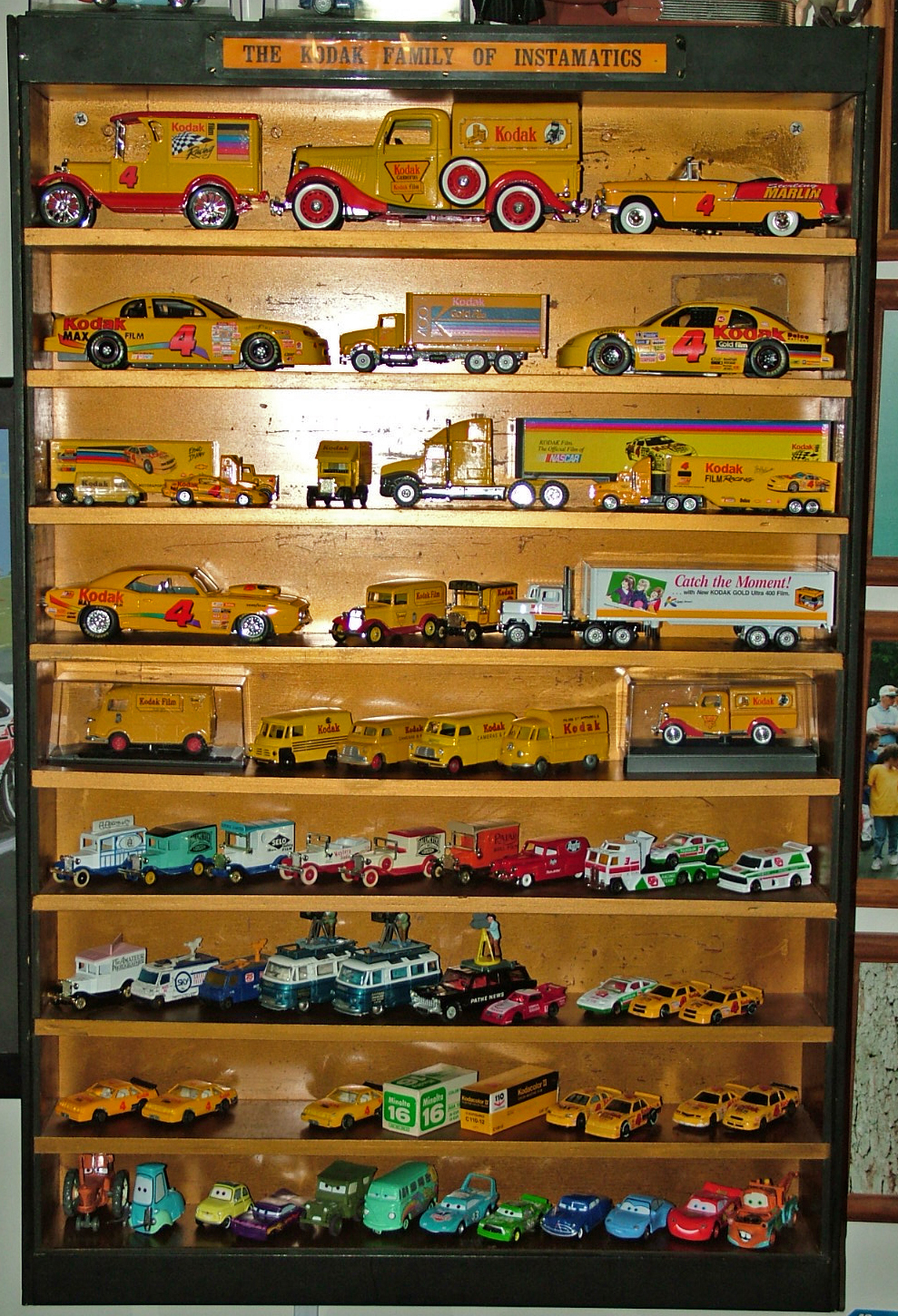
(After I sold all the Instamatic cameras for him, I brought home his entire camera related car collection. I sold them all off, save one Kodak van.)

Empty space on the seventh shelf is for a 1:24th scale die cast model of a 1964 Chevy Impala. I am in the process of making it look more like my first car in 1973.
Other representations of cars we have owned are: 3rd shelf down, a RED 1994 Chevy Camaro Z28, we had a white 1996 model. The model is a promotional model sent to Chevy dealers.
4th shelf has a dark red 1997 Chrysler Sebring JXI convertible. Ours was black with a black top and gray leather interior. The top is made of cloth on the model and raises and lowers. Same shelf at the right end is a Welly Audi TT in RED, ours was the blue you see on other TT models.
The 6th shelf has a 1974 Chevy Vega. We had the Kammback two-door wagon in real life. To the right of that is also promotional dealer model of a 1975 Chevy Monza 2+2. Ours had the 4.3 liter (262 cubic inches) V8 engine. My first NEW car was a 1979 version of it, but the front and rear end were different.
7th shelf shows a Porsche 924 Turbo. We owned 1987 924S model in black. The 924S has the 944 Porsche engine, the earlier 924s had an Audi engine.
Next to that is a plastic model I built to represent the 1941 Plymouth Coupe I bought when I was 18. I put a 1957 Chevy V8 engine with 3-speed automatic trans and all Chevy driveline. The model has the same driveline in place of the Plymouth equipment and looks like I hoped it would of, had I finished it.  
8th shelf holds a row of various era Volvo wagons, including a V50 which is what I have now.
That's me working on my 1941 Plymouth coupe. Photo by my little brother, Jim. I miss that hair and trim body.
These are cars either I, or my wife have bought. Since I have my rule, I have not opened them since I must remove others from the collection. More on them later.
The final group is in a cabinet I built originally to house my wife's Beanie Baby collection. 
Later it housed my reduced camera collection (below) and now houses these cars. Not seen are the final cameras, most of which were given to me, which total 13, from 16mm to 4x5" film sizes.

4th shelf from the bottom, on the left is a 1:20th scale model I built of a 1997 Chevy Camaro Z28. It looks like ours did. 
Next shelf down holds a 1:18th scale Subaru WRX wagon, of which we had a non-STI variant in the same color. Next to it is a Porsche 924 Carrera GTS in black. Next to that is a Denim Blue Audi TT, same color ours was. 
Shelf below that holds a Red 1985 Porsche 924, it is the last year with the Audi engine. No diecast models were made of standard Porsche 944 cars. I find that odd.
Bottom shelf holds two JADA Scion tC models. My wife bought a new 2005 tC model back then.
To the right are two 1963 Ford Falcon Futura models in 1:18 and 1:32 scale. Her first car was a plain-jane light blue four door Falcon with straight six engine.
I owned over 500 cameras in total. I invented a safe and secure method to house camera collections. I called it CameraLock
But, I'm getting off track. The shelf and wall of cameras were once on the wall behind me. 
Note the large NASCAR racers and a 1969 Porsche 917 in 1:20th scale.

I mentioned above that I'd talk about scale. We tend to assume, that a group of scale models will ALL in fact BE that scale. But that is not the case. 
A look at these cars show the vividly. Anyone who has seen a Shelby Cobra knows they are small cars. Yet, next to the red Camaro on the 3rd shelf down, they are larger than the Camaro, which is much larger in real life. 
While I don't have a Cobra to compare to our Z28, you can get an idea of how long it is.
Next shelf down, look at the dark red Sebring convertible. They are MUCH larger than a wee Volvo C30, and Audi TT.
This is a row of Ford GT40 race car models. While all are classified as 1:64, only the one on the left IS truly 1:64th scale. 
All are Mark I models which ran 289 small block Ford V8 engines. The black one is painted in the livery of the winning car in 1966, but that was a Mark II which used the 427 large block engine and had large cooling ducts on what would be the trunk lid on most cars.
A closer look at the two for comparison sake.

Here are two mid-engine Porsches to compare. A 550 Spyder from the 1950's DWARFS the Carrera GT which uses a V10 engine and is half a century newer and MUCH larger.
 A 1970's green Porsche 914, also mid-engine and a small car in it's own right is smaller than it's grandfather which is not the case in reality.
These are images of the cars still sealed to their cards.
I just found the Porsche Panamera WAGON the other day. It's actually a hybrid. A Porsche station wagon!
To the right are two 197o's Porsche 917 LH (Langheck is German for "long tail"). #18 in Gulf Oil colors and #3 was called the "Hippie Car" in the 1970 season.
My wife bought me many of these. My family owned a number of VW buses when we were growing up. She recognizes Gulf Oil colors and bought the Fiat. 
Two of the original run of Hot Wheels in 1968 recreated for the 50th anniversary.
3/5ths of the set of cars honoring Microsoft's Forza racing simulation dynasty. I simulation race, much safer and cheaper that the real thing.
In 2016 Ford returned to Le Mans, 50 years after their first win with 21st Century Ford GT racers. They won again.
Above is a Johnny Lightning 1972 Chevy Vega Kammback wagon. I owned a 1974 model, no options except a roof rack and it had a four-speed manual transmission. Never gave me a problem.
Below that is a 2002 Panoz LMP-1 EVO American Le Mans Series race car. I attended the one-and-only, Cadillac Grand Prix of Washington, D.C. race. The Panoz won outright. I have photos of it and all the other competitor's cars.
This image is from the end of the race when the winning Panoz is heading for the winner's circle.
She bought me another #72 GT40, having forgotten that she already gave me one. This is the actual 1:64th scale car.


Above represents Chad McQueen's (son of film legend, Steve McQueen, star of the 1971 film, Le Mans) Grand-Am Daytona Prototype race car in Gulf Oil livery. Sadly, he crashed the car and was hurt. He has fully recovered. I was shocked and pleased they chose to make a model of it.
A couple of close-up shots of the Fiat 500. 
I want the 1969 Mustang and McLaren racers from the same series, also in Gulf Oil livery.
I did not previously mention the Micro Machines cars which sit at the extreme right end of the shelf.
1950's Jaguar D-Type racer, the original 1950's Ferrari Testarossa, a 1965 Shelby Daytona Coupe, a Porsche 917K (Kurtz is German for "short") in almost Gulf colors and a C6 (I think) Corvette racer.
The bodies, for their size and price are pretty good. The tires are cartoon-like.

A 1948 Tucker Torpedo, a 1963 Ford Thunderbird, a 1970 Datsun 240Z (or "24 ounce" as I called it) and what I believe is a Fisker Karma. 

Since they are approximations of the real cars, I could be way off about the Fisker.
I hand wrote eight pages of lists of all the cars. Here are the totals by scale, smallest to largest:
1:87        2
1:64    159
1:43      14
1:32      15
1:24      23
1:20        1
1:18       16
Misc     16
Total 246 

Looks like more to me, but I double checked my figures. The grandkids ave almost 100 1:64 scale ones they play with. They look longingly at mine.

Thank you SO much for taking the time to read my humble blog. 

Scott
January 19, 2020
#349


Porsche 917 Le Mans Steve McQueen I Love Them All!

January 6, 2020
#348

Gentle reader,

Twenty four years ago, the eve of the Blizzard of '96, I married my best friend, soul mate and the love of my life.

But that is a coincidence. Today I write about another love of my life: Sports Cars and the racing of them. 

Born in the mid-1950's I was a car nut from a very early age. My mother says by age three I could identify any car I saw: Make, model and year. Methinks she exaggerates. But then, how many different cars could there have been in rural Kansas then?

A note on my images below. Short of taking everything that would fit on my scanner out of their frames and scanning them, I chose to shoot them in place. 
So, there are annoying reflections and in the one I used a flash, the reflection of it as well. Below, you can see my right knuckles reflected.
This is a print of a photo made of the winning 1970 Porsche 917K of JW Automotive Engineering's Gulf Oil sponsored team of three cars. Shot in the pits at Daytona in 1970. Probably made after practice but before the event. Paint chips from the sand adorn the front end, but by the end of the race, their damage was far greater.
A print of one of the most iconic images from the 1970 24 Hours of Le Mans. Signed by Vic Elford #25 and Brian Redman #20.
The image was made with a 4x5" press camera. Like the one below, which is mine. The film is sheets not rolls. 4x5" is the size of the negative.
The same type of camera was used to make the famous photo of the US Marines raising the flag over Iwo Jima in World War II.
Anyway, the photographer who shot it was standing in the ideal place to catch the start. 
However, the sudden roar of all those race engines starting at once startled him and he pressed the shutter too soon. 
To change film, one must slide a "dark slide" into the film holder. They hold two sheets inside.
Pull out the holder, flip it over and reinsert it. Then pull out that dark slide cock the shutter and aim.
By the time he did that, half of the cars had gone past him.
An image from the filming of Steve McQueen's 1971 release, Le Mans. Signed by Vic Elford and purchased from him.
A shot made during the 1970 Le Mans 24 Hour race of the winning 917K and "Hippie car" 917LH. 
Speaking of reflections, one can clearly see me above in this photo of a poster. Signed color print is inset. 
A line drawing of Brian Redman and the 1970 Porsche 917K he co-drove in the 1970 season. This car's engine was destroyed by his co-pilot as it was passing the pits during the race when he missed a shift and the engine over-revved.
Hollywood legend, the late-Steve McQueen loved racing and set out to make THE greatest racing film of all time. 
Above is a 1971 Gulf Oil magazine advertisement touting their part of it.
My loving wife bought this print and matted it and put it in a very nice black walnut frame.
This is some of the posters and art from the 1970 racing season. The reflections bother me, but shiny objects are hard to light without causing them.
The one at the lower right is a print made by artist Alain Lemere. Called "Mental Introspection". The print is #9 of 15 total. 
When I am interested in something, I buy everything I can afford about the subject. What follows are the books I have about the era and series.


The one above is one of several portfolios I have by Brooklands Books. They are every English language magazine article on the subject all bound into one book. I also have ones on many Porsche street cars.
Not to be confused by the book and now film titled: The Art of Racing in the Rain.
The one book I cannot afford is John Wyer's That Certain Sound. THE ultimate book about Ford GT40s and Porsche 917K racing.
An excellent book on the subject, chock full of wonderful insight and photos. I am certain I have the film (on VHS tape) he made at the same time but cannot locate it. 
An excellent book comprised of images made at Sebring that year.
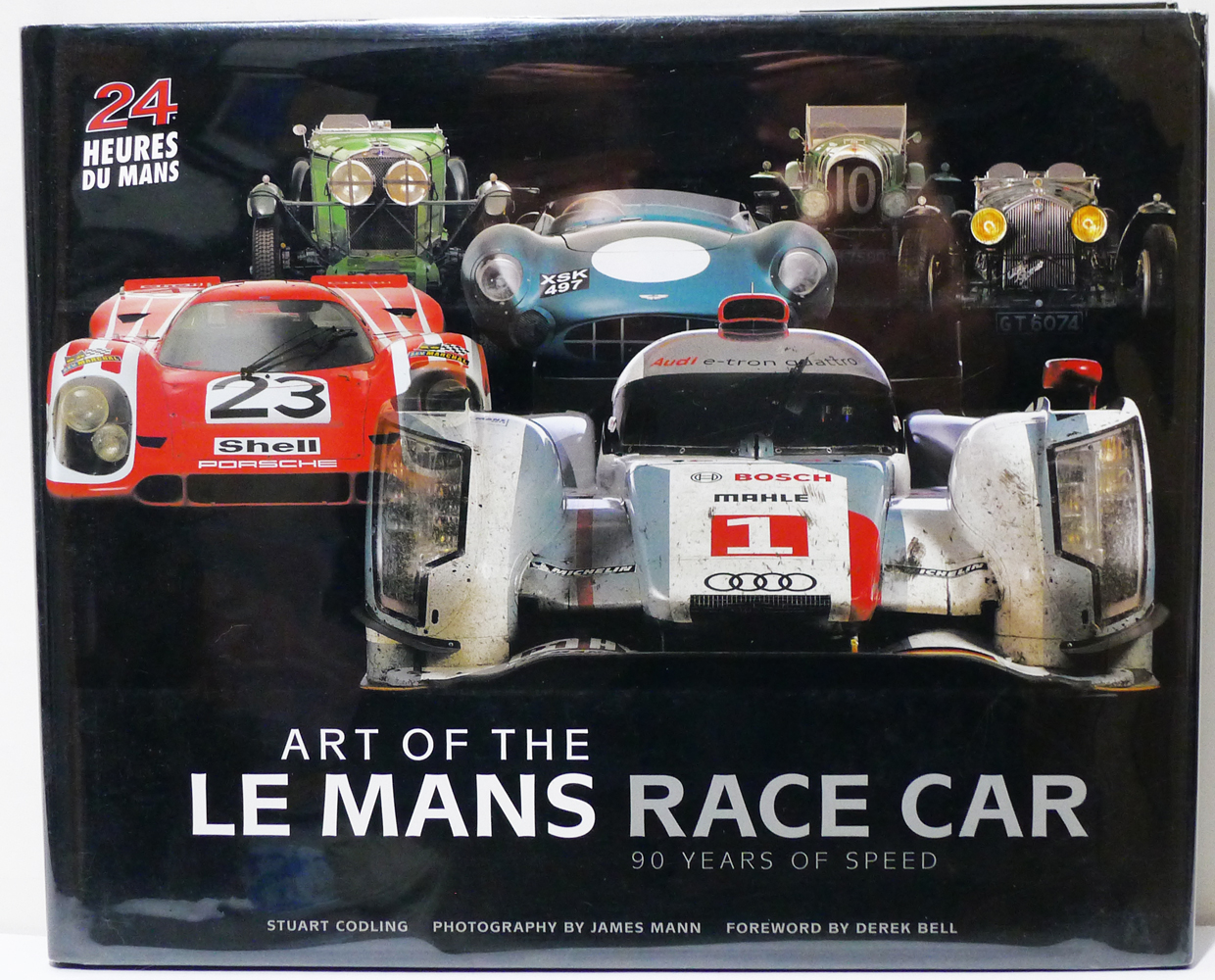
Other books on the racing, the iconic film and Steve McQueen follow. The one above is fantastic.
Michael Keyser who wrote The Speed Merchants also wrote this one.
Steve McQueen was not the only actor who loved to race.
Paul Newman was very successful (to say the least) as a racer.
As was James Garner. He had a team at Sebring in 1970, the same time Steve McQueen and Peter Revson were racing and almost won outright.

Today, another actor is also a racer and team owner: Patrick Dempsey. 
He was the racing director for the filming of  The Art of Racing in the Rain.
Which if you have not seen it, buy it on DVD, it is quite good and the racing is realistic. 

This is the first of (hopefully) a series of graphic novels about the movie.
My cars bookshelf, I built it some years ago. It is eight feet long and above the books is an area I covered with 1/4" Lexan which houses many diecast cars.
Our parents had VW cars, in fact theirs was the first one bought in their corner of Kansas. First a Beetle, but as we multiplied, a series of Buses.
I have no interest in open-wheel racing nor do I care for NASCAR.

I actually set out today to find Michael Keyser's film and grabbed these and the VHS tapes below on the subject.
When Le Mans came out in 1971, we were living in San Anselmo, California. I had just finished 8th grade.
I asked if my brother and I could see the film, it was showing in San Rafael, the next town over. Mom said, "Sure, if you can figure out a way to get there."
She did not count on my determination.
I obtained a local bus schedule and figured out what buses to catch to get there and back and when. She was so impressed she let us go.

When it was finally aired on TBS in the 1980's, I set the VCR to start at 2:00 AM.
I even got up at 2:00 to make sure the VCR was recording.
When I got home from work the next day, I rewound it and found that the second half of some other film was recorded and only the first half of  Le Mans!
I was so upset, I "wrote a strongly worded letter" to The Turner Broadcasting Station complaining.
The wrote back and apologized. They promised to show it again as soon as they could and would let me know by mail in advance when that would be.

Once it finally was released, I bought it on VHS tape. Then DVD and now have it on Blu-ray.

My wife and I got together with my son to see Ford V Ferrari. It was quite good.
But having grown up watching the races on TV, I (quietly) criticized the inaccuracies.
Nonetheless, they did a good job. The recreation and aging of the buildings and pits on the front straight was stunning.
Rural roads in Georgia (USA) were used for the racing at Le Mans. They reached speeds of 180 MPH on the long straight.
Again, if you have not seen it, do so.

Here is a link to a previous article I did which features diecast racers:
Ford GT-40s, Mark II, Mark IV and Porsche 917s at Le Mans 1965-1970 

Thank you SO much for taking the time to read my humble blog.
Your comments below and/or on Facebook are greatly appreciated.
They are what keep me writing and photographing.

Scott
January 6, 2020
#348

Whatever Happened to the Police Cars in 1970's TV Show ADAM 12? We May Have Found One!

  August 1, 2026 #550 Gentle reader, I am in my 70th year on this planet. Therefore, I have lived in eight decades. We grew up (once our par...