A "Modern" Dynaco Amp, Onkyo cassette and Amplifiers I have known

Gentle reader,

One thanks once again for taking the time to look at and read my blog. If you have done so for a while, you may remember that I started my audio journey in 1975 by building the then top-of-the-line Dynaco PAT-5 preamplifier from a kit. Dynaco was a top-flight audio company with a long history of making high quality great sounding equipment at a reasonable price. Made even more so by creating kits that the buyer built themselves. The factory assembled PAT-5 retailed for $400 in 1977 ($1,540 today) and the kit was $240 ($923 today). Prior to doing so, I had rarely soldered, I was 18 at the time. The directions were excellent and I enjoyed many years of great sound with that pre-amp.

For and excellent history of Dynaco, including breifly, the last company that bought the name and created state-of-the-art audiophile equipment. Dyna Company History 

I have only owned their modern version of the "Quadapter" that Dynaco came out with as an economical answer to the competing companies four-channel surround sound circuits. The "QD" series, again were an economical way to enjoy surround sound without having to buy a new receiver or amplifier. See below:


I have another one that I replaced all the spring-loaded terminals with proper 3-way binding posts so that I could use double-banana plugs.
A little rough looking, I admit but much more useful  and provides a better connection.

Anyway, I have coveted the modern Panor-made equipment and wanted to replicate the original PAT-5 preamp and Stereo 400 power amp I once owned with the newer equipment. When they do come up on ebay, I can never win one. 

For example, the modern Stereo 400 II power amp from 1992 retailed for $1,000 ($1,661 today) and the PAT-5 Series II from 1993 retailed for $750 ($1,209 today). 

Panor recreated or improved upon Dynaco designs such as: Stereo 70 Series II tube power amp, $995 in 1990 verses $170 as a kit starting in 1964 later available built for only $10 more. 

The most expensive power amp that Dynaco made prior to Panor was the 416A from 1977 which retailed for $950. At 208 watts-per-channel, it was powerful, large and very heavy. By the way, that's $3,653 in today's dollars. Cheap compared to most current audiophile 200 watt power amps.

To my delight, on ebay, a fellow in Ontario, Canada was selling a circa 1994 Panor/Dynaco Stereo 200.  Rated at 100 watts-per-channel retailing for $595 in 1993 worth in 2002 on the used market according to my 2002 Orion Audio Blue Book $312. List price in today's money: $935. He started the auction at $100 and I got it for that price. Took almost a month to get here, but arrived safe and sound. Sound's wonderful too!

Below is a visual comparison between the Dynaco Stereo 200 and the 130 watts-per-channel THX Certified Kenwood KM-X1000 power amp I've been using for a while now. Another ebay buy.

Both have thick solid aluminum fronts. The Kenwood has a whisper fan in the front and only the on/off switch. The Dynaco has level controls for each channel and a speaker selector switch.
Above shows that the Kenwood is deeper than the Dynaco.
The Dynaco is unusual in Audio equipment in that the AC input location is on the left verses the usual "industry standard" of being on the right. The industry did this so that all AC wiring can be kept separate from the signal carrying wiring which could pick up the 60 Hertz hum of AC current from the power cords. The Dynaco's is a standard IEC receptacle which allows for using a ready made audiophile power cord of your choice.

I replaced the factory cheap AC cord on the Kenwood with one I made from Belden's 19364 shielded cable. I will be making a power cord from the same cabling after the Holiday shipping frenzy has passed. I do not sell stuff on ebay after Thanksgiving because there are just too many packages moving around during the holidays.

I took the covers off each to make some comparison photos for this blog. Dynaco first.
Very neat construction, as you can see. Note the empty spaces marked on the board. These are for components used in the twice as powerful Stereo 400 II amp. Plenty of room for air to cool the heat sinks.
Note two descrete channels with very little shared. In this case, a Point for Dyanco. Better separation of the channels, little chance of "cross-talk".
Single AC transformer, called Toroidal. Toroidal transformers are far more expensive than traditional standard square one and reputed to sound better. Another Point for Dynaco.
Very thick heat sink for the eight power transistors. Holes in the bottom of the chassis for the cooling air to come up and over the heat sinks. A Point for Dyanco as far as heat sink size. 
                                                             Now for the Kenwood:
The components completely fill the chassis. The holes for air in the bottom are much smaller.


Note dual transformers, one for each channel. A Point for Kenwood there.  

Components are not discrete here. Both channel share everything. Minus one Point for Kenwood.

I did not make a photo of the Dynaco's transistors, but the Kenwood's are larger. Does that mean anything? No. They put out 30% more, so that may be why. By the way, a 3 decibel increase in volume (twice as loud) requires a DOUBLING of amplifier (watts) power. Therefore, the Dynaco Stereo 400 can only play 3 decibels louder than the 200. They Kenwood can play louder, but how much so? I do not know.

The Kenwood, being larger and having two transformers, weighs considerably more than the Dynaco does. Again, that doesn't mean anything. Their weight might be much closer had the Kenwood a single transformer.

Now as you may recall, I replaced the thrift-store-found SONY home theater receiver in here with an Onkyo A-RV401 integrated stereo amplifier made from 1991-94, which retailed for $410 then. Also found the next week, was it's matching T-401 digital tuner which retailed for $200 then. 

Last week, I found an older but still (R1) cassette deck, model TA-2120. Made from 1988-89 and it retailed for $220 then. Here is a photo of the stack. Less than $10 to buy. It works perfectly.
The photo was shot from this chair where they are all within easy reach. The top component is the SONY universal player for CD and SACD use.

AMPLIFIERS THAT I HAVE KNOWN (AND OWNED)

 While I would like to show you in chronological order, the amplifiers that I have enjoyed since 1975, that would take far longer for me to look through all the pictures I have to find them. I will start with the original Dynaco PAT-5 pre-amplifier:
It is partially hidden buy the plants. This is after leaving the "prior life" (our former marriages) but before marrying Nancy. Also shown is one of the Dynaco A25 speakers. I can't tell what brands the other components were. Above the PAT-5 is an FM-5 tuner.

My first power amplifiers were also kits, but I couldn't afford any Dynaco units so bought two SWTPC Tiger .01 mono amplifiers. I found a wonderful web site all about SWTPC products and here is a link to the Tiger .01: .01 | TigersThatRoar  Nice trip down memory lane for me, this site!

Everything seen above, save the PAT-5 and A25 speaker were thrift store finds, most likely. This photo is a scan one ones made with my first real camera: Olympus OM-10. I bought it from a pawn shop in April, 1995. 

The equipment that follows is in ALPHABETICAL order as found in archival photos in my computer.

First off, is the Adcom GFA-585 250 watts-per-channel, it was powerful, large and very heavy. It and the matching preamplifier and power conditioner were all found in Salvation Army for $149.99 for the set. Was I psyched that day! The GFA-585 sold for $1,200 in 1990, that's $2,140 today.

Note the huge toroidal transformer and two completely discrete channels. Each channel uses TEN T03 type transistors. The Tiger .01: two of them.

So, you may be thinking, "Why don't you still have it?" Good question. I turned it on one day and found the left channel didn't work. Found the fuse blown and the speaker's woofer unable to move.
An autopsy of the woofer revealed the voice coil had melted. This indicated a serious problem with that channel. A search found Adcom power amps to be prone to the large blue capacitors leaking toxic fluid. So rather than facing a possibly costly repair I sold it on ebay. 

Next up is the cute, tiny but awesome AIWA compact components that my Barber GAVE to me! They were nasty with nicotine and dust, but cleaned up nicely. Each is not much larger than a car stereo. I've featured them before, so won't get into particulars. Below, all cleaned up:
They are housed in an optional cabinet that AIWA made for them. 
Next, I have a Denon stereo receiver, the DRA-425R. From 1988-91. Rated at 50 watts-per-channel. Retailed for $450.


Nothing that fancy, but take a look at that heat sink assembly! The tube is bolted to the actual heat sink the transistors are on and has a fluid that carries the heat over to the larger fins. Cool!

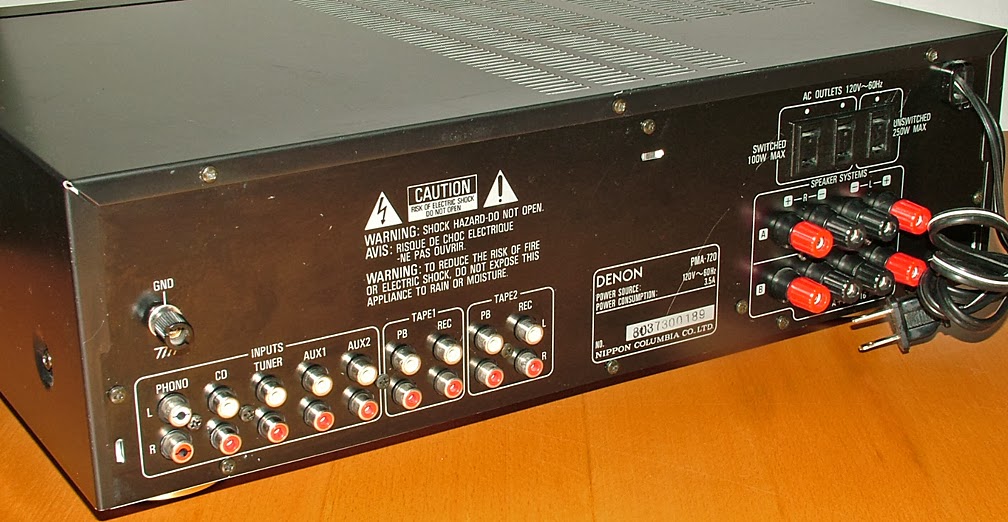
Looking through the many pictures, I see that I have owned a LOT of Denon equipment! Next up is the PMA-720 a stereo integrated "Optical Class A" amplifier. Made from 1988-91 and retailed for $450. Rated at 90 watts-per-channel. 

As you can see, a toroidal transformer and the four capacitors of a split power supply. 
Now, thanks to ebay, I was able to finally own that huge Dynaco Stereo 400 200 watts-per-channel
amplifier. I bought another PAT-5, the Stereo 400 and another FM-5 tuner. 
Didn't I tell you it was big? It was a bargain, too! 
Above is the rear of the PAT-5. I actually had three of them. Below is the interior shot of one of them. One had been modified by someone of note. I can't recall his name, nor whether this one is stock or modified. Remember this is a preamp, so no power transistors, etc.

You can see the color difference of the two of them above and below.
Below is the rear of the Stereo 400.


Prior to owning the above Stereo 400, I had a unique (one-in-the-world) Stereo 120 converted to Dual-Mono. It was rated at 60 watts-per-channel. See the manual below, followed by front, rear and inside photos:


As you can see above, he added a second transformer, capacitor and power supply board. All in the very tight chassis. Talk about heavy!

I'd forgotten about the Dynaco surround sound receiver pictured below. It doesn't appear in any Dynaco paperwork I've ever seen. In fact it was a "badge engineered" version of another company's unit. 


It's model number: 2583 does not compare to other product names nor is there any information on Dynaco ever having made a home theater or any other receiver.

Next was an unusual find. Fisher was once known for very nice equipment, but like so many other great names, they were sold and bought and the quality of their equipment suffered.
 It is a CA-9335. No listing in Orion but a similar unit is the CA-9050 which was part of a system as was this unit. See the three little connectors below? They hooked with special cables to units in the system. It was the way to have a stack of components that looked good, but in fact were only marginal in performance.
Another thrift store find was the Harmon/Kardon (another of those brands that have seen better times) HK-3500 receiver. Made from 1990-93 and retailing for $550, it was rated at 50 watts-per-channel.


The ONLY TUBE equipment I ever owned was one that has been widely copied. The INDEED tube headphone amplifier used a triode tube to drive both channels. I was not impressed. 

In January, 2011, I found a bunch of goodies all at one store:
Some of them I have written about before. The Spendor LS3/5A speakers (bottom pair) were as far as value, one of the BEST bargains I ever made: $10 for the pair. Retailed for $1,295 a pair!

My first and so far only encounter with purely digital equipment was the following JVC RX-402B digital hybrid receiver. I had nothing at the time that put out HDMI so could not test it. 

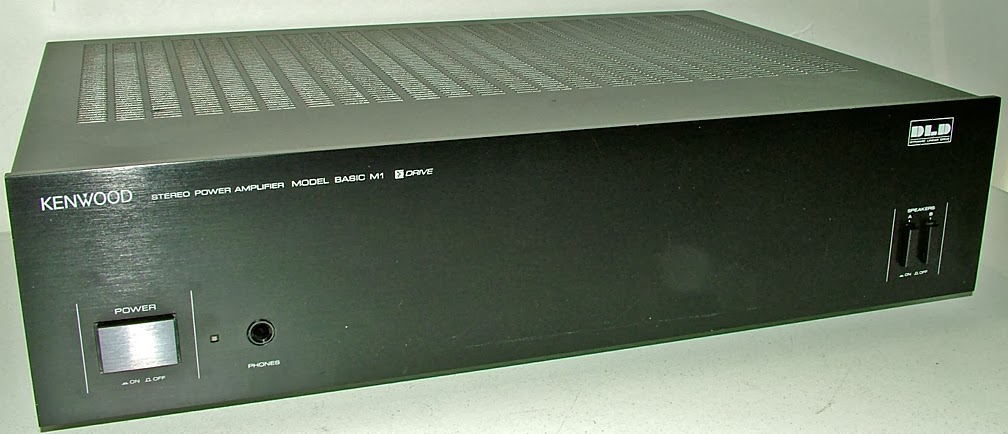
Next in the list is another Kenwood, the Basic M1 power amplifier, Made from 1982-84 and rated at 105 watts-per-channel.
 It was designed to "read" the feedback from the speakers and make some adjustments to work better. Snake oil? I don't know. It required a separate third wire to each speaker.


The one-and-only Marantz unit I ever owned was this nice Model 2220B receiver. Made from 1974-77, it retailed for $350 ($1,655 today) and put out 20 watts-per-channel.

Check out how neatly everything was arranged inside. Marantz continues to this day making products with high performance and high pricing.

Above are the stereo pairs of T03 type transistors mounted on their heat sink for cooling.


One of the most sought after kit I managed to buy were Mitsubishi's line of "Dual-Mono" equipment from the late 1970's. Comprised of either a receiver, or tuner/preamp combo and a separate power amp. Three were available rated at 75, 100 or 150 watts-per-channel. I had the latter. 

Above is the front of the power amp and below is the rear. 

Above is the power amp mated to the optional meters. Below shows them separately.

Above is the meters and below, the front of the preamplifier.
The preamp could be mated to the power amp instead of the meter. The connections were on the sides to facilitate this. Made for a huge and HEAVY unit!

Below is the AM/FM tuner. All came with these large handles often associated with rack mountable equipment.


The only other Mitsubishi equipment I have known is what was called "midi" larger than the mini ones like the AIWA equipment above, but smaller than the standard 17" wide.


Comprised of a integrated amp, cassette deck and tuner. They also made a matching full size turntable. They were all linked by those little black wires. Designed to alert the amp when a source component was turned on. The amp switched automatically to that source.

Next up, and I don't know why I don't have a photo of the front, is a NAD 7240PE receiver. Made from 1986-92 and rated at 40 watts-per-channel.It used "Power Envelope Circuitry"


As you can see, it had "pre-out main-in" RCA connectors so that it could be used as a pre-amp or power amp. 

I have found a number of vintage Pioneer equipment, I won't document them all here, just the nice separates below: 

I have had at least four different SX series receivers as well. Orion does not list the above equipment.

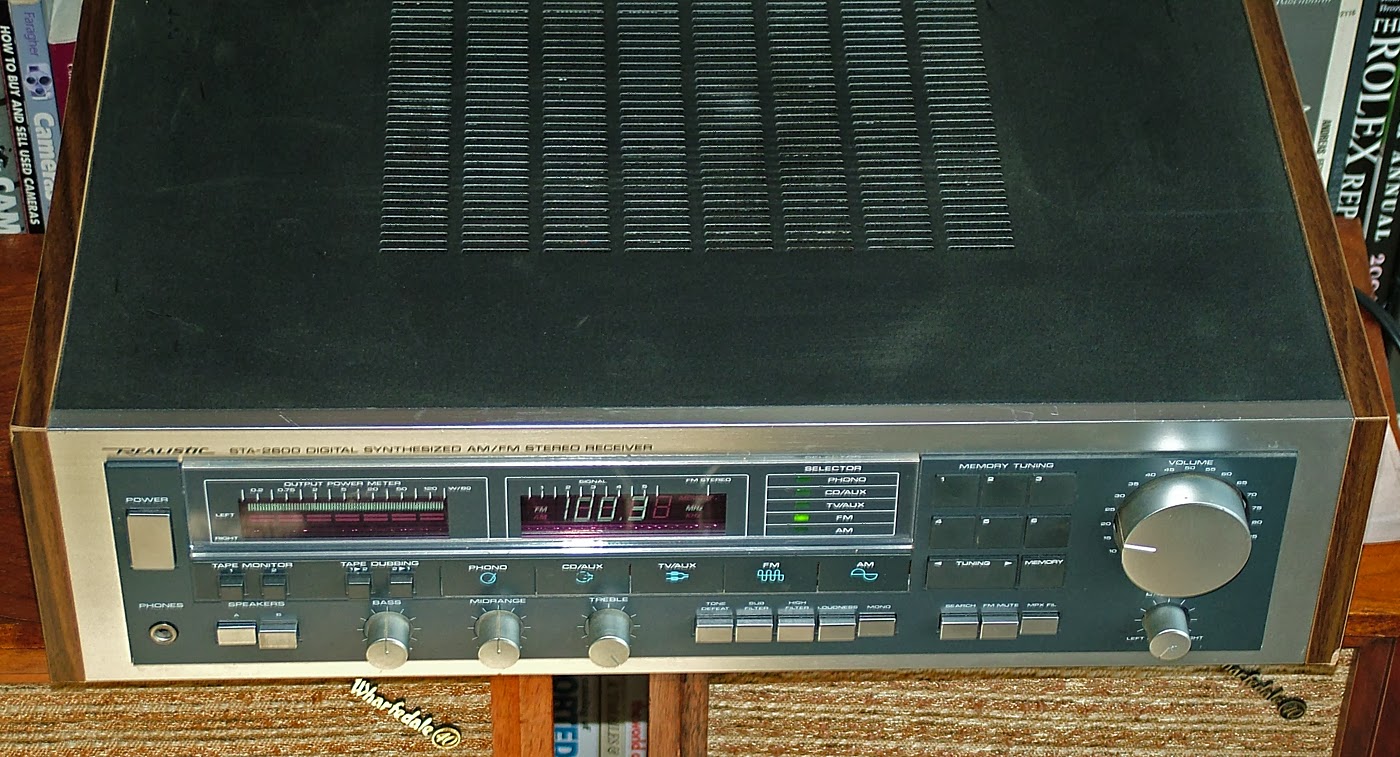
Radio Shack used to be known for something besides cell phones, they used to sell their own equipment under the Realistic and Optimus brands as well as other names.


Something I found at an outdoor flea market was the Rotel power amp below. Model number RB-980BX. Sold from, 1992-97 and rated at 120 watts-per-channel or 360 watts in bridged mono.


 Through the vents, above you can see the toroidal transformer and heat sinks.
Under Radio Shacks Optimus brand was this nice STAV-3470 home theater receiver. Made from 1996-97 and rated at 110 watts-per-channel. 


Featured above in the January finds is this awesome Sansui Au-717 integrated amp. Made from 1977-79 it retailed for $550 and was rated at 85 watts-per-channel. 


A pair of Sansui components that were sadly damaged in shipment were based on an earlier pair with different model numbers. Thus these were called "Classique". No info in Orion. 


Below is a photo of a Sansui Quad receiver that was our introduction to surround sound home theater. I'm not sure if it is the exact model. It was very wide and heavy. The circuit Sansui used for Quadrophonic is what Dolby later used for their early surround sound for home movies.
A unit made for professionally installed home theater applications, I found on ebay. Made by Sherbourn it was rated at 75 watts-per-channel.


Again, not much larger than your average car stereo power amp, it packed a lot of quality in a small space. 

SONY has made a number of pieces that I have had for a while. 

Below is the SONY that I used to have in here which the Onkyos replaced. Had I the remote, I might have replaced the Yamaha in the living room with it.


Well, that's all I'm going to list today. I also had several Yamaha home theater receivers of various sizes and vintages. The one in the living room works and sounds great so I see no need to replace it. WHEW! This was a lot more work than I though it would be. Thanks for your patience!

Scott 

New Digital players join the Den stereo DAT!

Gentle reader,

Once again, thanks for taking the time to look at and read my blog. More than 32,000 visits so far!

After a LONG dry spell at the local Salvation Army, I was delighted to find several medium-to-high end brand name electronics to choose from. 


To begin, I spied this golden SONY first thinking, "What the heck is that?" Then I spied DAT on the panel in the center. "COOL!" I plugged it in, pressed the open button, and out came a tiny DAT tape cassette. Looks and works like a tiny VHS (or BETA) video cassette. Closed it, hit play and the meters showed it was working. 
It is a SONY DTC-2000ES. Called the BEST DAT machine ever made it retailed for, get this, $2800 in 1994! Easy to see why DAT never caught on with consumers. 
Recording studios loved them, however. I have been thinking about making tape recording of LPs and then transferring the music to CD on the Pioneer CD recorder but didn't want the reduced range and tape hiss. Well, this DAT will solve those problems. I found a seller on ebay selling 90 minutes sealed SONY brand DAT cassettes $25 for five and ordered a set of them.


Next up was a CARVER five disc CD player with rack handles, but oddly, no rack mounting holes. Anyway, CARVER was a fellow known for top quality home electronics and if I recall correctly he worked for Dynaco for many years. This puppy retailed for $600 in 1994 and was highly reveiwed.


Above, LUXMAN a name still revered in the high-end audio market for excellent equipment. This cassette deck also from 1994 retailed for $380. Were it a three head model, I would keep it. But since I previously found a three head JVC unit (to be seen below) it's bound for ebay as is the CARVER.


Above is what is called "The best sounding five-disc CD player ever made." Made by Nakamichi in 1998, it retailed for $1175! That's big bucks. It has already replaced my beloved Denon DCM-380. While the Nak' doesn't decode HDCD discs, the OPPO in the surround sound system does. It really does sound fantastic!


Finally, above is the SONY DAT and Nakamichi CD changer in place in the Den stereo setup. 
For the first time, I'm down to only one Denon component where once they all were. 
 
When I was telling Nancy about the changes, she was holding her lips closed. My electronic changes are a source of puzzlement to her. Well, she rarely even GOES into the den, and never plays music in the house unless from her ipod in the little stereo player I got her for that purpose. Plus, I'm not changing the living room setup. Well, no plans to anyway.

Thanks for looking,

Scott

In the 1960's it was G.I.Joe. Now it's..................

Gentle reader,

If you follow my blogs, thank you very much! I'm always astounded at how many people have visited here.

As a kid, being a typical American boy, I played, er, interacted, "yeah, that's the ticket!" with G.I.Joe action figures. And built models, and played with HO slot cars. THEN we moved from Marin County, California (just across the Golden Gate Bridge) to Denver, Colorado. 
Unbeknownst to us (my brother and three sisters) Mom and Dad "donated" a BUNCH of our toys! When we were unpacking, all five of us were saying things like, "Hey, wheres my....?" That was the last I saw of my G.I.Joes and HO slot cars.

Sometime after marrying Nancy, we came across a "Toy Show". It featured vintage, collectible and some new toys. We found SO many things that we used to play with. Yet, I merely looked at the many G.I. Joes that were there. As you may have seen, many things like HO slot cars, HO scale trains, Dawn Dolls and other things we began to collect again.

It wasn't until earlier this year that I came across in one of our thrift store haunts, a new-in-the-box modern iteration of the classic G.I.Joe. Different company and WAY more detailed. It was less that $20., so I took the plunge.

Thanks to ebay, I discovered this whole 1/6th scale world out there! Some VERY expensive figures with incredible realism! In photos, one could easily be convinced you were looking at a real person. Such is the attention to detail.

In an effort to declutter in here, I decided to photograph my figures and carefully put them away for a future time that I can create diorama sets to display them. I photographed all but one in front of the inside of a box that held a 10" (1/6th are 12" tall) action figure that I bought for my grandson. I shot each with flash and without. I found the "without" shots more realistic and three dimensional. 

I was determined to assemble a set of figures from World War II to present day. From my years involvement with the U.S. Marines, I concentrated on USMC uniforms, mostly. In some cases, I bought a nude figure and uniform, boots, hats (covers in the Marines) helmets, weapons, etc. 

First up, below is a very detailed U.S. Army paratrooper from D-Day (June 6, 1944). His weapon is a folding stock M1 Carbine rifle. I don't remember any of the makers of these various figures.


Below is an Army figure from the Korean War. The seller said he looks like Harrison Ford. He's standing next to one of a series of diorama displays that hooked together. This one is for the outside of a M.A.S.H. tent. The only thing missing is the sling his M1 Garrand rifle should have.

Below is a Marine from the Viet Nam War. Figure, M16 rifle, helmet and cover and boots are all from different sources. Some might argue that it is a WW II uniform. The detail is much less that the other figure's uniforms and equipment. 

Below is the "Woodland" camo uniforms that all branches of the U.S. Military all wore. Now only the National Guard still wear them. The rest have gone "digital" with each having their own pattern and look. See: The Robb Collections: A Study in US Military Uniform Camouflage
 

Now skipping ahead to pre-Desert Storm, we have a uniform more suitable for rocky/desert situations. Note the "boonie hat" instead of a helmet. Also the tan suede boots. This photo shows the whole box background.
Note that the vest and other equipment was still in the Woodland pattern. Uniforms were much easier and quicker to manufacture than the vests and other equipment that U.S. forces are famous for draping themselves with. The UK (British) troops refer to U.S. forces as "Ninja Turtles".
Finally, below is a U.S. Marine wearing the digital Woodland pattern uniform. BTW, that helmet actually IS metal, covered with fabric. Note the modern M16/M4 with adjustable stock and 30 round magazine. 

Below is a set of FN SCAR rifles that the U.S. Military Special Operations COMmand (SOCOM) tested and accepted for their elite troops. Nancy's nephew, Matt was shocked at the amazing detail. They are accurate right down to the magazines being painted tan only on the portion that shows when in the rifle. 
They are the two versions of the SCAR. Note the physical differences. Seeing that Matt owns a real FN SCAR, he vouches for the accuracy. I was bothered to see the folding front site of one is missing. It may have been vacuumed up at some point after the fellow holding it fell off the shelf.

That's it for now. I feel good about the area in here being less cluttered and easier to move around in. Thanks for looking!

Scott

Forza 4 verses Gran Turismo 5

Gentle reader,

There will be no photos or videos with this post from my racing. Mainly because I don't yet know how to capture either AND get them on the Internet. I did upload a replay video from Forza 4, but where it is on the web?

OK, for the rest of this article, I will be abbreviating Microsoft's Forza 4 as F4 and Sony's PlayStation 3's Gran Turismo 5 as GT5.

First some personal history. I have been into cars since I was two, that means 55 years. I am old as far as "gamers" tend to be. I played with Aurora and later AFX HO slot cars as a kid and later when my kids were in their teens I got back into it. No RC cars in my past. My favorite type of car racing, is and always will be "road" racing with sports cars up to and including "Prototype" cars. Road racing once met they raced on public roads closed for the event days, but the rest of the year, they were regular roads. Today, they are called street circuits and city streets are lined with purpose-built Jersey walls topped by thick, strong wire fencing which hopefully will bounce an out of control race car back onto the track. Google "ALMS Baltimore" to see a replay of the races there to comprehend "street circuit".

Another car related activity, I have built many car models in my lifetime and have dozens waiting for.....retirement(?). Sadly, though die-cast replicas are generally far better made and detailed than I am likely ever to compete with. So it is hard to get motivated to work on them. There are so many other things I can do in my spare time. Of late, racing simulations are my obsession. There, I said it. Yes, I have made my wife a gamer's widow! She is not alone.

In the past. we bought various game consoles for the kids and even tried some ourselves. I found "racing" games to be unrealistic because in most cases, the driver's (aka: player) was behind and above the car. Perhaps this stems from the designers themselves once playing with RC cars. I don't know. PLUS, I can not drive or race a digital car unless I have a steering wheel and pedals. See:


My experience with racing simulations all started with a friend giving me the PC (as is computer) game Test Drive Le Mans. Being that Le Mans racing (now called WEC and it's soon to be gone American cousin: ALMS) is my all time favorite type of racing, I was quite excited and pleased that he gave it to me. This was about 2001. I tried with the keyboard, but....well, you know. BTW, this is when I was a novice to this whole Internet thing. Remember dial-up? I found a steering wheel and pedals set for PC with USB plug at a local computer store made by Logitech. It did the trick and I was immersed in the game. Little did I know that Sony and later Microsoft were hatching plans to create realistic racing simulations. Below is an image of Test Drive Le Mans, and both GT3 and GT4 covers:

 
 https://encrypted-tbn0.gstatic.com/images?q=tbn:ANd9GcQudvRcwrjHvuvBoO6AZD5o9KbuLQMQWikf_POawMKhy-viB_La75xQRtVZ


I tried other PC racing games, but they didn't compare. Around 2003, my step-daughter, Bekka, bought me a brand new Sony Play Station 2 (the latest thin kind) and my son, Daniel, bought me Sony's GT3. Which is short for Gran Turismo. I was hooked and later bought GT4 and the Logitech wheel set designed and sanctioned by Sony for GT4. If you looked at my linked page above, you saw the collapsible stands I built for them. BTW, I just yesterday I modified the stand for the PS steering wheel kit with uprights like the one for XBox. Makes it easier to get in and out of and just looks better too.

The ONE thing I really wanted to see was in-cockpit-view. I wanted to "sit" inside each car, see the controls and hands on the wheel. GT4 has something like that with gauges and a rearview mirror suspended in space, but not really the interior. But it just isn't enough.

Daniel bought an XBox 360 and Forza 3. He, being born with a controller in his hands, had no problem with mastering the game. To my delight, F3 had in-cockpit-view! The one wheel set that I bought at the time so that I could race also, I think it was Madkatz brand did not work well, and being used to GT4 I was lousy at Forza 3. Believe me, it takes lots of patience, practice and determination to get good at these sims. In F3 was available Porsche 944 Turbo. It looked identical to my real 924S. Also there was the Audi TT, again, identical to my TT. Cool!

When Forza 4 came out, he bought it and was thrilled with it. I bought him a genuine Microsoft steering wheel/pedals set which he loved. Even though he excelled with the controller.

OK, now for the meat of what the title shows. Thanks to Daniel moving in with his big brother, he lent me his XBox 360 kit and Forza 4. ALSO, thanks to Jonathan, Bekka's Marine husband (now in Okinawa) HE lent me his Play Station 3 and it accepts the same GT4 wheel set. I bought GT5, the complete game, at 2nd & Charles, used and for a bargain price. I was all set.

I was SO excited to finally be able to use a PS3/GT5! At this point, I'd been racing in F4 for a while but it was not an obsession, just something to do. Getting into GT5, I found it was quite different from GT4 (plus one cannot import data from GT4) so one had to start from scratch. For that matter, GT4 was quite different than GT3. Again, thanks to Jonathan, I downloaded a bunch of cars and tracks INCLUDING: Subaru BRZ (right hand drive), Scion FR-S (left hand drive) AND Toyota GT86, (right hand drive). Go Karts were included in this including a couple indoor tracks. Very challenging and very fun. 

I quickly won races, credits and cars in GT5. Getting up to Level 22 and over 1,000,000 credits. However, some races eluded me. Now, I've been "racing" for ten years, always with steering wheel/pedals. So I knew what I was doing, but the higher level races were simply too hard. Being it man, this is quite hard to admit.

A friend/co-worker's son ALSO gave him HIS XBox 360 and Forza 4. Steve too was really getting into it and got me fired up about it. So, the PS3 got put aside for a while while Forza 4 took up a LOT of my time. He is up to level 180+ and I'm at 156. Yesterday after modifying the wheel stand, I gave GT5 another whirl.

I became frustrated with: The SOUND, it sucks! Where is the exhaust note? These are racecars and as such they are LOUD. But not in GT5. Again, being very experienced, I became frustrated with not doing well with true racecars verses other racecars in GT5. Plus, reverse is gained by pressing the triangle! So, back I went to F4.

Now for the specifics:

Graphics. GT5 holds the edge, but only slightly over F4. The sensation of speed seems more accurate in GT5. Still, I prefer F4. Driving the Nurburgring in each, one can see differences. There are plenty of web pages with videos and stills comparing them, so I won't go into that.

Sounds. F4 has amazing engine and other sounds for each car. Both have more tire squeal than real racecars have. I've listened to countless hours of real in car laps in many kinds of racecars and I never hear any tire squealing. Crash sounds are extremely realistic and loud in F4. In GT5, it's a kettle drum: thump! Thump? Really?

Cars and tracks. While many of the made-up tracks carry over from GT4 to GT5, they do have some very detailed city courses. The made-up tracks in F4 are fewer but with genuine details and the real tracks have many configurations as do the real one.  Thus making for shorter or longer racing laps.
I have every car available in F4 and "own" over 160. In GT5, I have 70. They are divided into Premium and Standard. Premium are ones that you bought with $cash or credits. They have realistic interior and in-car-view. The standard cars have blacked out interior with the same two floating gauges but hidden in the murky interior are the driver's hands.
If a car has paddle shifters in real life, that's what the driver uses in GT5. However, the way the hands hold the wheel is strange. The thumbs are straight up on the outside of the wheel and when "he" goes to paddle shift up or down, the hand raises up and seems to reach behind the wheel. Weird. 
In F4, the hands grip the wheel correctly, as far as paddle shifters in most cases, "he" uses them, naturally. Lower cost cars such as a Mitsubishi Evolution X which has paddle shifters, "He" still reaches down to shift the lever. ALL cars in F4 have accurate interiors. Repeat, ALL cars. 
Porsche only allows their cars to be in one company's game and though sub-licensing, F4 has them too. In any GT version, only RUF cars are available. Still Porsches, but fewer and no race cars.  

Types of racing. GT5 has the edge here as it offers Rallying, and yes, go karts. Plus weather changes, night racing and combinations such as the Nurburgring 24 Hours which combines the F1 track and "ring" together just like the real race. In F4 one may be able to choose sunrise for instance. And it adds shadows and glare as in real life. 

Realism. Both GT5 and F4 offer amazing realism in every detail. With my setup, being so close to the HDTV, it is easy to get total immersion. The shine on sheet metal, the feedback through the steering wheel, the physics of load and G forces, all as real as one can make in their home.

Fun things. I haven't really explored what one can do besides race in GT5, except upgrading. In that, it is fairly simple. Weird thing, is no Brakes category, however. Every modification cost you credits the higher output you desire, the more you pay. In F4, one has "quick" upgrades which take the car to higher classes buy selectively reducing weight and adding power. IF you race and win four or five races with a stock car in F4, you have earned free upgrade parts. Tuning in GT5, I haven't tried. In GT4, one can adjust many factors. In F4, it is limited as far as I've seen to tire pressure changes.
In F4, one can do engine swaps, change a car from front to rear wheel drive, even make some all wheel drive. Once can paint, apply vinyl wraps and sponsor decals. Although I have yet to figure it out. Hundreds of thousands of F4 fans HAVE mastered it and offer their designs for free or for credits. ALL my F4 cars now LOOK like proper race cars. Well, my GMC Typhoon SUV looks just like a US Border Patrol vehicle and my Audi RS6 sedan looks like a German police car.
Speaking of RS6 Audis, GT5 offers the Avant, or station wagon version. Twin-turbo V12, AWD station wagon? Oh, yeah! Neither offers Cadillac's CTS-V wagon, though. 

Climbing levels. In GT5, there is licensing. I.e., earning your racing licence. Tough to do, especially the last one, driving a Honda CRZ hybrid around Indy and passing at least six cars. Easy? Not for me. I got past five each time and no more. Turns out you don't need a license to race. In F4, no such thing. In GT5 win a series of races and you win a car. Same for F4, but it's for each level which is 50,000 credits. A choice of cars and bonus credits which amount adds 2500 each level. Past level 50, no more free cars. Past level 150, no more bonuses. 

Dificulty. One can choose the dificulty in F4 in many ways. I made my choices to always shift, traction control, ABS, and car-computer-controlled overrides if you get to squirly, ON. Driving line, braking only. AI (artificial intelligence) cars are set at medium. I've tried hard, it is! I don't need that much frustration in my life! 
In GT5, there is no choice that I can find. Weird thing in GT5 is you can choose any car that meets the races's needs. English cars? Jaguar Prototype verses street cars. In F4 you have to have the same CLASS of car as the AI cars.
The all Ferarri race, I chose a car I could afford, even with all the money in mods I put in, I still can't get close! Another level 19 series, I'm driving my Jaguar Prototype and doing well, but one screw up and that's it! OK, so in real life, there is no "RESTART" like there is in F4, but GT5 doesn't allow it at all. Give up? On to the next race. Try again, yeah right! In F4, you can keep trying until you win. 
I think SONY has made the GT5 sim too relistic, thus unobtainable for most to fully enjoy and progress. On the other hand, SONY and NISSAN have teamed to allow the best on-line racers to actually get a chance to be a REAL racer! That is too cool! See:

Introduction - GT Academy - gran-turismo.com

Final thoughts. As others have indicated, IF you are fortunate enough to have both consoles and you love racing, by all means do both! Eventually, Daniel and Jonathan are going to want their consoles back. In the case of F4, I can save my garage and records/levels on a USB drive and (hopefully) transfer them to an XBox I might buy. I probably wont miss the PS3. I always have the PS2/GT4 to fall back on. I'm really good in it, but will really miss the graphics of GT5. I have tried dozens of other racing games in PS2 and the XBox 360. But not in the PS3. Most are fun, but having the technical know how and financial backing of SONY and Microsoft makes GT5 and Forza 4 the best at what they do.

Best of all. These racing simulations allow me to be a "Walter Mitty" and drive/race in cars I am highly unlikely to see, let alone own, on race courses all over the world. All for low cost, no danger and no leaving the house!

Will I buy a PS4 and GT6? Not likely. An XBox One and Forza 5? Maybe. But I have a LONG way to go in F4. Plus, F5 requires HDMI and it doesn't work on this HDTV. One of the main reasons we bought a new one for the living room. HDMI so simplifies hookups and full digital sound and picture. 

Thanks one again, for taking the time to read my ramblings. Just think, if those guys that love "first person shooters" or killing games instead were racing, perhaps a lot more people would still be alive and cries for more anti-gun laws would not be heard. Just a thought, not a sermon.

Scott

Have found a few collectible cameras, even though I don't collect them anymore. Right.....

Gentle reader,

I thank you most humbly once again for taking the time to read/view my blog. 

I still routinely tour the various local thrift shops for the things, and if you're a regular reader, you know what those "things" are, I like to dabble in. Therefore, I needed to create room in the cabinet. I squeezed all the GULF colors Porsches and Fords onto one shelf.
I also moved the Ford Falcon, a fancier 1/18th scale model of Nancy's first car up with the others.
Lest you are concerned, that is not a real pistol. 'Tis the now afflicted gas blowback 1911 airsoft pistol. Below the cabinet is the top book shelf that contains many of my favorite books from my youth. Gotta love ABEBOOKS and ebay for finding them!
Above, you can see I squeezed the Pentax AF film SLR (silver one) next to the Olympus OM-2S. To the right of that is a Sears branded Ricoh manual focus film SLR. It is also Pentax K mount. Directly above that, next to the Leica is a Canon Canonet G-III QL rangefinder 35mm film camera. The best of the Canonet line. So that makes 23 cameras on those three shelves. Believe it or not, one of the tiny ones IS a real camera!
Above, the left two were gifts from one of my sisters. Next the Rolleiflex TLR, then two of my late father-in-laws movie cameras. Lastly, looking more like flashes are the two Olympus dedicated units for the SLR and ZLR cameras above.
Lastly are the big ones. The "Press" camera was an unexpected gift from my father-in-law. It takes 4" by 6" sheet film. The one on the right is an all-paper camera that I made from a kit. It uses 35mm film and a pin-hole lens for long exposures.

The only film cameras not on display are the Voigtlander Bessa R with all it's lenses and the Olympus OM-10 and all it's lenses. Still have film in the freezer, just waiting!

Thanks for looking,

Scott

Earbuds In-Ear Verses Over-Ear Headphones Which Ones Sound Better?

 October 8, 2026 #553 Gentle reader, I have been in the best-sounding-enjoyment-of-recorded-music-I-can-afford, hobby for fifty years. I do ...